



Domenico Fiasella
Working from Genoa for over five decades, Domenico Fiasella became the most productive supplier of altarpieces along the Ligurian coast, running one of the busiest studio operations in seventeenth-century Italy. He is known locally as 'Il Sarzana', after the Ligurian town of his birth in 1589[1].
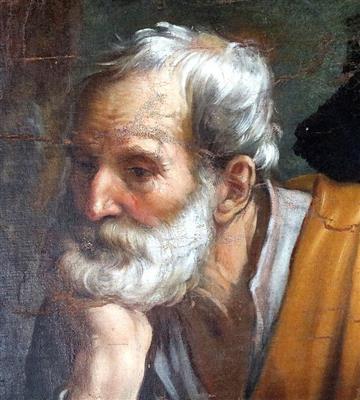
Biography
Fiasella trained in Rome, where he absorbed the Caravaggesque naturalism of Orazio Gentileschi before gravitating toward the softer, more idealising approach of Guido Reni and the Bolognese classicists. This synthesis (direct observation tempered by elegant composure) would define his altarpieces for the rest of his career.
Returning to Genoa around 1616[1], he took his place alongside Bernardo Strozzi and Giovanni Andrea de Ferrari as one of the dominant painters serving the city's merchant aristocracy and its religious orders. The Capuchins and Jesuits were among his most regular clients, commissioning devotional works for churches across Liguria and beyond. His output was considerable: nearly six decades of production that kept his workshop fully employed and spread his style throughout the region.
Despite this long career and wide influence, Fiasella has remained less internationally visible than his Genoese contemporaries. He died in 1669[1] at the age of eighty, his reputation solid within Liguria even if it never quite reached the wider European audience that Strozzi attracted.
Timeline
- 1589Born in Sarzana, Liguria. He was known locally as 'Il Sarzana'.
- 1616Returned to Genoa and became one of the dominant painters, alongside Bernardo Strozzi and Giovanni Andrea de Ferrari.
- 1669Died at 80. His reputation remained solid within Liguria.
Notable Works
Tap to view larger.
Next stop
Baroque →
Explore the artists and ideas of Baroque.
Related Artists


Frequently Asked Questions
What is Domenico Fiasella known for?
Domenico Fiasella is known for being the most productive supplier of altarpieces along the Ligurian coast. He ran one of the busiest studio operations in seventeenth-century Italy.What is Domenico Fiasella's most famous work?
Domenico Fiasella (1589[1]-1669[1]) was a Genovese painter of the early Baroque[1] period. Although no single work can be described as his "most famous", he is best known for large-scale religious paintings and fresco cycles within Liguria. One important painting is *The Martyrdom of Saint Andrew*, executed in 1608[1]-09. This early work demonstrates the influence of Mannerist artists such as Luca Cambiaso, as well as the impact of late Renaissance Venetian painting. The composition shows an interest in dramatic narrative. Later, around 1616, Fiasella painted *The Virgin Appearing to St. Luke*. This altarpiece, now in the Museo di Villa Croce, Genoa, shows a developing naturalism, moving away from earlier artificiality. Fiasella's frescoes in the Cathedral of Sarzana, near La Spezia, are also significant. These decorations, depicting scenes from the life of the Virgin, were completed between 1621 and 1623. They represent a high point in his career, displaying a mature Baroque style, with dynamic compositions and a careful attention to detail. He also completed paintings for the Palazzo Ducale in Genoa.What should I know about Domenico Fiasella's prints?
Domenico Fiasella, a Genoese painter active in the early 17th century, had his work reproduced as prints to raise money for his family. Prints were made from copper plates of the Galleria, in editions limited to 200 copies. The money raised from the print sales was intended to benefit the poorest members of Fiasella's family in Genoa. The prints were sold to invest in Monti Camerali; the capital was to remain untouched, while the proceeds would be used for his family. The plates were collected at different times. Several artists lived in the Palazzo Giustiniani from about 1633[1], suggesting prints were produced systematically. Giovanni Valesio contributed eleven images to the first volume, but none to the second. Mellan left Rome early in 1636 and made no new plates for Volume II. The Galleria may have been conceived as an illustrated catalogue. Most plates bear the Giustiniani stemma, similar to how works in the collection were mounted on plinths with the same emblem.What style or movement did Domenico Fiasella belong to?
Domenico Fiasella, active mainly in Genoa during the first half of the 17th century, is usually associated with the early Baroque[1] movement. However, his artistic style is not easily categorised. Some art historians view the Baroque as an evolution of Renaissance art, while others see it as a distinct departure. The Baroque style, which emerged in Italy around 1600[1], moved away from the strict principles of classical antiquity. It is difficult to draw a clear line between the Renaissance and Baroque periods, as the two styles often merge. Fiasella's work reflects the influence of several artistic currents. While his paintings exhibit some characteristics of the Baroque, such as dynamic compositions and dramatic use of light, they also retain elements of classicism. Some contemporaries considered his figures "troppo marmoreo", suggesting a restrained, classical approach.What techniques or materials did Domenico Fiasella use?
Without specific documentation of Fiasella's methods, we can only discuss general practices of the period. Italian Renaissance artists employed diverse techniques. Fresco, painting on wet plaster, was common for murals. Artists would apply plaster in sections, completing one section (a giornata) per day. Sometimes, they painted on dry plaster (a secco) for details or to use pigments that did not bind well with wet plaster. Sculptors carved in stone (especially marble) or wood. Stone carving involved outlining a design on a block, removing excess material with axes and chisels, and refining the surface. Wood carving was similar, but wood was less durable. Both stone and wood sculptures were often painted. Modelling used pliable materials like wax and clay. Clay could be fired to create terracotta. Lost-wax casting was used for bronze sculpture, involving a wax model encased in a clay mould. Molten bronze was poured into the mould, melting away the wax. Printmaking included woodcut, engraving, and etching. Woodcut involved carving a design on a woodblock. Engraving used a burin to cut into a metal plate. Etching involved scratching a design into a wax-covered metal plate and then bathing the plate in acid.What was Domenico Fiasella known for?
Domenico Fiasella (1589[1]-1669[1]) was a Genovese painter of the early Baroque[1] period. He is best known for historical and religious subjects, and for a classicising style that blended the influence of the Carracci family with a specifically Genovese attention to surface detail. Fiasella trained first with his father, a goldsmith, then with Giovanni Battista Paggi. He travelled to Rome in 1607[1] or 1608, where he remained for nearly a decade. While there, he studied antique art and the works of Raphael, Giulio Romano, and Annibale Carracci. He also absorbed influences from contemporary painters such as Orazio Gentileschi and Giovanni Lanfranco. Returning to Genoa in 1617, Fiasella established a successful studio. He secured important commissions from local churches and private patrons. His paintings from this period, such as "The Virgin Annunciate" (c. 1618), demonstrate a refined technique and a talent for dramatic narrative. Fiasella’s later career included collaborations with other artists, and he is known to have produced designs for engravings. He also acted as a teacher; Giovanni Andrea de Ferrari and Valerio Castello were among his pupils.When did Domenico Fiasella live and work?
Domenico Fiasella (1589[1]-1669[1]) was a painter of the early Baroque[1] period in Italy. He was born in Sarzana, Liguria. Fiasella, nicknamed "Il Sarzana", initially trained with his father, a goldsmith. By 1607[1], he had moved to Rome, where he became a pupil of Aurelio Lomi. He also studied with Orazio Gentileschi and travelled in the company of Giovanni Lanfranco. Rome exposed him to diverse artistic influences, including the work of Caravaggio and his followers, as well as the Carracci school of Bologna. Around 1617 or 1618, Fiasella returned to Genoa. There, he established a studio and workshop that became one of the most important in the region. He completed numerous commissions for local churches and private patrons. His work can be seen in the Oratorio di San Giacomo della Marina and the church of Santissima Annunziata di Portoria. He is known for history paintings and altarpieces. One of his pupils was the Baroque painter Valerio Castello.Where can I see Domenico Fiasella's work?
Domenico Fiasella's paintings can be viewed in several locations. Within Italy, examples are held at the Galleria degli Uffizi (Florence), the Pinacoteca di Brera (Milan), and the Palazzo Pitti (Florence). Other Italian museums that hold his works include the Museo Nazionale del Bargello (Florence), the Galleria e Museo Estense (Modena), and the Pinacoteca Nazionale di Siena. Outside Italy, museums with collections of Fiasella's art include the Los Angeles County Museum of Art (LACMA), the Metropolitan Museum of Art (New York), the Minneapolis Institute of Arts, and the Royal Ontario Museum (Toronto). The Victoria & Albert Museum (London) also possesses pieces by Fiasella. These institutions offer opportunities to study his artistic style and themes.Where was Domenico Fiasella from?
Domenico Fiasella was from Liguria, a coastal region in north-western Italy. He was born in 1589[1] in Sarzana, near La Spezia. Sarzana is a town with a rich history, located close to the border with Tuscany. Fiasella's artistic training began in his home region. He then moved to Genoa, the major urban centre of Liguria, where he studied with Aurelio Lomi and Giovanni Battista Paggi. Genoa provided him with exposure to a wider range of artistic influences. Later in his career, Fiasella spent time in Rome. This experience further broadened his artistic style. However, he eventually returned to Genoa. He established a successful workshop there. He continued to work in Genoa until his death in 1669[1]. His origins in Sarzana and his subsequent activity in Genoa shaped his artistic development and career.Who did Domenico Fiasella influence?
Domenico Fiasella's artistic influence is most notable in Venetian portraiture. He established a particular tone that was followed for several years. Fiasella was known for emphasising the physical properties of his subjects' faces and clothing. An example is his portrait of the ivory carver Ascanio dai Cristi (Munich, Alte Pinakothek). His work also had an impact on the succeeding generation of Venetian painters. Ridolfi, in his biography of Fiasella, noted the artist's literary education and enthusiasm for depicting poetic themes, including subjects from Ariosto. Major examples of subjects drawn from secular literature include the Venus and Adonis with the Three Graces (Chicago, Art Institute) and the Death of Adonis (Tucson, University of Arizona).Who influenced Domenico Fiasella?
Domenico Fiasella's artistic development occurred in Genoa during a period of significant artistic exchange. While specific influences are not detailed in the provided text, it is known that the Futurists, including Giacomo Balla and Umberto Boccioni, drew inspiration from a wide range of sources. These included pre-Renaissance artists such as Cimabue, Renaissance masters such as Botticelli, Leonardo da Vinci, Raphael and Michelangelo, and more modern artists such as Paul Cezanne, Edgar Degas, Auguste Renoir, and Henri Matisse. The Futurists' influences also extended beyond painting to encompass figures in music, literature, and science, such as Johann Sebastian Bach, Ludwig van Beethoven, Dante, Edgar Allen Poe, and Albert Einstein. It is plausible that Fiasella was exposed to similar influences, given the cross-disciplinary nature of artistic inspiration during his time.Who was Domenico Fiasella?
Domenico Fiasella (1589[1]-1669[1]) was an Italian painter of the early Baroque[1] period, active mainly in Genoa. He is also known by the nickname Il Sarzana, after his birthplace of Sarzana, Liguria. Fiasella initially trained with his father, a goldsmith, before studying painting in Genoa with Aurelio Lomi, and later in Florence by 1607[1] in the studio of Domenico Passignano. Around 1608, he moved to Rome where he remained for nearly a decade. While there, he studied with Giuseppe Cesari (Cavalier d'Arpino). He also befriended Pietro da Cortona and gained exposure to the work of artists such as Caravaggio and Annibale Carracci. Returning to Genoa in 1617, Fiasella established a successful workshop. He secured commissions from local churches and patrician families. His style blended Florentine and Roman influences with a Genoese sensibility, characterised by dramatic compositions and a use of colour. His pupils included Valerio Castello, Giovanni Andrea de Ferrari, and Gregorio de Ferrari. Major works by Fiasella include *The Virgin Presenting Christ to Saints* (1616) and *Esther before Ahasuerus*.
Sources
Editorial draws on the following primary and tertiary references for Domenico Fiasella.
- [1] wikipedia Wikipedia: Domenico Fiasella Used for: biography, birth dates, death dates, identifiers, movement attribution, nationality.
- [2] book Robert Neuman, Professor of Art History, Florida State University, Baroque and Rococo Art and Architecture (Subscription) Used for: biography.
- [3] book Gianlorenzo Bernini : new aspects of his art and thought : a commemorative volume Used for: stylistic analysis.
- [4] book Lilian H. Zirpolo, Historical Dictionary of Baroque Art and Architecture Used for: biography.
- [5] book Masterpieces of western art : a history of art in 900 individual studies from the Gothic to the present day Used for: biography.
- [6] book 1892-1968, Panofsky, Erwin,, Tomb sculpture: four lectures on its changing aspects from ancient Egypt to Bernini Used for: biography, stylistic analysis.
Editorial overseen by Solis Prints. Sources verified 2026-09-19. Click a source for details, or hover over [N] in the page above to preview.
Editorial standardsMethodologyCorrectionsAI disclosureAbout the editorial team