



Domenico Induno
In March 1848[3], Domenico Induno left his easel to take part in the Cinque Giornate: the five days of street fighting that drove the Austrian garrison out of Milan. He was thirty-two, already an established painter at the Brera Academy, and he went to the barricades alongside his younger brother Girolamo. When Austrian forces returned and retook the city, the brothers fled to Ticino. Domenico and his wife Emilia would not return to Italy for roughly two years.
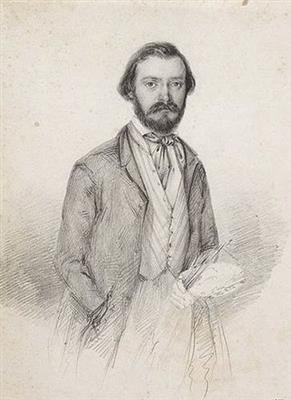
Biography
That episode of political commitment shaped the rest of his career. Induno had trained at Brera under the Neo-classical painter Francesco Hayez, a Risorgimento sympathiser, and had won a commission from the Austrian Emperor Ferdinand I as early as 1840[3]. After exile he turned toward subjects that could carry patriotic weight: the human cost of conflict, the domestic textures of wartime, the everyday life of people who had also taken sides.
His 1859[3] Villafranca Armistice series brought him direct royal patronage: Victor Emmanuel II commissioned one of the works, and Induno was admitted to the Order of Saints Maurice and Lazarus. He showed at the 1855 Exposition Universelle in Paris to considerable success, and was appointed Director of the Brera Academy in 1863.
Alongside his overtly political works, Induno was one of the most skilled genre painters of the Lombard school, producing meticulously observed scenes of bourgeois and working-class Milanese life. His technical precision, absorbed from years under Hayez, gave even his most intimate domestic scenes a quiet authority. He died in Milan in 1878[3] at sixty-three.
Timeline
- 1815Born in Italy.
- 1840Received a commission from Austrian Emperor Ferdinand I.
- 1848Participated in the Cinque Giornate in Milan at 32.
- 1848Fled to Ticino with his brother Girolamo after Austrian forces retook Milan.
- 1855Exhibited at the Exposition Universelle in Paris to considerable success.
- 1859Created the Villafranca Armistice series, which led to royal patronage.
- 1859Victor Emmanuel II commissioned one of his works, and Induno was admitted to the Order of Saints Maurice and Lazarus.
- 1863Appointed Director of the Brera Academy.
- 1878Died in Milan at 63.
Notable Works
Tap to view larger.
Where to See Domenico Induno
1 museum worldwide.
-
 11 works
Gallerie d'Italia – Milano
Milan, Italy
Tue–Sun 09:30–19:00, closed Mondays · 12 € adults
Next stop
Browse the movements →
Every movement in the collection, from the Renaissance to Pop art.
Frequently Asked Questions
What is Domenico Induno known for?
Domenico Induno is known for his paintings that carried patriotic weight, particularly those depicting the human cost of conflict and everyday life during wartime. He also produced meticulously observed genre scenes of bourgeois and working-class Milanese life.What is Domenico Induno's most famous work?
Domenico Induno (1815[3]-1878[3]) was an Italian painter and patriot. He is best known for genre scenes and historical subjects, often depicting episodes from the Risorgimento, the 19th-century movement for Italian unification. It is difficult to identify one single "most famous" work, as popularity and recognition can shift over time and vary by audience. However, several of his paintings are particularly well regarded. *The Mower's Meal* (Il pasto del falciatore) is a notable example of his genre scenes. It presents an intimate view of peasant life. Another popular work is *The Evicted* (Gli sfrattati), which portrays the plight of a family being forced from their home. This painting is admired for its social commentary and emotional impact. Induno's paintings often combined realistic details with sentimental narratives, a style that appealed to a broad public during his lifetime. His art provides insights into the social and political climate of 19th-century Italy.What should I know about Domenico Induno's prints?
When considering Domenico Induno's prints, it's useful to understand some basic terminology. A 'vintage print' is one made around the same time as the negative. A 'period print' is made within 10 to 15 years of the shot. Anything printed later is simply an 'old print', as opposed to a 'modern print' created recently from the original negative. An 'original print' is made by the artist or under their supervision. A 'facsimile' is a reproduction that attempts to match the original print's materials and processing as closely as possible. The market considers a print 'original' if the artist conceived it as a print and executed it solely as a print, usually in a numbered and signed edition. Each print is individually inked and pulled, making it a 'multi-original'. A reproduction, on the other hand, is a copy of a work initially created in another medium, such as painting or watercolour, and reproduced via photomechanical means. The intent behind the print determines its status; an original print aims to be a unique artistic statement, while a reproduction seeks to replicate an existing image.What style or movement did Domenico Induno belong to?
Domenico Induno (1815[3]-1878[3]) was an Italian painter associated with the Romantic movement, but his work also anticipates aspects of Realism. He is best known for genre scenes depicting everyday life, often with sentimental or anecdotal elements. Induno's early training was at the Brera Academy in Milan, where he was influenced by the academic tradition. However, he moved away from grand historical subjects, preferring to paint scenes of ordinary people, particularly those from the lower classes. His paintings often possess a narrative quality, inviting viewers to imagine the stories behind the depicted moments. While Induno's focus on contemporary life aligns him with Realist painters, his work retains a sense of idealisation and emotional engagement characteristic of Romanticism. He did not engage in the social critique that became a hallmark of later Realist art. His style is marked by careful attention to detail, a delicate touch, and a sensitivity to the nuances of human emotion.What techniques or materials did Domenico Induno use?
Domenico Induno (1815[3]-1878[3]) was an Italian painter and patriot. He is known for genre scenes and historical subjects, often depicting everyday life. Induno's early training was at the Accademia di Brera in Milan. He initially worked in the Romantic style, but later developed a more realistic approach. His brother, Gerolamo Induno, was also a painter, and the two shared some stylistic similarities. He favoured oil paint on canvas, using careful detail to create realistic depictions. Some sources mention his use of watercolour, although oil paintings are more common in museum collections. He often depicted scenes of Italian life, with attention to costumes and settings. His paintings often feature small figures and anecdotal details. Induno's technique involved careful observation and accurate representation. His paintings are characterised by their naturalism and attention to detail. He aimed to capture the realities of Italian society in his art.What was Domenico Induno known for?
Domenico Zampieri, called Domenichino, was an Italian Baroque painter of the Bolognese School. Alongside Guido Reni, he is considered one of the most important successors of the Carracci family of painters. Domenichino trained with Lodovico Carracci in Bologna. From 1602, he assisted Annibale Carracci in Rome. His early works, such as "The Maiden and the Unicorn" (circa 1602), show the influence of both Carraccis. They also demonstrate an individual, classically clear style. After Annibale’s death in 1609, Domenichino became a foremost Bolognese painter. His landscapes from 1610 to 1615 explored new principles of composition. Claude Lorrain later adopted these. He also demonstrated alternatives to Cortona’s formulations in interior decoration, as seen in Sant’ Andrea della Valle, Rome. In 1621, he was summoned back to Rome to work as a papal architect. Domenichino completed the choir of Sant’Andrea della Valle in 1627. The scenes depict the story of St Andrew, to whom the church is dedicated. In 1631, Domenichino settled in Naples. He began work on the Cappella del Tesoro in the Church of San Gennaro. He died there in 1641.When did Domenico Induno live and work?
Domenico Induno (1815[3]-1878[3]) was an Italian painter and patriot. He was born in Milan. He is known for genre scenes and historical subjects, often with a focus on military life and Risorgimento themes. Induno's artistic career began at the Accademia di Brera in Milan. There, he studied under Luigi Sabatelli. He became involved in the Italian independence movement. He volunteered in 1848[3] during the Five Days of Milan, a revolt against Austrian rule. His experiences during this period influenced his artistic output, leading to paintings that reflected patriotic sentiments. After the conflicts, Induno continued to produce art, gaining recognition for his detailed depictions of everyday life and historical events. He participated in numerous exhibitions throughout Italy. He also travelled to other parts of Europe. His brother, Gerolamo Induno, was also a well-known painter, and the two brothers occasionally collaborated on projects. Domenico Induno died in Florence in 1878.Where can I see Domenico Induno's work?
Domenico Induno's works can be viewed in several museum collections. In Italy, these include the Biblioteca Ambrosiana in Milan, Museo Archeologico, and Museo Correr e Quadreria Correr in Venice. Other Italian museums that hold his pieces are the Museo della Cattedrale in Monopoli, Museo Regionale in Messina, and Pinacoteca Provinciale in Bari. His art is also held at the Tesoro della Cattedrale di San Andrea a Veroli. Outside of Italy, Induno's work is on display at the Israel Museum in Jerusalem and the Museum of the Studium Biblicum Franciscanum, also in Jerusalem. Additional locations include the Archivio della Badia, Monastery of Monte Cassino, Biblioteca Nazionale Marciana in Venice, and Congregazione Armena Mechitarista, also in Venice. These institutions provide opportunities to appreciate Induno's artistic contributions.Where was Domenico Induno from?
Domenico Induno was an Italian painter and patriot, born in Milan in 1815[3]. He came from a family with artistic connections. His brother, Gerolamo Induno, was also a well-regarded painter, particularly known for his scenes of military life and the Risorgimento; Domenico initially studied with him. Milan, during Induno's early life, was under Austrian rule, a factor that influenced his artistic and political development. He became involved in the Italian independence movement and even participated in the Five Days of Milan, an uprising against Austrian rule in 1848[3]. This event marked a turning point in his life and career, with themes of patriotism and social justice appearing in his later works. Although born in Milan, Induno's artistic career took him to other parts of Italy. He spent time in Florence, another important centre for Italian art and culture, further developing his skills and establishing his reputation. He died in his birth city in 1878[3].Who did Domenico Induno influence?
Domenico Induno's artistic influence is not well documented. Domenico Tintoretto, son of Jacopo Tintoretto, perpetuated his father's style into the seventeenth century. Pallucchini has studied Domenico Tintoretto's influence on later Venetian painters. Domenico Tintoretto's style, particularly his use of lighting, showed greater realism than his father's. This realism, with a sharp focus on detail, has been compared to Annibale Carracci. Domenico Tintoretto's work established a tone for portraiture in Venice for many years, emphasising physical properties of sitters and their costumes. Giovanni Bellini's late style inspired a generation of Venetian painters, including students who moved away from his idiom but worked within the boundaries Bellini's art marked. Bellini's concepts about the figure, pictorial composition, portraiture, and nature influenced Venetian artists throughout the sixteenth century.Who influenced Domenico Induno?
Domenico Induno's artistic development involved several influences. He was part of the Accademia Ambrosiana in Milan, where he encountered Giulio Cesare Procaccini. Procaccini's style is evident in Induno's earlier work, for example, *Miracle of St Martha* (1636). Later, Induno showed an interest in Anthony van Dyck and Guido Reni. Because of the Reni-esque elements in his art, he became known in Milan as the Guido Lombardo (Lombard Guido). Some art historians have suggested Bartolomé Esteban Murillo also influenced Induno, though there is no firm evidence they came into contact. Van Dyck's impact is visible in two portraits by Nuvolone from the late 1640s: *Portrait of a Gentleman in Armour* and *Portrait of a Lady*. These works feature full-length figures, elegantly dressed, set off by a raised curtain, similar to portraits Van Dyck made during his time in Genoa. The classicism of the Bolognese School, especially Reni, appears in Nuvolone’s *Joseph and the Wife of Potiphar* (circa 1640). The figures are refined, with porcelain-like complexions, and their gestures are mannered.Who was Domenico Induno?
Domenico Induno was an Italian artist who lived during a period of significant change in Italy. Prior to 1861[3], Italy was not a united country; it was divided into several minor kingdoms, many under the control of the Habsburg Empire. This foreign control, particularly by Austrian leader Klemens von Metternich, incited anti-foreign sentiment and fostered the rise of the Risorgimento, the Italian unification movement. Revolutionaries like Giuseppe Mazzini actively sought unity and independence. Following a series of revolts, the Kingdom of Sardinia, aided by the French, defeated the Austrians in 1859 and, by 1861, unified Italy. However, Venetia and Rome were not included until 1866 and 1870, respectively. The newly formed Kingdom faced challenges, including heavy debts, limited resources, high illiteracy, and social unrest due to extreme poverty and regionalism. Despite these difficulties, Italy began to industrialise in the 1890s, particularly in northern cities such as Turin and Milan.
Sources
Editorial draws on the following primary and tertiary references for Domenico Induno.
- [1] museum Gallerie d'Italia – Milano Used for: museum holdings.
- [2] museum Galleria d'arte moderna di Milano Used for: museum holdings.
- [3] wikipedia Wikipedia: Domenico Induno Used for: biography, birth dates, death dates, identifiers, movement attribution, nationality.
- [4] book Lilian H. Zirpolo, Historical Dictionary of Baroque Art and Architecture Used for: biography, stylistic analysis.
- [5] book Braun, Emily, 1957-; Asor Rosa, Alberto; Royal Academy of Arts (Great Britain), Italian art in the 20th century : painting and sculpture, 1900-1988 Used for: biography, stylistic analysis.
- [6] book Museum of Fine Arts, Houston, Italian paintings XIV-XVI centuries in the Museum of Fine Arts, Houston Used for: biography.
- [7] book Masterpieces of western art : a history of art in 900 individual studies from the Gothic to the present day Used for: biography, stylistic analysis.
- [8] book Feltman, Jennifer M.; Thompson, Sarah; , The Long Lives of Medieval Art and Architecture Used for: biography.
Editorial overseen by Solis Prints. Sources verified 2026-08-03. Click a source for details, or hover over [N] in the page above to preview.
Editorial standardsMethodologyCorrectionsAI disclosureAbout the editorial team