



Dominique Appia
The Geneva-based Swiss[1] painter Dominique Appia (1926[1]-2017[1]) spent a career producing dreamlike compositions that were regularly mistaken for the work of Salvador Dalí, a comparison he earned rather than borrowed. Where Dalí staged desire and anxiety, Appia tended toward quieter spatial impossibilities: a cathedral that becomes a railway station, the Mediterranean sea surging up from the Paris Métro, children dissolving into rooms invaded by other worlds.
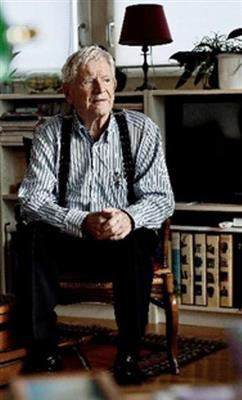
Biography
His best-known image, Entre les trous de la mémoire (Between the Holes in the Memory), captures the method in its title. These are paintings that take the structure of memory rather than the logic of dreams as their starting point, using familiar urban and landscape elements reconfigured into scenarios that feel almost plausible. The result sits closer to the uncanny than to surrealist theatre.
Appia worked quietly and in relative obscurity, which kept him little-known outside specialist circles despite the immediate visual accessibility of his pictures. His death in January 2017[1] attracted minimal international attention, and his work remains largely undiscovered except among those who seek out painters who resisted the art world's promotional machinery. In that obscurity there is something appropriate: his paintings are about things that slip through the gaps in attention, the holes in memory that his best-known title names directly.
Timeline
- 1926Born in 1926.
- 1926Produced dreamlike compositions that were regularly mistaken for the work of Salvador Dalí.
- 1926His paintings take the structure of memory rather than the logic of dreams as their starting point.
- 1926Created "Entre les trous de la mémoire (Between the Holes in the Memory)".
- 2017Died in January 2017, aged 90. He worked quietly and in relative obscurity during his career.
- 2017His death attracted minimal international attention.
Notable Works
Tap to view larger.
Next stop
Browse the movements →
Every movement in the collection, from the Renaissance to Pop art.
Related Artists




Frequently Asked Questions
What is Dominique Appia known for?
Dominique Appia is known for his dreamlike compositions, which use familiar urban and landscape elements reconfigured into scenarios that feel almost plausible. His best-known image is Entre les trous de la mémoire (Between the Holes in the Memory).What should I know about Dominique Appia's prints?
When considering Dominique Appia's prints, it is helpful to understand some printmaking basics. Printmaking has a long history; its origins can be traced to ancient Egypt and China, where stamps were used. As paper became readily available in Europe at the close of the fourteenth century, printmaking began to flourish. Several types of prints exist. An artist creating a limited edition will typically number all prints, such as 35/100. The larger number indicates the total prints in the edition, while the smaller number shows the print's sequential number. Artists may reserve up to ten percent as artist's proofs, marked with AP after the number, for example, 5/100 AP. These are often signed in pencil. The letters T/P can signify early proofs, made while work continues on the block. V2, V3, and so on, signifies a variant edition, such as when different colours are used. Prints are signed to confirm authenticity and the artist's approval. Edition sizes are limited to control quality, influencing the price based on availability and preventing printing after the plate degrades.What style or movement did Dominique Appia belong to?
Dominique Appia's artistic approach is closely linked to the theories of stage design developed by his father, Adolphe Appia, in the early 20th century. Appia, along with Edward Gordon Craig, sought to reform the theatre by moving away from painted sets toward three-dimensional, architectonic constructions. These constructions aimed to create a dynamic space for actors, allowing for freedom of movement and expression. Appia's theories influenced the development of modern stage design, emphasising the importance of light, space, and the actor's physical presence. Appia believed that stage design should serve the inner rhythm of the drama, using simplified forms and modulated light to create atmosphere and enhance the emotional impact of the performance. In productions such as Gluck's opera *Orpheus and Eurydice*, Appia experimented with light as a central element, using it to create striking visual effects and evoke a sense of mystery. His work encouraged the use of movement to express inner feeling, and he analysed gestures and their psychological impact.What techniques or materials did Dominique Appia use?
Dominique Appia's practice involved a range of materials and techniques related to earthen construction. These included adobe, bauge, and pisé. Adobe bricks were created using a mixture of earth, plant stabilisers, and water, shaped in rectangular moulds. The bauge technique involved direct, manual shaping of earth, often incorporating domestic waste, for specific architectural needs such as door repairs. Pisé construction used mass walls made from a mixture of sands, silts, and clays. The earth used in these methods often came from local sources. For example, the Saada region provided clean sand for masonry work. The earth mixtures were prepared by hand and, later, with mechanical mixing. Mechanical mixing improved the consistency of the materials, particularly regarding water content. Stabilisation methods, such as adding cement, were also employed to enhance the material's resistance to weathering. These techniques reflect an understanding of traditional practices, adapted for modern construction and conservation.When did Dominique Appia live and work?
Dominique Appia was born on 28 July 1926[1] in Brussels. His father was Swiss[1], and his mother was from Belgium. He is known as a painter and printmaker. Appia studied at the École des Beaux-Arts in Geneva from 1942[1] to 1946. He then moved to Paris, where he attended the École Nationale Supérieure des Beaux-Arts until 1949. During this period, Appia encountered geometric abstract painting, seen at exhibitions such as the Salon des Réalités Nouvelles. He was interested in artists such as Max Bill, Auguste Herbin, and Richard Lohse. Appia also visited the Salon de Mai shows, where he saw work by School of Paris artists, including Henri Matisse. Appia’s work was also influenced by Henri de Toulouse-Lautrec's posters, Japanese woodcuts, Wassily Kandinsky, Jean Arp's woodcuts, and Matisse's ink drawings.Who influenced Dominique Appia?
Dominique Appia's influences are diverse, spanning music, dance, and philosophy. Philosophically, Appia may have been affected by Rudolf Laban and his theories of movement. Although there is no direct evidence Laban influenced Appia, their shared milieu and similarities in philosophy suggest a common source. Musically, Appia's work connects with composers such as Alban Berg and Arnold Schönberg. These composers broke from convention, much like Appia. Appia's dance piece "Scenario", which premiered in 1997[1], featured music by Takehisa Kosugi. This collaboration demonstrates Appia's interest in contemporary musical forms. Appia's influences include figures like Pierre Boulez, who explored the relationship between harmony and melody. These figures, along with choreographers Isadora Duncan, Martha Graham and Mary Wigman, contributed to Appia's artistic development.Why are Dominique Appia's works important today?
Dominique Appia's significance lies in his contribution to a specific moment in French architecture and design. In the 1980s, a shift occurred, moving away from strict functionalism and towards a more expressive individualism. Appia was part of this movement, which sought to re-establish the supremacy of imagination through objects. This period saw a break with the Modern movement's functionalist principles. Appia, along with other designers, drew inspiration from various cultural sources, including Futurism, Constructivism, and Pop art. The intention was to create a new language of signs and colours, prioritising an object's capacity for representation and emotional impact over its pure function. While the Informel movement, with which Appia was associated, faced criticism for being unfocused, it offered an alternative to the established School of Paris. This approach encouraged a rediscovery of coherence and rationality, contrasting with what some considered seductive, facile effects in design. Appia's work, therefore, reflects a broader trend towards "calming the waters" and re-evaluating the role of objects in conveying meaning beyond mere utility.What was Dominique Appia's art style?
Dominique Appia's art style can be described as dreamlike compositions using familiar urban and landscape elements reconfigured into scenarios that feel almost plausible. His work sits closer to the uncanny than to surrealist theatre.How did Dominique Appia die?
Dominique Appia died in 2017[1] at the age of 91.
Sources
Editorial draws on the following primary and tertiary references for Dominique Appia.
- [1] wikipedia Wikipedia: Dominique Appia Used for: biography, birth dates, death dates, identifiers, movement attribution, nationality.
- [2] book guggenheim-anglesofvisionfr00denn Used for: biography.
- [3] book guggenheim-invested00blis Used for: biography.
- [4] book guggenheim-peggygu00alle Used for: biography.
- [5] book guggenheim-twopri00weis Used for: biography.
- [6] book Masterpieces of western art : a history of art in 900 individual studies from the Gothic to the present day Used for: biography.
Editorial overseen by Solis Prints. Sources verified 2026-09-30. Click a source for details, or hover over [N] in the page above to preview.
Editorial standardsMethodologyCorrectionsAI disclosureAbout the editorial team