

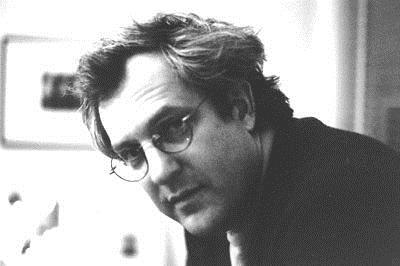
Donald Sultan
The studio Donald Sultan built in lower Manhattan during the late 1970s came equipped with workers: he hired a team of tradespeople to lay industrial vinyl floor tiles, pour tar, and apply spackle alongside him on each painting. The materials were not metaphors. They were the substance of the work itself, and Sultan was as much foreman as artist.
Biography
Born in Asheville, North Carolina in 1951[2], Sultan studied at the University of North Carolina before completing an MFA at the School of the Art Institute of Chicago in 1975. He arrived in New York in time for the downtown art explosion and became associated with the New Image Painting movement, a generation of artists who returned the human figure and recognisable objects to painting after decades of abstract dominance.
His paintings are monumental in scale and spare in composition: a single lemon against black, a flower rendered in tar on steel-reinforced panels, eggs arranged across a field of dark industrial material. The Lemons and Flowers series made Sultan one of the most collectible painters of the 1980s, with works entering MoMA, the Guggenheim, the Metropolitan Museum, and Tate Modern. By the late 1980s his canvases commanded over $100,000 each.
The recurring motifs, botanical and domestic, sit in tension with the blunt industrial process behind them. Sultan's prints and drawings extend the same vocabulary into works on paper, where the graphic weight of black and the precision of the outline become even more apparent. In 2000 he designed the entire interior of the Art'otel Budapest, installing 579 original works throughout the building. His output has continued across six decades without stylistic retreat.
Timeline
- 1951Born in Asheville, North Carolina.
- 1970Studied at the University of North Carolina.
- 1970Moved to New York and became associated with the New Image Painting movement.
- 1975Completed an MFA at the School of the Art Institute of Chicago.
- 1980Paintings from the Lemons and Flowers series made Sultan a collectible painter.
- 1980Built a studio in lower Manhattan, employing tradespeople to assist with his art.
- 2000Designed the interior of the Art'otel Budapest, installing 579 original works.
Notable Works
Tap to view larger.
Next stop
Pop Art →
Explore the artists and ideas of Pop Art.
Related Artists
_%E2%80%93_LOC.jpg)




Frequently Asked Questions
What is Donald Sultan known for?
Donald Sultan is known for his large-scale paintings that combine botanical and domestic motifs with industrial materials like vinyl floor tiles, tar, and steel-reinforced panels. His Lemons and Flowers series, in particular, gained him significant attention and made him a collectible painter in the 1980s. He also designed the interior of the Art'otel Budapest, installing hundreds of original works.What was Donald Sultan's art style?
Donald Sultan's art style combines recognisable objects, such as lemons and flowers, with industrial materials and processes. His paintings are often monumental in scale and spare in composition, featuring a single object against a dark background. The graphic weight of black and the precision of the outline are apparent in his prints and drawings.When was Donald Sultan born?
Donald Sultan was born in 1951[2].Who was Donald Sultan?
Donald Sultan is an American[2] artist who emerged in the downtown New York art scene and became associated with the New Image Painting movement. He is known for his use of industrial materials and processes in creating his art, often employing tradespeople to assist in the construction of his pieces. His work gained recognition in the 1980s, leading to inclusion in major museum collections.
Sources
Editorial draws on the following primary and tertiary references for Donald Sultan.
- [1] museum Harvard Art Museums Used for: museum holdings.
- [2] wikipedia Wikipedia: Donald Sultan Used for: biography, birth dates, death dates, identifiers, movement attribution, nationality.
- [3] book guggenheim-australianvision00wald Used for: biography.
- [4] book guggenheim-refigur00kren Used for: biography.
- [5] book guggenheim-transfsi00wald Used for: biography.
Editorial overseen by Solis Prints. Sources verified 2026-10-07. Click a source for details, or hover over [N] in the page above to preview.
Editorial standardsMethodologyCorrectionsAI disclosureAbout the editorial team