



Donato Bramante
- High Renaissance
The Tempietto at San Pietro in Montorio in Rome is barely nine metres across, but in 1502[1] nothing quite like it had been built for over a thousand years. Commissioned by Ferdinand and Isabella of Spain to mark the traditional site of Saint Peter's martyrdom, Bramante's small circular structure in Tuscan Doric achieved what earlier Renaissance architects had theorised but never executed: a building that could stand beside ancient Rome's finest monuments without apology.
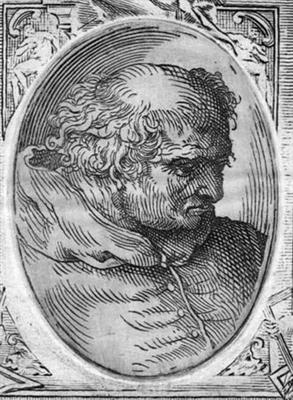
Biography
Born in 1444[1] near Urbino, Donato di Pascuccio d'Antonio came to architecture through painting. He trained in the milieu of Piero della Francesca and absorbed the spatial reasoning behind Renaissance perspective before applying it three-dimensionally. His first major posting was at the Sforza court in Milan, where from around 1476 he worked alongside Leonardo da Vinci. There he designed Santa Maria presso San Satiro (1482-86), painting an illusionistic trompe-l'oeil choir into a space too constrained for the real thing, and the tribune of Santa Maria delle Grazie.
When French forces took Milan in 1499, Bramante moved to Rome and found in Pope Julius II a patron whose ambitions matched his own. The two embarked on a programme of building that would define the High Renaissance[1]: the terraced Belvedere Court at the Vatican, begun around 1503[1], and most consequentially, the commission for an entirely new Saint Peter's Basilica in 1506. Bramante's original Greek-cross plan, recorded on Caradosso's foundation medal, was later modified but never abandoned. Michelangelo's final dome rests on foundations Bramante laid.
He died in Rome in April 1514[1], having transformed a city and a discipline.
Timeline
- 1444Born near Urbino as Donato di Pascuccio d'Antonio.
- 1476Began working at the Sforza court in Milan alongside Leonardo da Vinci.
- 1482Designed Santa Maria presso San Satiro in Milan (completed in 1486), which included a trompe-l'oeil choir.
- 1499Moved to Rome after French forces took Milan.
- 1502Commissioned to design the Tempietto at San Pietro in Montorio in Rome.
- 1503Began work on the terraced Belvedere Court at the Vatican.
- 1506Commissioned to design a new Saint Peter's Basilica by Pope Julius II; his original plan was a Greek cross.
- 1514Died in Rome in April at the age of 70.
Notable Works
Tap to view larger.
Next stop
Browse the movements →
Every movement in the collection, from the Renaissance to Pop art.
Related Artists

%20(14598379677).jpg)

%20Bust%20of%20Sebastiano%20del%20Piombo%20by%20Lorenzo%20Moretti%20Larese%20-%20gallerie%20Accademia%20Venice.jpg)
Frequently Asked Questions
What is Donato Bramante known for?
Donato Bramante is known for his architecture, including the Tempietto at San Pietro in Montorio in Rome, Santa Maria presso San Satiro, and the tribune of Santa Maria delle Grazie. He is also known for his work on the Belvedere Court at the Vatican and the commission for a new Saint Peter's Basilica.What is Donato Bramante's most famous work?
Donato Bramante is best known for his architectural work, particularly his designs for St Peter's Basilica in Rome. Although he did not live to see its completion, his plans laid the foundation for one of the most important religious buildings. Bramante's design was a centrally planned Greek cross, influenced by the High Renaissance[1] ideals of symmetry and proportion. Bramante was initially commissioned by Pope Julius II in 1505[1] to rebuild the basilica, which was in disrepair. His design included a large dome, inspired by the Pantheon, and four equal arms extending from the centre. After Bramante's death in 1514[1], other architects, including Raphael, Michelangelo, and Carlo Maderno, altered the original design, eventually changing it to a Latin cross plan. Despite these changes, Bramante's initial vision had a considerable effect on the final structure.What should I know about Donato Bramante's prints?
Donato Bramante (1444[1]-1514[1]) was an architect working in the early 1500s. Although he was not an engraver, his architectural designs were later reproduced as prints. These prints document his architectural plans and structures. Examples include the Tempietto (built in 1502[1]) at San Pietro in Montorio, Rome, and his designs for the Belvedere Court in the Vatican (begun circa 1503). A medal by Caradosso from 1506 shows Bramante's design for St Peter's Basilica, and his original plan for St Peter's was also recorded in print. Later, in the 1700s, Giovanni Battista Piranesi produced prints of Roman antiquities that were collected by those on the Grand Tour. Piranesi's etchings document the ruins and buildings of Rome, and they sometimes included plans and elevations of structures designed by architects such as Bramante.What style or movement did Donato Bramante belong to?
Donato Bramante is associated with the High Renaissance[1], a style that drew inspiration from classical antiquity. He is known for developing the High Renaissance form of the central-plan church. His style, consistent with the humanistic values of the era, was based on ancient Roman models. A prime example is the Tempietto, commissioned by King Ferdinand and Queen Isabella of Spain in 1502[1]; though work may not have started until later. It is located on the Janiculum hill overlooking the Vatican. The Tempietto, meaning 'little temple', resembles a small ancient temple, specifically inspired by round temples of Roman Italy. Bramante aimed for balance and harmony in the relationship between the parts (dome, drum, and base). He conceived it as a tall, domed cylinder projecting from the colonnade. Bramante was chosen by Pope Julius II to replace the Constantinian basilica, Old Saint Peter’s, with a new structure.What techniques or materials did Donato Bramante use?
Donato Bramante mastered the techniques of Roman builders. He studied ancient monuments in Rome, taking measurements and excavating foundations. This allowed him to understand how to raise soaring vaults and massive walls. Like Brunelleschi before him, Bramante derived inspiration from ancient ruins. However, he did not superficially copy the style of the ancients. Instead, he adapted classical forms to meet the requirements of a new age. An architect needed to know how to do many things, including how to judge materials, determine amounts, and select appropriately for each project. Tactile knowledge held by craftsmen was an essential part of architectural practice. Bramante designed the Tempietto (1502[1]) at S. Pietro in Montorio, Rome. Around 1503, he began work on the Belvedere Court in the Vatican. In 1506, he designed a plan for St Peter's, Rome.What was Donato Bramante known for?
Donato Bramante (1444[1]-1514[1]) was an architect of the High Renaissance[1], initially a fresco painter from Urbino. Early in his career, he was influenced by Piero della Francesca and Andrea Mantegna. He developed skills in perspective, possibly influenced by his time alongside Leonardo da Vinci at the court of Milan. After moving to Rome in 1499, Bramante gained first-hand experience of Roman buildings. Around 1502[1], he was commissioned by the Spanish monarchs Ferdinand and Isabella to build the Tempietto (small temple) to mark the supposed site of Saint Peter’s crucifixion. The Tempietto is attached to the church of San Pietro in Montorio. Sebastiano Serlio recorded that Bramante intended to surround the Tempietto with a circular colonnaded courtyard, though this was never constructed. Pope Julius II chose Bramante to replace the Constantinian basilica, Old Saint Peter’s, with a new structure. Julius II wanted to make Rome comparable to the Rome of the Caesars. Bramante’s architectural style drew from ancient Roman models. His Tempietto initiated the High Renaissance era, with its sculptural handling of architectural masses. Andrea Palladio considered Bramante to be "the first to bring back to light the good and beautiful architecture".When did Donato Bramante live and work?
Donato Bramante (1444[1]-1514[1]) was an Italian architect and painter. He introduced Renaissance architecture to Milan and the High Renaissance[1] style to Rome. Born in Monte Asdrualdo (now Fermignano), near Urbino, he initially trained as a painter. His early works include frescoes in Bergamo and possibly a contribution to the Palazzo della Cancelleria in Rome. Around 1477, he moved to Milan, where he designed several churches, including Santa Maria presso San Satiro (c. 1480s). This structure demonstrates his innovative use of perspective to create architectural illusions. In 1499, political instability in Milan prompted Bramante to relocate to Rome. There, he gained the patronage of Pope Julius II. One of his first Roman commissions was the Tempietto (1502[1]) in the courtyard of San Pietro in Montorio; it is a small, centralised temple that encapsulates High Renaissance ideals. Bramante's most significant project was his design for the rebuilding of St Peter's Basilica, commissioned in 1505. His plan called for a massive structure in the shape of a Greek cross, with a large dome inspired by the Pantheon. Although Bramante died in 1514, his design laid the foundation for the basilica's eventual construction.Where can I see Donato Bramante's work?
Donato Bramante (1444[1]-1514[1]) was an architect and painter who introduced Renaissance architecture to Milan and the High Renaissance[1] style to Rome. Many examples of Bramante's architecture exist in Milan. These include the church of Santa Maria presso San Satiro (from 1478), which includes both painting and architecture, and the tribune of Santa Maria delle Grazie (from 1492). He also worked on the abbey of Sant'Ambrogio. After Bramante moved to Rome in 1499, he designed the Tempietto (1502[1]) in the courtyard of San Pietro in Montorio. He also worked on the Belvedere Courtyard (from 1506) connecting the Vatican Palace with the Villa Belvedere. Bramante was appointed chief architect of St Peter's Basilica in 1506. He began the design, but the basilica was not completed until long after his death. Some paintings formerly attributed to Bramante are now attributed to Bramantino (Bartolomeo Suardi).Where was Donato Bramante from?
Donato Bramante was working in Milan by 1474, possibly as early as 1472. There, he became known as an architect who favoured brick and terra cotta. His structures from this period include the church of San Satiro, with its barrel-vaulted nave and octagonal baptistery, and the cupola of Santa Maria delle Grazie. Bramante's style in Lombardy was based on the region's traditional red brick churches. He incorporated charm and a sense of proportion into his designs. One could argue that Milanese architecture, under Bramante, surpassed that of Florence. As a painter, Bramante followed Mantegna, adopting his perspective techniques and use of crumpled draperies. Bramante later moved to Rome, where he designed the Tempietto (1502[1]), the Belvedere Court at the Vatican (begun circa 1503), and made original plans for St Peter's (1506).Who did Donato Bramante influence?
Donato Bramante's architectural designs and theories had a considerable effect on many later architects, particularly during the High Renaissance[1]. His innovative approach to space and form helped to define the architectural style of the 16th century. One of Bramante's most significant influences was on his younger relative, Raphael. Raphael adopted Bramante's classical style, particularly in his architectural work in Rome. This can be seen in Raphael's designs for villas and palaces. Bramante's work on St Peter's Basilica also had a far-reaching effect. Although his original plan was altered after his death, it set the tone for the project. Architects such as Michelangelo and Carlo Maderno, who continued the construction of St Peter's, were influenced by Bramante's concepts. His ideas about centralised planning and the use of classical elements continued to shape the building. Furthermore, Bramante's influence extended beyond his direct successors. His designs and principles were studied and adapted by architects throughout Europe. His impact can be seen in the development of Renaissance architecture and its spread to other countries.Who influenced Donato Bramante?
Donato Bramante's artistic development involved multiple influences, from ancient Roman architecture to contemporary Lombard masters. Bramante studied ancient monuments in Rome, measuring them and analysing their construction. He aimed to emulate their sense of space while adapting classical forms to modern needs. The Pantheon and Basilica of Maxentius were particularly important to him. In Milan, Bramante based his art on the Lombard style, known for its red brick churches. He added charm and proportion to this style. As a painter, he followed Andrea Mantegna, adopting Mantegna's perspective techniques and use of drapery. According to the art historian Constantin von Seidlitz, Bramante learned about proportion from Vincenzo Foppa. Bramante had contact with Leonardo da Vinci in Milan. Although the exact nature of their relationship is unknown, both artists were working in Milan at the same time. Later in life, Bramante mentored Raphael, introducing him to the principles of architecture. He also sketched the portico for Raphael's *School of Athens*.Who was Donato Bramante?
Donato Bramante (1444[1]-1514[1]) was an architect born in Urbino. He began his career as a fresco painter, and he became skilled at rendering architectural settings. He may have been influenced by Leonardo da Vinci, as they were colleagues at the court of Milan. His architectural works used Brunelleschi and Alberti as their points of departure. After Milan fell to the French in 1499, Bramante went to Rome. Around 1500[1], the Spanish rulers commissioned Bramante to build the Tempietto, a structure attached to the church of San Pietro in Montorio. The Tempietto, or 'little temple', was erected to mark the supposed site of St Peter’s crucifixion. Bramante's design evoked Roman circular temples. A plan recorded by Sebastiano Serlio shows that Bramante intended to surround the Tempietto by a circular, colonnaded courtyard. Bramante's work brought him to the attention of Pope Julius II, who wanted to physically renew Rome. In 1506, Julius II commissioned Bramante to replace the Constantinian basilica of St Peter's with a more magnificent church. Bramante's original plan was of a Greek cross, with four arms of the same length and a large round dome at the crossing. Bramante died in 1514; by that time, only the four crossing piers had been built.
Sources
Editorial draws on the following primary and tertiary references for Donato Bramante.
- [1] wikipedia Wikipedia: Donato Bramante Used for: biography, birth dates, death dates, identifiers, movement attribution, nationality.
- [2] book Penelope J.E. Davies, Walter B. Denny, Frima Fox Hofrichter, Joseph Jacobs, Ann S. Roberts, David L. Simon, Janson's History of Art_ The Western Tradition (8th Edition) Used for: biography.
- [3] book Janson, H. W. (Horst Woldemar), 1913-1982, ed., Key monuments of the history of art : a visual survey Used for: biography, stylistic analysis.
- [4] book Miles J. Unger, Michelangelo Used for: stylistic analysis.
- [5] book Gombrich, E. H. (Ernst Hans), 1909-2001, The story of art Used for: biography, stylistic analysis.
Editorial overseen by Solis Prints. Sources verified 2026-09-19. Click a source for details, or hover over [N] in the page above to preview.
Editorial standardsMethodologyCorrectionsAI disclosureAbout the editorial team