



Doris Ulmann
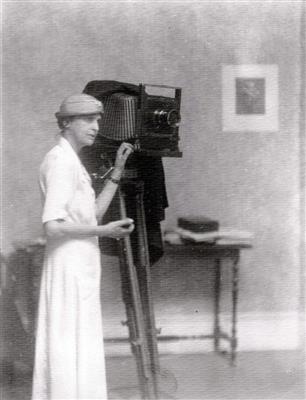
Doris Ulmann began her photographic career at the Clarence H. White School of Modern Photography in New York, where she trained in the Pictorialist tradition, with its emphasis on soft focus, careful tonal gradation, and photography as fine art rather than document. Her early portraits of American[1] cultural life, W.B. Yeats, Martha Graham, Paul Robeson, placed her in the company of the era's most prominent intellectuals and performers, and she published extensively in the 1920s in books devoted to American professional types and literary figures.
Biography
The turn that defined her legacy came in 1928[1], when she began travelling into the Appalachian mountains, photographing craftspeople, musicians, and subsistence farmers across six years of sustained fieldwork. Working with a large-format camera on glass plates and using available light, she produced portraits of extraordinary intimacy, often of subjects who had never been photographed before. The 1933 book Roll, Jordan, Roll, made with writer Julia Peterkin, documented the Gullah people of South Carolina's Sea Islands, and remains one of the most significant photographic studies of African-American[1] life produced in the interwar period. Her photographs for Allen Eaton's Handicrafts of the Southern Highlands, published posthumously in 1937, became a foundational document of Appalachian craft culture.
Ulmann died in New York in August 1934[1], aged fifty-two, having donated her archive to Berea College in Kentucky shortly before her death. The University of Oregon Libraries now hold 2,739 of her negatives alongside 304 prints. Her work is also held at the J. Paul Getty Museum and the Smithsonian.
Timeline
- 1882Born in the United States.
- 1920Began publishing photographs in books devoted to American professional types and literary figures.
- 1928Began photographing craftspeople, musicians, and subsistence farmers in the Appalachian mountains.
- 1933Published "Roll, Jordan, Roll" with writer Julia Peterkin, documenting the Gullah people of South Carolina's Sea Islands.
- 1934Died in New York at 52.
- 1934Donated her archive to Berea College in Kentucky.
Notable Works
Tap to view larger.
Next stop
Browse the movements →
Every movement in the collection, from the Renaissance to Pop art.
Related Artists
_%E2%80%93_LOC.jpg)



Frequently Asked Questions
What is Doris Ulmann known for?
Doris Ulmann is known for her photography, particularly her portraits of American[1] cultural figures and her documentation of rural communities. Her 1933[1] book, Roll, Jordan, Roll, made with writer Julia Peterkin, is a significant photographic study of African-American life during the interwar period.What is Doris Ulmann's most famous work?
It is difficult to name one single work as Doris Ulmann's 'most famous'. Her body of photographic portraits, taken primarily in the American[1] South in the late 1920s and early 1930s, are her best-known works. Ulmann's photography concentrated on capturing images of rural people, particularly those in Appalachia and the Gullah communities of the Sea Islands. She aimed to document what she perceived as a vanishing way of life, focusing on individuals engaged in traditional crafts and occupations. These photographs provide a view into a specific time and place in American history. Although she made portraits of notable figures such as William Butler Yeats, her work among the rural populations of the South is what has received the most attention.What should I know about Doris Ulmann's prints?
Doris Ulmann (1882[1]-1934[1]) was an American[1] photographer known for her portraits of rural people, particularly in the Southern United States. She aimed to document traditional crafts and ways of life. Ulmann studied at the Clarence H. White School of Photography. White's influence is apparent in her pictorialist style, which often features soft focus and carefully arranged compositions. Her work moved away from purely documentary photography towards a more artistic approach. Many of Ulmann's photographs were made into photogravures, a printing process that produces images with continuous tones and a velvety surface. This technique suited her aesthetic. Photogravures are created from copper plates etched with a photographic image. The plates are then inked and used to print the image onto paper. This process allows for a wide range of tonal values and subtle details, making it a popular choice for fine art photography. Ulmann's subjects included Appalachian craftspeople, African American communities in the South, and members of religious groups like the Shakers and Mennonites. She often worked with writer Julia Peterkin, illustrating Peterkin's books about Gullah culture in South Carolina. Her photographs provide a record of these communities during the early 20th century.What style or movement did Doris Ulmann belong to?
Doris Ulmann was active in the late 19th and early 20th centuries. Determining a single movement for her work is difficult, as her career spanned a period of significant artistic change. Ulmann is best known for her portrait photography, particularly of people in the rural American[1] South. Her work often documented the lives and traditions of marginalised communities. Some consider her work to be aligned with Pictorialism, an international style and movement that dominated photography during the late 19th and early 20th centuries. Pictorialism prioritised artistic effect over documentary realism, with an emphasis on soft focus, atmospheric effects, and handcrafted printing processes. Other scholars place her within a broader context of documentary photography, due to her focus on capturing specific communities and ways of life. Her portraits offer a view into a particular time and place in American history.What techniques or materials did Doris Ulmann use?
Doris Ulmann was an American[1] photographer known for her portraits, particularly of people in the rural American South. Her primary artistic medium was photography, and she favoured the use of a large-format camera, which allowed for a high level of detail and tonal range in her prints. Ulmann often employed natural light in her photography, creating soft, diffused effects that added to the atmospheric quality of her images. She printed her own photographs, typically using platinum or palladium printing processes. These techniques, popular among Pictorialist photographers, produced prints with a wide tonal scale and a subtle, matte surface. The platinum and palladium processes were also known for their archival qualities, resulting in prints that were exceptionally stable and long-lasting. Ulmann's choice of materials and techniques reflected her artistic goals: to create timeless, evocative portraits that captured the dignity and character of her subjects.What was Doris Ulmann known for?
Doris Ulmann (1882[1]-1934[1]) was an American[1] photographer known for her portraits of the rural American South, particularly of Appalachian people and African Americans in the early 20th century. She sought to document what she saw as a disappearing way of life. Born in New York City to a wealthy family, Ulmann studied at the Ethical Culture Fieldston School and later at Columbia University. She also attended the Clarence H. White School of Photography. White's artistic approach, which emphasised pictorialism and the aesthetic qualities of photography, influenced Ulmann's early work. Her initial focus was on portraiture of literary and artistic figures in New York. Later, she turned her attention to the rural South. Ulmann travelled extensively, photographing individuals from various backgrounds and occupations. These included craftspeople, farmers, and religious figures. She often used a large-format camera, which allowed her to capture a high level of detail and create a sense of intimacy in her portraits. Ulmann's work provides a valuable record of a specific time and place in American history.When did Doris Ulmann live and work?
Doris Ulmann was born on 3 May 1882[1], in New York City. She died on 28 August 1934[1]. Ulmann was a photographer known for her portraits of the rural people of the American[1] South, particularly the Appalachian region. She studied at the Ethical Culture Fieldston School, a progressive school that emphasised ethics, social responsibility, and direct experience. Later, she took courses at Columbia University and the Clarence H. White School of Photography. White, a member of the Photo-Secession movement, influenced Ulmann's artistic approach; she adopted a pictorialist style, characterised by soft focus and an emphasis on atmosphere. Ulmann's work aimed to document and preserve aspects of American folk culture that were disappearing due to industrialisation and modernisation. She received support from figures like Julia Peterkin, a novelist who wrote about Gullah culture in South Carolina. Ulmann's photographs provide a record of early twentieth-century rural life.Where can I see Doris Ulmann's work?
Doris Ulmann (1882[1]-1934[1]) was an American[1] photographer known for her portraits of rural Americans, particularly in the Southern Appalachian region. While specific, permanent displays of Ulmann's work are not widely publicised, her photographs can sometimes be viewed at institutions that hold significant photography collections. These may include the Museum of Modern Art, New York; the Smithsonian American Art Museum, Washington, D.C.; or the J. Paul Getty Museum, Los Angeles. Additionally, keep an eye out for temporary exhibitions that include her work. These pop up at various galleries and museums, both in the United States and internationally. Checking the catalogues of major photography exhibitions, or searching museum websites, will provide information on current or upcoming displays of her photographs. Auction houses such as Christie's or Sotheby's also occasionally feature her prints, offering another avenue for viewing her work.Where was Doris Ulmann from?
Bella Ullmann-Broner was born Bella Ullmann in Nuremberg, Germany, on 2 March 1905[1]. Her family were assimilated Jewish hop merchants. She seems to have been uninterested in a conventional biography; she supplied an incorrect name and birth year (1911 instead of 1905) for a Bauhaus publication during her lifetime. Around 1926, Ullmann studied at the Loheland School, an artists' commune near Fulda. The school's holistic approach comprised education in handicrafts and art, as well as gymnastics and farming. In 1933, she married civil engineer Karl Ernst Rosenthal in Munich; the marriage ended in 1938. She married Erwin Broner in Palestine. Broner had studied painting at the art academies in Munich, Dresden, and Stuttgart. They shared an artistic approach and spent much of their lives together until their divorce in 1948. In 1938, the couple settled in Los Angeles, where he worked as a cameraman and architect, and she as a set designer for films. In 1948, they moved to Krumville, New York, where Ullmann's family had owned a farm since 1941.Who did Doris Ulmann influence?
It is difficult to identify specific individuals directly influenced by Doris Ulmann. However, one can examine the influence she had on photographic practice and the broader art world. Ulmann's work contributed to a growing interest in documentary photography during the early 20th century. Her portraits of rural communities, particularly in the American[1] South, helped to shape perceptions of these cultures. This approach influenced later photographers who sought to document social issues and cultural traditions. Furthermore, Ulmann's focus on portraiture, and her attempts to capture the character of her subjects, resonated with a wider movement in photography that valued artistic expression over purely documentary aims. This artistic approach may have had an impact on photographers who explored portraiture as a means of conveying emotion and psychological depth. Although direct lines of influence are hard to trace, Ulmann's contributions to documentary photography and portraiture played a part in the development of these genres.Who influenced Doris Ulmann?
Information on Doris Ulmann's influences is scarce in the provided texts. However, one passage mentions Annelise Fleischmann (later Anni Albers), who studied with the Postimpressionist Martin Brandenburg. Brandenburg's strict discipline benefited Fleischmann, even if she questioned his methods. She also admired a Lucas Cranach painting. Another passage notes the Bauhaus's influence on various artists and designers. While Doris Ulmann is not explicitly mentioned in connection to the Bauhaus, several individuals associated with the Bauhaus are listed, including Anni Albers, László Moholy-Nagy, and others working across different artistic media. Without more specific information, it is difficult to identify Ulmann's influences with certainty. The passages suggest Postimpressionism and the Bauhaus as possible artistic movements that may have shaped her work, if indirectly.Who was Doris Ulmann?
Bella Ullmann-Broner (1905[1]-1993[1]) was a Bauhaus artist who studied wall painting and illustration, and designed architecture. Born Bella Ullmann in Nuremberg, she came from a Jewish family of hop merchants. Around 1926, she studied at the Loheland School, an artists’ commune near Fulda. In 1929, she matriculated at the Bauhaus, where she helped create industrial designs in the textile workshop under Gunta Stölzl. Ullmann supported Stölzl when she faced criticism, and they remained in contact for years. Ullmann was dismissed from the school for political reasons in 1930. As a "half-Jew" during Nazi oppression, Ullmann's life was threatened. She went to Palestine, where she worked with Arieh Sharon on cooperative housing designs in Tel Aviv. After the Second World War, she worked as a stills photographer on the French musical film *Alice in Wonderland* (1951). Later, she worked as a textile industry stylist and a children’s book illustrator in New York. She returned to Germany in 1968 for the *50 Years Bauhaus* anniversary exhibition in Stuttgart. She obscured details of her life, sometimes using aliases and changing residences frequently.
Sources
Editorial draws on the following primary and tertiary references for Doris Ulmann.
- [1] wikipedia Wikipedia: Doris Ulmann Used for: biography, birth dates, death dates, identifiers, movement attribution, nationality.
- [2] book Elizabeth Otto & Patrick Rössler, Bauhaus Women Used for: biography, stylistic analysis.
- [3] book guggenheim-kandinskyrussian00kand Used for: biography, stylistic analysis.
- [4] book Post-impressionism : cross-currents in European painting Used for: biography.
- [5] book Post-impressionism : cross-currents in European painting Used for: biography.
Editorial overseen by Solis Prints. Sources verified 2026-08-03. Click a source for details, or hover over [N] in the page above to preview.
Editorial standardsMethodologyCorrectionsAI disclosureAbout the editorial team