



Dumitru Ghiatza
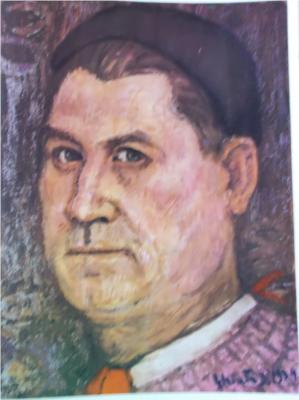
Dumitru Ghiată spent his early years as a laboratory worker in Romania before the painter Arthur Verona recognised his ability and took him on as a pupil. Three years of training led to a scholarship that brought him to Paris in 1913[1], where he enrolled at the Académies Ranson and Delécluse. He arrived the year before the First World War disrupted everything.
Biography
His paintings are primarily still lifes: flower arrangements and tabletop compositions in a palette that stays deliberately sober. The Post-Impressionist handling he absorbed in Paris fuses with a synthetic, slightly flattened drawing style that critics connect to the folk-art traditions of his native Oltenia region. There is nothing showy in his canvases; the interest lies in how plainly and honestly he sets things down.
Ghiată exhibited internationally across his career, with shows in Budapest, Athens, Helsinki, Prague, London and Turin. Works entered the National Museum of Art of Romania in Bucharest and, notably, the Jeu de Paume in Paris, a collection that in the 1920s and 1930s focused specifically on foreign artists working in or connected to France.
He continued painting until late in life, dying in 1972[1] at the age of 83. Though not among the celebrated names of Romanian modernism, he represents a strand of early twentieth-century Central European painting that absorbed the lessons of Paris without abandoning its local roots.
Timeline
- 1888Born in Romania.
- 1913Awarded a scholarship to study in Paris, enrolling at the Académies Ranson and Delécluse.
- 1913Studied with Arthur Verona for three years before receiving a scholarship.
- 1920His works were added to the collection at the Jeu de Paume in Paris.
- 1972Died at 83. He continued painting until late in life.
Notable Works
Tap to view larger.
Next stop
Browse the movements →
Every movement in the collection, from the Renaissance to Pop art.
Frequently Asked Questions
What is Dumitru Ghiatza known for?
Dumitru Ghiatza is known for his still-life paintings. His works often depicted flower arrangements and tabletop compositions, using a deliberately sober palette.What should I know about Dumitru Ghiatza's prints?
Dumitru Ghiatza (1888[1]-1972[1]) was a Romanian Post-Impressionist painter. He is best known for his portraits, figures, and still-life works. Ghiatza studied at the National School of Fine Arts in Bucharest, and he later taught there. His early paintings show the influence of academic realism. He then moved toward a more personal style, with simplified forms and brighter colours. His travels in France exposed him to modern art movements. He developed a style that combined elements of Impressionism and Expressionism. Ghiatza's prints often feature bold brushstrokes and a strong sense of colour. His subjects are often everyday people and objects. He captures the essence of Romanian life in his art. He was a member of the Arta Română group, and he exhibited his work widely both in Romania and abroad. His paintings are held in major Romanian museums, as well as private collections. Ghiatza received several awards and honours during his lifetime, confirming his position as a leading figure in Romanian art.When did Dumitru Ghiatza live and work?
Dumitru Ghiatza was born in Romania in 1888[1]. He died in 1972[1]. Other European artists born in the 1880s include Georges Braque (born 1882), Juan Gris (born 1887), Jean Arp (born 1886), and Max Beckmann (born 1884). Like Ghiatza, these artists lived through both World Wars and the rise of modernism. Braque, for example, was born in Argenteuil-sur-Seine in 1882. He studied at the École des Beaux-Arts in Le Havre. He later worked with Pablo Picasso, developing Cubism. Braque was wounded during World War I but continued to exhibit work until his death in 1963[1]. These dates provide a sense of the time in which Ghiatza lived and worked, though specific details of his career are not in the reference passages.Where can I see Dumitru Ghiatza's work?
Dumitru Ghiatza's work can be viewed in several museums. These include the Los Angeles County Museum of Art (LACMA), located on Wilshire Boulevard in Los Angeles, and the Metropolitan Museum of Art, situated on Fifth Avenue in New York. Additionally, the Minneapolis Institute of Arts in Minnesota and the Museum of Modern Art (MoMA) in New York also hold pieces. Other locations include the Royal Ontario Museum in Toronto, the Virginia Museum of Fine Arts in Richmond, and the Wolfsonian at Florida International University in Miami Beach. In the UK, you might find his work at the Brighton Museum & Art Gallery, Manchester Art Gallery, the National Museums of Scotland Royal Museum in Edinburgh, or the Victoria & Albert Museum in London. The Charles Hosmer Morse Museum of American Art in Winter Park, Florida, also has holdings.Where was Dumitru Ghiatza from?
Dumitru Ghiatza was Romanian. Although details of his early life are scarce, he became a significant figure in Romanian modernism. He was born in 1888[1]. Ghiatza's artistic journey took him through various stages. He initially explored post-impressionism, but later developed a personal style influenced by expressionism. His paintings often feature bold colours and dynamic compositions. They capture the essence of Romanian rural life and its people. Throughout his career, Ghiatza exhibited widely, both in Romania and internationally. He gained recognition for his unique artistic vision and his contribution to the development of Romanian art. He died in 1972[1], leaving behind a substantial body of work. His pieces continue to be admired for their artistic quality and their depiction of Romanian culture.Who did Dumitru Ghiatza influence?
Dumitru Ghiatza (1888[1]-1972[1]) was a Romanian painter known for his Expressionist and Cubist-influenced work. Although it is difficult to measure influence directly, we can consider his position within the Romanian art scene and his connections to other artists. Ghiatza belonged to a generation that sought to modernise Romanian art. He was associated with groups such as Arta Română and Contimporanul. These associations put him in contact with artists such as Constantin Brâncuși, considered a pioneer of modern sculpture, and the avant-garde poet and artist Ion Vinea. Ghiatza's teaching at the Nicolae Grigorescu Institute of Fine Arts in Bucharest also provided opportunities to influence younger artists. His students were exposed to his artistic approach, which combined elements of Romanian folk art with modern European movements. His work provides an example of how international styles were adapted and reinterpreted within a specific national context. While the specific impact on individual students requires further study, his role as an educator suggests a transmission of ideas and techniques.Who influenced Dumitru Ghiatza?
Dumitru Ghiatza (1888[1]-1972[1]) developed a personal style after exposure to several artistic movements. Early in his career, Ghiatza’s work displayed academic realism, a common approach for artists of his generation. However, exposure to Impressionism and Post-Impressionism during his travels to France and Italy shifted his artistic direction. The bright colours and visible brushstrokes of these movements are apparent in his later paintings. He adapted these techniques to his own vision, focusing on the Romanian countryside and its people. Some critics have also noted the influence of Nicolae Grigorescu, an earlier Romanian painter known for his rural scenes, on Ghiatza's subject matter. While Ghiatza absorbed elements from various sources, he synthesised them into a distinct artistic voice. His paintings are characterised by bold compositions and a focus on the play of light and shadow, creating a unique interpretation of Romanian life.Who was Dumitru Ghiatza?
Dumitru Ghiatza (1888[1]-1972[1]) was a Romanian painter, born in Colibasi, Romania. He is known for post-impressionist and expressionist works. Ghiatza studied at the National School of Fine Arts in Bucharest, under professors G.D. Mirea, Ipolit Strâmbulescu, and Cecilia Cuţescu-Storck. He then continued his studies in Paris at the Académie Julian. His early paintings show influences from academic training. Later, he moved toward a personal style with bold colours and simplified forms. He often depicted rural subjects: peasant life, village scenes, and still lifes. These subjects allowed him to explore colour and form. Ghiatza was a member of the artistic group Arta Română. He exhibited widely both in Romania and internationally, including at the Venice Biennale. His work can be found in major Romanian art museums, as well as private collections. Although he experimented with different styles, his mature work is characterised by a distinctive approach to colour and composition.Why are Dumitru Ghiatza's works important today?
Dumitru Ghiatza (1888[1]-1972[1]) was a Romanian Post-Impressionist painter. He is known for his landscapes and portraits, particularly of Roma people. Ghiatza's importance lies in his contribution to Romanian modernism, and his focus on social themes. He moved away from academic painting, embracing a more expressive style. His work often depicted rural life and the struggles of ordinary people. This approach was significant in a period of social and political change. His paintings offer insight into Romanian society during the first half of the 20th century. They document a specific time and place, preserving cultural memory. By portraying Roma people with dignity, Ghiatza challenged stereotypes. His artistic choices reflect a social consciousness that remains relevant. His work continues to be exhibited and studied, securing his place in Romanian art history.What was Dumitru Ghiatza's art style?
Dumitru Ghiatza's art style combined Post-Impressionist techniques with a synthetic, slightly flattened drawing style. Critics have connected this style to the folk-art traditions of his native Oltenia region.How did Dumitru Ghiatza die?
Dumitru Ghiatza died in 1972[1] at the age of 84.
Sources
Editorial draws on the following primary and tertiary references for Dumitru Ghiatza.
- [1] wikipedia Wikipedia: Dumitru Ghiatza Used for: biography, birth dates, death dates, identifiers, movement attribution, nationality.
- [2] book guggenheim-artoftomorrowfif1939gugg Used for: biography.
- [3] book guggenheim-guhe00solo Used for: biography.
- [4] book guggenheim-masterp00solo Used for: biography.
- [5] book guggenheim-twopri00weis Used for: biography, stylistic analysis.
Editorial overseen by Solis Prints. Sources verified 2026-09-30. Click a source for details, or hover over [N] in the page above to preview.
Editorial standardsMethodologyCorrectionsAI disclosureAbout the editorial team