



Eduard von Grützner
- Munich school
Eduard von Grützner made his name painting monks. Not solemn ecclesiastics bent in prayer, but jolly friars sampling cellar wine, Falstaff-like figures caught mid-sip or mid-nap in the warm interiors of monastery refectories. A local pastor in Upper Silesia first noticed his talent and funded his passage to Munich in 1864[2]; within six years he had his own studio and a clientele that grew steadily through the following decades.
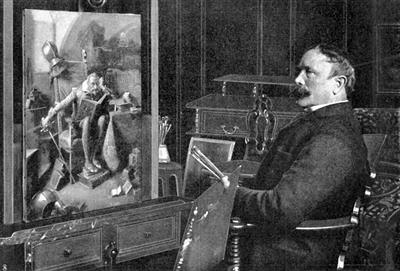
Biography
He studied under Carl Theodor von Piloty at the Munich Academy, alongside Max Makart and Franz von Lenbach, before establishing himself as one of the city's leading genre painters. The Prince Regent of Bavaria awarded him the title of professor in 1886[2], and he was knighted in 1916. His formula of detailed academic rendering applied to comic-religious subject matter transferred smoothly to the private collectors who made Munich an art-market centre in the later 19th century.
Grützner returned to the figure of Falstaff repeatedly, with canvases from 1906[2] and 1921 among the best known. A dedicated collector himself, he developed a late interest in Japanese philosophy and Far Eastern objects, an incongruous enthusiasm for a painter whose public success rested on cosily Bavarian subject matter.
His reputation acquired an unfortunate shadow when Albert Speer recorded Adolf Hitler claiming Grützner would "someday be worth as much as a Rembrandt." That association coloured critical reception for decades. The work itself, whatever its cultural baggage, demonstrates considerable technical command.
Timeline
- 1846Born in Upper Silesia.
- 1864Funded by a local pastor, he moved to Munich to study art.
- 1870Six years after moving to Munich, he had his own studio and clientele.
- 1886The Prince Regent of Bavaria awarded him the title of professor.
- 1906Painted one of his best-known Falstaff canvases.
- 1916He was knighted.
- 1921Painted another of his best-known Falstaff canvases.
- 1925Died at 79.
Notable Works
Tap to view larger.
Next stop
Browse the movements →
Every movement in the collection, from the Renaissance to Pop art.
Related Artists




Frequently Asked Questions
What is Eduard von Grützner known for?
Eduard von Grützner is known for his paintings of monks, particularly jolly friars enjoying wine or naps in monastery settings. He also repeatedly depicted the figure of Falstaff in his art. His work gained further attention, though controversially, when Adolf Hitler claimed Grützner would one day be as valuable as Rembrandt.Who was Eduard von Grützner?
Eduard von Grützner was a German[2] genre painter who studied under Carl Theodor von Piloty at the Munich Academy. He became one of Munich's leading artists and was awarded the title of professor in 1886[2], followed by a knighthood in 1916. Grützner is also known as a dedicated collector with a late interest in Japanese philosophy and Far Eastern objects.What was Eduard von Grützner's art style?
Eduard von Grützner's art style involved detailed academic rendering applied to comic-religious subject matter. This approach proved popular with private collectors, establishing him in the Munich art market.How did Eduard von Grützner die?
Eduard von Grützner died in 1925[2] at the age of 79.
Sources
Editorial draws on the following primary and tertiary references for Eduard von Grützner.
- [1] museum Musées Nationaux Récupération Used for: museum holdings.
- [2] wikipedia Wikipedia: Eduard von Grützner Used for: biography, birth dates, death dates, identifiers, movement attribution, nationality.
- [3] book German expressionism : documents from the end of the Wilhelmine Empire to the rise of national socialism Used for: biography.
- [4] book guggenheim-expger00neug Used for: biography, stylistic analysis.
- [5] book guggenheim-kandinskyinmunic00kand Used for: stylistic analysis.
- [6] book Husslein-Arco, Agnes, editor; Koja, Stephan, editor; Law, Rebecca (Translator), translator; McInnes, Robert (Translator), translator; Somers, Nick, translator; Monet, Claude, 1840-1926. Paintings. Selections; Österreichische Galerie Belvedere, h Used for: biography, stylistic analysis.
- [7] book Masterpieces of western art : a history of art in 900 individual studies from the Gothic to the present day Used for: biography.
Editorial overseen by Solis Prints. Sources verified 2026-10-07. Click a source for details, or hover over [N] in the page above to preview.
Editorial standardsMethodologyCorrectionsAI disclosureAbout the editorial team