



Egry József
- Európai Iskola
József Egry spent most of his adult life beside Lake Balaton, and the lake made him. No other Hungarian[1] painter devoted himself so obsessively to a single landscape, or extracted so much from its particular quality of light: the shimmer off shallow water, the haze between shore and hill, the way colour dissolves toward midday.
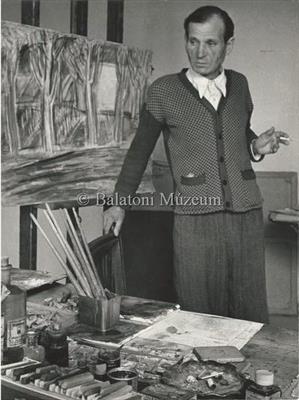
Biography
Born in 1883[1], Egry was largely self-taught before travelling to Paris, where he attended the Académie Julian in 1905[1], and then through Munich, Vienna, and Brussels. The European academies gave him technique; the Expressionist and Constructivist currents of the early twentieth century gave him permission to pursue something more personal. He developed a distinctive mixed oil-pastel method that let him capture light with a speed and directness that conventional oil painting resisted.
His career was interrupted by the First World War, during which a serious training accident altered his health permanently. He met his future wife, Juliska Pauler, while convalescing at a military hospital in Badacsony, which also became the town where he settled and died. Italian travels in the 1930s produced Taormina (1930[1]) and Nervi (1938), paintings that test his luminous idiom against Mediterranean light, but Balaton remained his subject. Golden Gate (1944), finished in the last year of the war, was his final completed work.
In 1948[1] Egry was among the first recipients of the Kossuth Prize, Hungary's highest state cultural honour. He died in Badacsony in 1951[1]. Critics at the time described his achievement as a new interpretation of naturalism, original within European painting; that verdict has held.
Timeline
- 1883Born in Hungary. He was largely self-taught as an artist.
- 1905Attended the Académie Julian in Paris.
- 1914His career was interrupted by the First World War, during which a training accident altered his health permanently.
- 1914Met his future wife, Juliska Pauler, while convalescing at a military hospital in Badacsony.
- 1914Settled in Badacsony after being hospitalised there.
- 1930Painted "Taormina" during travels in Italy.
- 1938Painted "Nervi" during travels in Italy.
- 1944Finished "Golden Gate", his final completed work.
- 1948Received the Kossuth Prize, Hungary's highest state cultural honour.
- 1951Died in Badacsony.
Notable Works
Tap to view larger.
Next stop
Browse the movements →
Every movement in the collection, from the Renaissance to Pop art.
Related Artists

Frequently Asked Questions
What is Egry József known for?
József Egry is known for his paintings of Lake Balaton. He devoted himself to capturing the lake's unique light, the shimmer off the water, the haze, and the dissolving colour toward midday.What is Egry József's most famous work?
It is difficult to name one single work as Egry József's most famous. He is best known for his paintings of Lake Balaton in Hungary, where he lived and worked for much of his life. Egry's style is characterised by its focus on light and atmosphere. He sought to capture the unique qualities of the Balaton region, often painting the lake at different times of day and in varying weather conditions. His works often feature a limited colour palette, with an emphasis on subtle tonal variations. While he painted other subjects, such as portraits and religious scenes, it is his Balaton paintings that have secured his place in Hungarian[1] art history. These paintings are appreciated for their poetic and evocative qualities, and for their ability to capture the spirit of the Balaton region.What should I know about Egry József's prints?
When considering Egry József's prints, it is useful to know some basic print terminology. An "original print" is made by hand by the artist, using techniques such as woodcut, engraving, linocut, etching, or lithograph. The image is created specifically to be a print, with the artist working directly on the plate, block or screen. Each print is considered an original, and these are often sold through specialist galleries. A "reproduction" is a copy of a work originally created in another medium, such as a painting or watercolour. These are usually produced using photochemical means. Numbering or signing a reproduction does not make it an original print. Other types of prints include giclée prints, which are inkjet fine art prints, and canvas transfers, where the image is transferred onto canvas to resemble a painting. The Professional Art Dealers Association of Canada defines an original print as an image conceived by the artist as a print, executed solely as a print, usually in a numbered edition, and signed by the artist. Each print is made from a matrix created for that purpose, with each being individually inked and pulled.What was Egry József known for?
Egry József (1883[1]-1951[1]) was a Hungarian[1] painter who worked primarily with watercolour and oil. He is best known for his depictions of Lake Balaton, a large freshwater lake in western Hungary. Egry studied law at first, then attended art school under Károly Ferenczy. Early in his career, he painted in a naturalistic style. He served on the Italian front during the First World War. The experience influenced his artistic style, which became more simplified and expressive. After the war, Egry settled in Badacsony, a town on the northern shore of Lake Balaton. The location became a central theme in his art. He painted the lake under varying light conditions and in different seasons. His paintings often feature a limited colour palette, emphasising the atmosphere and mood of the scene. He explored themes of solitude and the relationship between humans and nature. Egry's work moved toward a spiritual dimension. His later paintings are characterised by an increasing simplification of form and a focus on light. He received the Kossuth Prize in 1948[1].When did Egry József live and work?
József Egry was born in Zala County, Hungary, in 1883[1]. He died in 1951[1]. He is known for his paintings of Lake Balaton. Egry began his artistic studies with Tivadar Zemplényi, and Károly Ferenczy, in Budapest. He continued his studies in Paris at the Académie Julian. During the First World War, he served as a war artist. From 1918[1], Egry lived in Badacsony, on the northern shore of Lake Balaton. The area's atmosphere and light became central to his art. He mainly painted the lake, the local people, and the surrounding hills. His style moved toward a personal form of expressionism, capturing the moods of nature. Egry's works often feature simplified forms and a muted colour palette, reflecting a sense of melancholy and contemplation. He is considered one of Hungary's most important modern painters.What was Egry József's art style?
Egry József developed a mixed oil-pastel method. This allowed him to capture light with a speed and directness that conventional oil painting resisted; critics at the time described his achievement as a new interpretation of naturalism.How did Egry József die?
Egry József died in 1951[1] at the age of 68.
Sources
Editorial draws on the following primary and tertiary references for Egry József.
- [1] wikipedia Wikipedia: Egry József Used for: biography, birth dates, death dates, identifiers, movement attribution, nationality.
- [2] book guggenheim-solomonrguggenhe00gugg Used for: biography.
- [3] book Husslein-Arco, Agnes, editor; Koja, Stephan, editor; Law, Rebecca (Translator), translator; McInnes, Robert (Translator), translator; Somers, Nick, translator; Monet, Claude, 1840-1926. Paintings. Selections; Österreichische Galerie Belvedere, h Used for: biography.
- [4] book By Jeffrey Taylor, In Search of the Budapest Secession: The Artist Proletariat and the Modernism’s rise in the Hungarian Art Market, 1800-1914 Used for: biography, stylistic analysis.
- [5] book Masterpieces of western art : a history of art in 900 individual studies from the Gothic to the present day Used for: biography.
Editorial overseen by Solis Prints. Sources verified 2026-10-14. Click a source for details, or hover over [N] in the page above to preview.
Editorial standardsMethodologyCorrectionsAI disclosureAbout the editorial team