



Elga Sesemann
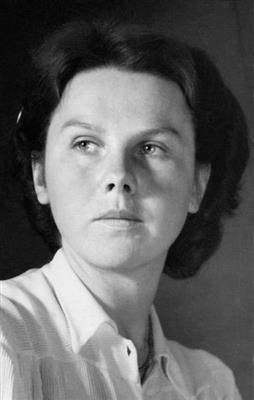
Sesemann was born in 1922[1] in Viipuri, on the Karelian Isthmus, a city that would become Soviet territory during the Winter War, taking her childhood landscape with it. Of German descent, she grew up trilingual in German, Russian, and Finnish[1], and enrolled at the Ateneum in Helsinki in 1941[1] under the shadow of wartime. Material scarcity shaped her practice early: unable to afford proper canvas, she worked on cardboard, applying oil and pastel with a palette knife that became her characteristic instrument.
Biography
Her first solo exhibition opened on 17 March 1945[1] at Taidesalonki, Helsinki, showing fifty-two works. She was twenty-two. In the years that followed, she developed a visual language of unease: figures caught between reality and dream, religious imagery blended with the imagery of anxiety and loneliness. The influence of de Chirico's metaphysical distances and German Expressionism's emotional directness runs through her work without overwhelming its distinctively Finnish[1] quietness.
She married fellow artist Seppo Näätänen in 1945[1] and moved to rural Ruovesi in 1947, where she remained, largely apart from the Helsinki art world, until his death in 1964. Despite over a hundred exhibitions during her lifetime, international recognition came slowly. In the years after her death in 2007, her reputation has grown considerably: major retrospectives toured Finland, Sweden, Estonia, Denmark, China, Japan, and the United States. The Finnish[1] National Gallery holds sixty-one of her works, and a headline retrospective at the Ateneum opened in 2025.
Timeline
- 1922Born in Viipuri, on the Karelian Isthmus. She grew up trilingual in German, Russian, and Finnish.
- 1941Enrolled at the Ateneum in Helsinki under the shadow of wartime.
- 1945Her first solo exhibition opened on 17 March at Taidesalonki, Helsinki, showing fifty-two works; she was twenty-two.
- 1945Married fellow artist Seppo Näätänen.
- 1947Moved to rural Ruovesi, remaining largely apart from the Helsinki art world.
- 1964Her husband, Seppo Näätänen, died.
- 2001Sesemann died. (aged 78)
Notable Works
Tap to view larger.
Next stop
Browse the movements →
Every movement in the collection, from the Renaissance to Pop art.
Related Artists
Frequently Asked Questions
What is Elga Sesemann known for?
Elga Sesemann is known for developing a visual language of unease. Her artwork often featured figures caught between reality and dream, religious imagery, and imagery of anxiety and loneliness.What is Elga Sesemann's most famous work?
It is difficult to name Elga Sesemann's single most famous work, as different sources provide long lists of paintings without indicating which ones are most well-known. She created a number of paintings of people, such as Albert Kollmann, Ellen Warburg, Erdmute Esche with Doll, Friedrich Nietzsche, Harry Graf Kessler, and Elisabeth Förster-Nietzsche. Sesemann also painted self-portraits. She painted many pictures of families, such as Jonas Lie with His Family. She also painted many portraits of children, such as Two Girls with Blue Aprons. Sesemann also painted landscapes, such as Beach with Rocks, House in Borre, and Spring in Åsgårdstrand. She also painted pictures of groups of people, such as Drinkers, Groups of People on the Beach, and Women on the Bridge.What should I know about Elga Sesemann's prints?
Elga Sesemann (born 1922[1]) was a German-Finnish[1] artist known for her photography. When considering her prints, it is helpful to understand some basics of printmaking and the art market. Original prints are produced by hand, with the artist creating the artwork directly on a plate, block, stone, or screen. Each print is considered an original, as opposed to a reproduction made by photochemical means. These originals are often sold in specialist galleries. Printmakers often limit the number of prints in an edition; this is the artist's choice rather than a technical requirement. Each print in a limited edition is numbered, titled, and signed in pencil, usually on the bottom margin. The numbering (for example, 12/25) indicates the specific print number and the total edition size. This convention provides a record of the number of prints. The value of a photograph is affected by when it was printed. A "vintage" print is one made shortly after the original photograph was taken, ideally by the photographer or under their supervision. Provenance, or the history of ownership, can also affect value.What techniques or materials did Elga Sesemann use?
Elga Sesemann's practice involved a range of media, as well as both direct and indirect processes. One technique she used was sandblasting on flashed glass; this involved using opaque glass, often milk glass covered with a thin film of another colour. A stencil was applied to the glass, and the design was cut out. Sandblasting then ground a relief into the glass where it was uncovered. This process could also be used to dull the surface of the glass, creating a grey tone on a black background. Glass painters' colours could also be applied and made permanent in a kiln. Sesemann also worked with watercolours, favouring Whatman's Medium paper, a wove paper known for its uniform surface. She used graphite pencils, ranging from F to 6B, for rough drawings. For colour work, she used Raphael sable brushes and watercolours from Lefranc & Bourgeois, and Windsor & Newton. She avoided using black or white in her watercolour paintings.What was Elga Sesemann known for?
Elga Sesemann (born 1922[1]) is a Finnish[1] artist known for her abstract paintings and printmaking. She studied at the Free Art School (Vapaa Taidekoulu) in Helsinki during the 1940s, a time when the school was a centre for modernism in Finland. Sesemann's early work was influenced by constructivism and geometric abstraction. Over time, her style evolved to incorporate looser, more organic forms. She often used colour to create a sense of depth and space in her compositions. Sesemann was part of a generation of Finnish artists who sought to move beyond traditional artistic conventions. She exhibited widely both in Finland and internationally, helping to promote abstract art in her country. Although her work is less well known outside of Finland, she is regarded as an important figure in the development of Finnish modernism. Her prints and paintings are held in major Finnish museum collections.Where can I see Elga Sesemann's work?
While a comprehensive list of institutions holding works by Elga Sesemann is unavailable, several museums with collections of related art may be of interest. These include institutions with holdings of Art Deco and Post-Impressionism, two movements that were roughly contemporaneous with Sesemann's career. In the United States, the Metropolitan Museum of Art (New York), the Los Angeles County Museum of Art (LACMA), the Minneapolis Institute of Arts, the Museum of Modern Art (New York), the Virginia Museum of Fine Arts (Richmond), and the Wolfsonian at Florida International University (Miami Beach) all hold relevant works. In Canada, the Royal Ontario Museum (Toronto) may be of interest. In the United Kingdom, collections can be found at the Brighton Museum & Art Gallery, the Geffrye Museum (London), the Manchester Art Gallery, the National Museums of Scotland (Edinburgh), and the Victoria & Albert Museum (London). On the continent, consider the Kunsthalle (Bremen), the Ludwig Museum (Cologne), the Folkwang Museum (Essen), and the Nationalgalerie (Berlin).Who did Elga Sesemann influence?
It is difficult to identify specific individuals who Elga Sesemann influenced directly. However, her artistic practice can be situated within a broader context of assemblage artists who share certain motivations and approaches. Rosalie Gascoigne, an Australian assemblage artist, offers insight into the mindset of artists working in this medium. In 1992[1], Gascoigne judged an art prize for assemblage, collage, and mixed media works. She observed that such artists are often motivated by a love of found objects; they appreciate colour, shape, texture, and chance. They find art in unexpected places and delight in inventiveness. Gascoigne's description provides a framework for understanding the influences that shape assemblage art, including Sesemann's work.Why are Elga Sesemann's works important today?
Elga Sesemann (1904-1998[1]) was a German-British artist and photographer. Her work offers a view into the lives of émigré artists in post-war Britain. Sesemann studied photography in Berlin during the 1920s. There, she absorbed the aesthetics of the New Objectivity movement. This style favoured sharp focus and unadorned depictions of everyday subjects. After leaving Germany in 1933[1], she settled in London. She became part of a circle of artists and intellectuals who had also fled Nazi Germany. Her photographs and paintings from this period document her surroundings and social network. They include portraits of fellow artists such as Kurt Schwitters, and scenes from London. These works are valuable as historical records and as examples of modernist aesthetics adapted to the British context. Sesemann's practice moved between different media. She produced photographs, paintings, and drawings. This multimedia approach reflected the interdisciplinary nature of the artistic circles she inhabited. Her work is now held in collections such as the National Portrait Gallery, London.What was Elga Sesemann's art style?
Elga Sesemann's art style shows the influence of de Chirico's metaphysical distances and German Expressionism's emotional directness. However, her style maintains a distinctively Finnish[1] quietness.How did Elga Sesemann die?
Elga Sesemann died in 2001[1] at the age of 79.
Sources
Editorial draws on the following primary and tertiary references for Elga Sesemann.
- [1] wikipedia Wikipedia: Elga Sesemann Used for: biography, birth dates, death dates, identifiers, movement attribution, nationality.
- [2] book Gianlorenzo Bernini: new aspects of his art and thought : a commemorative volume Used for: biography, stylistic analysis.
- [3] book guggenheim-expger00neug Used for: biography.
- [4] book guggenheim-refigur00kren Used for: biography.
- [5] book Masterpieces of western art : a history of art in 900 individual studies from the Gothic to the present day Used for: biography.
Editorial overseen by Solis Prints. Sources verified 2026-09-30. Click a source for details, or hover over [N] in the page above to preview.
Editorial standardsMethodologyCorrectionsAI disclosureAbout the editorial team