

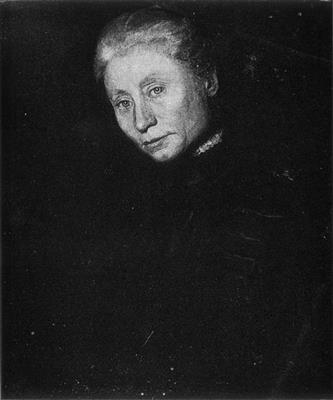
Elizabeth Coffin
In 1872[1], when the Hague Academy of Fine Arts admitted Elizabeth Coffin as its first female student, the institution was doing something the American art world had not yet managed. That the daughter of a Brooklyn Quaker family should end up at one of Europe's oldest academies, winning medals in anatomy, composition, perspective, and drawing, says something both about her persistence and about the limits she faced at home.
Biography
Coffin came to painting by an unusual route. She took a BA at Vassar in 1870[1] and returned for an MFA in 1876, becoming the first person in the United States to hold that degree. In between, she spent three years in The Hague. Back in America, she continued her training at the Art Students League, the Pennsylvania Academy of Fine Arts, and for a period under Thomas Eakins in Philadelphia. Maria Mitchell, Vassar's astronomy professor, remained her closest mentor throughout.
Her subject was Nantucket: specifically the island's whaling communities in their final decades. She was an eighth-generation descendant of the original Nantucket settlers Tristram and Dionis Coffin, which gave her work both a personal and a documentary dimension. "Hanging the Nets" won the Norman W. Dodge Prize at the National Academy of Design in 1892[1] for best picture by a woman, a distinction she claimed again in 1902. She showed at the World's Columbian Exposition in Chicago in 1893.
Beyond painting, she helped reopen the Coffin School in 1903[1], expanding its remit to both genders for the first time since the institution was established in 1852. She died in Nantucket on 21 June 1930[1].
Timeline
- 1850Born Elizabeth Coffin to a Quaker family in Brooklyn.
- 1870Received a BA from Vassar College.
- 1872Admitted to the Hague Academy of Fine Arts as its first female student.
- 1876Received an MFA from Vassar College, becoming the first person in the United States to hold that degree.
- 1892Won the Norman W. Dodge Prize at the National Academy of Design for best picture by a woman for "Hanging the Nets".
- 1893Showed work at the World's Columbian Exposition in Chicago.
- 1902Again won the Norman W. Dodge Prize at the National Academy of Design for best picture by a woman.
- 1903Helped reopen the Coffin School, expanding its remit to both genders.
- 1930Died in Nantucket on 21 June.
Notable Works
Tap to view larger.
Next stop
Browse the movements →
Every movement in the collection, from the Renaissance to Pop art.
Frequently Asked Questions
What is Elizabeth Coffin known for?
Elizabeth Coffin is known for her paintings of Nantucket's whaling communities during their final decades. Her connection to the island, as an eighth-generation descendant of original settlers, gave her work a personal and documentary aspect. She twice won the Norman W. Dodge Prize at the National Academy of Design.What should I know about Elizabeth Coffin's prints?
When considering Elizabeth Coffin's prints, bear in mind some key aspects of printmaking. An "original print" is conceived as a print and executed solely as a print. Each one is made individually from a plate, stone, screen or block created for that purpose. There is no single original from which copies are made. The artist inks and pulls each print individually; it is a "multi-original" medium. The artist decides the number of prints in the edition. Sequential numbering accounts for the number of prints, with each having a specific number, such as 12/25 (print number 12 of an edition of 25). Numbering has only recently become standard; early prints were often unsigned and unnumbered. A reproduction is a copy of artwork conceived in another medium (painting or watercolour), usually made by photo-mechanical means. Numbering and signing a reproduction does not change its essence; it remains a reproduction, not an original print. Original prints can include woodcuts, engravings, linocuts, mezzotints, etchings, lithographs or serigraphs. These are produced by hand by the artist. The work is created specifically to be a print, with the artist creating the artwork directly on the plate, woodblock, etching stone or screen.What style or movement did Elizabeth Coffin belong to?
Without more information about Elizabeth Coffin's work, it is difficult to assign her definitively to a particular movement. However, the Rococo style was prominent during her lifetime. Rococo was a light-hearted, ephemeral style that flourished in Europe between approximately 1742 and 1760. French influence was paramount in certain fields, especially in the design of English textiles. Rococo designs often featured 'C' scrolls, asymmetrical panels, shells, and other decorative elements. English designers often chose fresh, outdoor colours and exploited the white ground of cotton and the sheen of silk to create a sense of space and air. Rococo coincided with a renewed interest in natural history, with realistic depictions of flowers and other natural forms becoming popular. Rococo was essentially a lighthearted and ephemeral style.What techniques or materials did Elizabeth Coffin use?
Elizabeth Coffin's artistic approach involved a range of materials and methods. Like many artists, she began with preliminary sketches. For her paintings, she employed a process of layering, starting with thin washes of subdued colour to establish the basic forms. She then built up the surface with opaque paint, adding details as she went. Glazes of red and transparent earths were used to add depth to shadows. Touches of off-white were applied to create the effect of reflective light. Coffin, like other artists, prepared her canvases with a ground layer. Her palette included pigments such as ultramarine, ochres, madder, black, Prussian blue, gamboge, vermilion and gold. She applied paint in small strokes, leaving areas of the white ground exposed to create highlights, similar to watercolour techniques. After the painting was nearly complete, she reworked certain details. Finally, she applied layers of glue and varnish to give the painting a glossy surface and saturate the colours.When did Elizabeth Coffin live and work?
Elizabeth Coffin, a painter and etcher, lived from 1850[1] to 1930[1]. She was born in Brooklyn, New York. Coffin came from a Quaker background. She studied at The Hague with Hendrik Willem Mesdag, a Dutch marine painter of the Hague School; she also studied with William Merritt Chase. She is known for portraits, genre scenes, and coastal views. She exhibited at the Paris Salon, the Royal Academy, and the Society of American Artists. Coffin belonged to several art organisations, including the New York Etching Club and the Art Students League. She received a bronze medal at the Exposition Universelle in Paris in 1889[1]. Coffin married William Anderson in 1898, after which she was sometimes known as Elizabeth Coffin Anderson. She died in Nantucket, Massachusetts. Her work can be found in the collections of the Metropolitan Museum of Art and the Brooklyn Museum.Where can I see Elizabeth Coffin's work?
You can view works by Elizabeth Coffin at several museums. These include US institutions such as the Metropolitan Museum of Art in New York; the Los Angeles County Museum of Art (LACMA); the Minneapolis Institute of Arts; the Museum of Modern Art (New York); the Virginia Museum of Fine Arts in Richmond; the Wolfsonian at Florida International University in Miami Beach; the High Museum in Atlanta; the Art Institute of Chicago; the Museum of Fine Arts, Boston; and the Textile Museum, at George Washington University, in Washington DC. Coffin's work can also be seen at the Royal Ontario Museum in Toronto, Canada. In the UK, see the Bakelite Museum, Brighton Museum & Art Gallery, the Geffrye Museum, the Manchester Art Gallery, the National Museums of Scotland (Royal Museum) in Edinburgh, and the Victoria & Albert Museum in London.Who influenced Elizabeth Coffin?
It is difficult to summarise the influences on Elizabeth Coffin (1850[1]-1930[1]). Anni Albers, who taught at Black Mountain College, affected many students at two major art institutions of the 20th century: the Bauhaus, in Weimar and Dessau, and Black Mountain College, near Asheville, North Carolina. Through her work, writings, and the dissemination of her ideas worldwide, she inspired and guided many artists in directions that have now become part of the mainstream. Albers collaborated with leading technicians, blending screenprint with photo-offset, etching, shifting and overprinting plates, and drenching lithographic stones in acid. Joan Mitchell, a student in Alfred Adler’s advanced psychology class, was familiar with Freud’s theories. Helen Richard may have been the first to bring them to bear on the adolescent’s own inner turmoil. Mitchell realised that her demons could be disempowered and hidden meanings wrested from life. Psychoanalysis was not self-indulgence but rather a form of authenticity, even heroism.Who was Elizabeth Coffin?
Elizabeth Coffin was an American painter who studied at The Hague Academy of Fine Arts, becoming the institution's first female student in 1872[1]. She also achieved the distinction of being the first person in the United States to hold an MFA degree. Maria Mitchell, Vassar's astronomy professor, served as her mentor.Why are Elizabeth Coffin's works important today?
Elizabeth Coffin's works offer insights into nineteenth-century American life, particularly regarding women and community identity. In 1836, Erastus Salisbury Field painted portraits of at least eight relatives from the Bassett family of Lee, Massachusetts. These commissions reflected the family's pride in their kinship and their role in establishing the town in 1778. The portraits of Nathaniel and Bethiah Bassett, for example, depict a prosperous couple. Nathaniel, a veteran of the Continental Army and a local hero, is shown as a mature man with a face reflecting his life experiences. Bethiah is portrayed as a matriarch, adorned with an elaborate cap and imported shawl, signifying her status as a wife and mother. Similarly, portraits such as those of Edwards Whipple Denny and Elizabeth Stone Denny reveal aspects of a virtually unknown social world. The sitters hold a pencil and a slate, tools that represented their literacy and deafness, and their means of communicating with the hearing world. These details offer a glimpse into the lives of individuals and communities that might otherwise remain obscure.How did Elizabeth Coffin die?
Elizabeth Coffin died in 1930[1] at the age of 80.
Sources
Editorial draws on the following primary and tertiary references for Elizabeth Coffin.
- [1] wikipedia Wikipedia: Elizabeth Coffin Used for: biography, birth dates, death dates, identifiers, movement attribution, nationality.
- [2] book Masterpieces of western art : a history of art in 900 individual studies from the Gothic to the present day Used for: biography.
- [3] book Post-impressionism : cross-currents in European painting Used for: biography.
- [4] book Landauer, Susan, The not-so-still life : a century of California painting and sculpture Used for: biography.
- [5] book 1892-1968, Panofsky, Erwin,, Tomb sculpture: four lectures on its changing aspects from ancient Egypt to Bernini Used for: biography.
Editorial overseen by Solis Prints. Sources verified 2026-09-30. Click a source for details, or hover over [N] in the page above to preview.
Editorial standardsMethodologyCorrectionsAI disclosureAbout the editorial team