



Émile Friant
- École de Nancy
The painting that made Émile Friant's reputation measures 254 by 334 centimetres. La Toussaint (All Saints' Day), shown at the Paris Salon in 1889[2], fills a wall with Nancéiens visiting the cemetery to lay chrysanthemums on family graves: mothers in black, children clutching flowers, a cityscape visible through the iron fence behind them. It is both a genre scene and, for anyone aware of Lorraine's post-1871 status as occupied territory, a painting about grief of a more political kind. The jury awarded it the Salon's first prize. Friant was twenty-six.
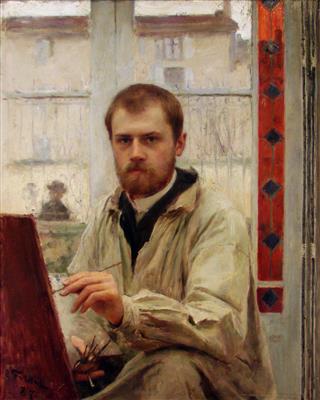
Biography
Born on 16 April 1863[2] in Dieuze, Lorraine, he was seven when the Franco-Prussian War ended and France ceded his home region to Germany. His family relocated to Nancy in 1871[2], a city then at the cultural edge of French[2] resistance to the occupation. He studied under Louis-Théodore Devilly, then under the academic painter Alexandre Cabanel in Paris, before returning to Nancy to work with Aimé Morot. He debuted at the Salon in 1882 with an honourable mention, winning medals in 1884 and 1885.
The 1889[2] triumph was comprehensive: in addition to the Salon prize, he received a gold medal at the Universal Exposition and the Légion d'Honneur. He returned to the Exposition in 1900 for a second gold medal. His Realist approach, meticulous in finish and photographic in preparation, produced works of considerable emotional directness. La Douleur (1898, Musée des beaux-arts, Nancy) and Chagrin d'Enfant (1898, Frick Art and Historical Center) confirm a persistent interest in faces registering loss.
In 1923[2] he was appointed professor at the École des Beaux-Arts in Paris, promoted to Commander of the Légion d'Honneur, and elected to the Institut de France. He died in Paris on 9 June 1932[2].
Timeline
- 1863Born in Dieuze, Lorraine, on 16 April.
- 1871His family relocated to Nancy after France ceded Lorraine to Germany; he was seven.
- 1882Debuted at the Salon and received an honourable mention.
- 1889His painting "La Toussaint (All Saints' Day)" won first prize at the Paris Salon; at 26.
- 1889Received a gold medal at the Universal Exposition and the Légion d'Honneur.
- 1900Received a second gold medal at the Universal Exposition.
- 1923Appointed professor at the École des Beaux-Arts in Paris.
- 1923Promoted to Commander of the Légion d'Honneur and elected to the Institut de France.
- 1932Died in Paris on 9 June.
Notable Works
Tap to view larger.
Where to See Émile Friant
1 museum worldwide.
-
1 works
Centre national des arts plastiques
Paris, France
Next stop
Browse the movements →
Every movement in the collection, from the Renaissance to Pop art.
Related Artists


Frequently Asked Questions
What is Émile Friant known for?
Émile Friant is known for his Realist paintings, particularly those depicting scenes of loss and grief. His 1889[2] painting, La Toussaint, earned him a gold medal at the Universal Exposition and the Légion d'Honneur.What is Émile Friant's most famous work?
It is difficult to name one single work as Émile Friant's most famous. However, several of his paintings gained considerable attention during his career. Friant's early academic training led him to produce realistic genre scenes and portraits, often depicting everyday life in France. These paintings, with their attention to detail and naturalistic style, were well received by critics and the public alike. Later in his career, Friant experimented with different styles and subjects, but he remained committed to realism. He received many official honours and commissions, solidifying his position as a respected artist in France. His legacy is one of technical skill and a dedication to portraying the world around him with accuracy.What should I know about Émile Friant's prints?
Émile Friant (1863[2]-1932[2]) was a French[2] artist known for his academic realism and genre scenes. Although he is best known as a painter, some of his compositions were reproduced as prints. Friant studied at the École des Beaux-Arts in Paris, and he won the Prix de Rome in 1889[2]. His style is characterised by careful attention to detail and naturalistic depictions of everyday life. He often depicted scenes of Parisian society, portraits, and nudes. Prints of Friant's work offer a more accessible way to own his art. These reproductions allow collectors to appreciate his technical skill and subject matter at a lower price point than original paintings. "October", a painting exhibited at the Salon in 1888, is among his best-known works; it exists in print form. Other paintings that were turned into prints include "La Toussaint". These prints capture the atmosphere and detail of Friant's paintings, making them attractive to a wider audience. Friant's prints provide insight into French society during the late 19th and early 20th centuries.What style or movement did Émile Friant belong to?
Émile Friant (1863[2]-1932[2]) is usually associated with Naturalism, a late 19th-century movement that aimed to depict subjects realistically and objectively. Naturalism emerged from Realism but often focused on the impact of social and environmental factors on individuals. Friant's style also shows characteristics of academic painting, given his training and success in the official Salon system. His technique is precise, with careful attention to detail and a smooth finish. While he did not directly participate in Impressionism or other avant-garde movements, his work reflects some influence from the changing artistic environment of his time. He captured scenes of contemporary life with a focus on accuracy and observation, fitting within the Naturalist aesthetic.What techniques or materials did Émile Friant use?
Émile Friant received academic training, which emphasised drawing before colour work. Students drew from sculptures, translating forms into monochrome gradations. Only after mastering this, and drawing from live models, were they permitted to use colour. The initial painting stage, called the ebauche, involved thinly painted lines and broad masses. Students prepared palettes using earth colours, Prussian blue, black, and lead white. They drew light charcoal lines onto primed canvas, reworking contours with a red-brown mixture, before broadly laying in shadows. Backgrounds were roughed in early to aid tonal value judgement. Lights were added with thicker paint, followed by careful halftones. The mosaic application of halftones was repeated, with highlights brought to full strength, and shadows deepened. A technical formula involved painting lights thickly in opaque impasto, and washing in shadows thinly and transparently.What was Émile Friant known for?
Émile Friant (1863[2]-1932[2]) was a French[2] artist known for his academic style and naturalistic depictions of everyday life. Born in Dieuze, Lorraine, Friant studied at the École des Beaux-Arts in Paris under Alexandre Cabanel. Friant gained recognition for his technically skilled paintings, often featuring scenes of contemporary Parisian society. His attention to detail and realistic portrayal of figures earned him critical acclaim. Among his well-known works are "La Toussaint" (1888[2]), a depiction of mourners in a cemetery, and "Ombres portées" (1891), a genre scene capturing figures in a sunlit setting. Although Friant's style remained rooted in academic tradition, his work also reflected influences from naturalism. He aimed to capture the nuances of light and atmosphere in his paintings, adding a sense of immediacy to his compositions. Friant's artistic output included portraits, genre scenes, and some paintings with social commentary. He received several awards and honours during his career, solidifying his reputation as a respected artist in France.Where can I see Émile Friant's work?
Émile Friant's works can be viewed in several museums, primarily in France. Many galleries are located in Paris, including the Musée des Arts Décoratifs, Musée du Louvre, Musée d’Orsay, Musée du Petit Palais, and Musée National d’Art Moderne, Centre Georges Pompidou. Outside of Paris, Friant's art can be found in the Musée des Beaux-Arts in Nancy, and the Musée des Beaux-Arts in Nantes. Other locations include the Musée des Beaux-Arts in Besançon and the Musée d’Art et d’Industrie in Saint-Étienne. These museums hold collections that may include paintings, drawings, or other works by the artist. Some galleries may not have their entire collection on display at any given time, so it is worth checking their websites for information.Where was Émile Friant from?
Émile Friant was French[2]. The reference texts do not specify his precise place of birth. However, his name appears in a listing of French academic artists of the 19th century. This puts him in the company of painters such as Jean-Jacques-Benjamin Constant, Gustave Courbet, Edgar Degas, and Eugène Delacroix; sculptors such as Jean-Antoine Houdon and François Frédéric Lemot; and architects such as Charles Percier and Guillaume-Abel Blouet. All of these artists worked within France. Friant is classified among the "artistes pompiers", a term applied to French artists who maintained the traditions of the French Royal Academy during the 1800s. Many of these artists participated in the Prix de Rome, an annual prize that gave painting and sculpture students from the French Royal Academy of Painting and Sculpture a scholarship to study at the French Academy in Rome.Who did Émile Friant influence?
It is difficult to say precisely who Émile Friant influenced. However, the late nineteenth century saw a surge of interest in earlier painters, especially Frans Hals. After the opening of the Haarlem Municipal Museum in 1862, artists from across Europe and America visited to study his works. The museum made five of Hals's six militia portraits and all three of his regent group portraits accessible to the public for the first time. Many painters with realist or anti-academic inclinations followed the advice of Thoré-Bürger and the example of Fantin-Latour in analysing Hals's paintings. French[2] painters such as François Bonvin, Claude Monet, Manet, Léon Bonnat, Jean-Léon Gérôme, and Fantin-Latour all travelled to Haarlem. Several German artists, including Wilhelm Busch, Franz von Lenbach, and Max Liebermann, also visited, as did Ilya Repin from eastern Europe. American painters Mary Cassat, J. Alden Weir, William Merrit Chase, and James Abbott McNeill Whistler are also recorded as visitors.Who influenced Émile Friant?
Émile Friant's artistic development occurred within a milieu influenced by several key figures and movements. Artists such as Antoine Watteau and Honoré Fragonard, who had moved away from smooth paint surfaces, were important to the Impressionists. Their broken strokes of colour and ability to capture nature's shimmering effects offered valuable lessons. They demonstrated that visible brushwork could render movement and the changing effects of nature. Also influential was Eugène Delacroix, regarded as an independent artist who brought new energy to classical traditions. Although he founded no school, his expressive colour and bold brushwork were admired by younger artists. His visible brushwork, suppressed by academic 'finish', came to represent the artist's individuality. Similarly, Corot, another independent artist, taught and encouraged young artists, including Camille Pissarro and Berthe Morisot. He abandoned traditional chiaroscuro and advocated immediacy, valuing the first impression as evidence of the artist's genuine response to the subject.Why are Émile Friant's works important today?
Émile Friant (1863[2]-1932[2]) was a French[2] artist associated with naturalism and the Belle Époque. He is remembered for his meticulous technique and his depictions of Parisian life. His paintings offer insights into the social customs and atmosphere of France during the late 19th and early 20th centuries. Friant's importance lies partly in his academic skill. He received instruction from artists such as Alexandre Cabanel, and he achieved recognition in the official Salon system. This training is evident in his precise handling of form and detail. His best-known works include "October" (1888[2]), now at the Musée d'Orsay, and "La Toussaint" (1889). These paintings present carefully observed scenes of contemporary society. "La Toussaint," for example, portrays a group of people visiting a cemetery. It is a study of mourning and social interaction. Friant's paintings are valued as records of a specific time and place. They also demonstrate the technical capabilities of academic painting.
Sources
Editorial draws on the following primary and tertiary references for Émile Friant.
- [1] museum Centre national des arts plastiques Used for: museum holdings.
- [2] wikipedia Wikipedia: Émile Friant Used for: biography, birth dates, death dates, identifiers, movement attribution, nationality.
- [3] book Harding, James, Artistes pompiers : French academic art in the 19th century Used for: biography, stylistic analysis.
- [4] book Masterpieces of western art : a history of art in 900 individual studies from the Gothic to the present day Used for: stylistic analysis.
Editorial overseen by Solis Prints. Sources verified 2026-09-22. Click a source for details, or hover over [N] in the page above to preview.
Editorial standardsMethodologyCorrectionsAI disclosureAbout the editorial team