



Émilie Charmy
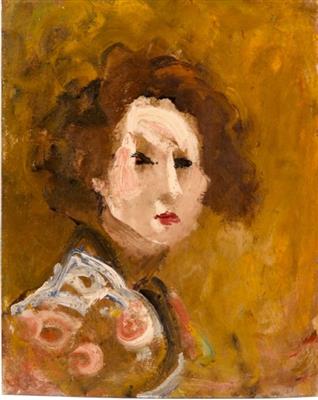
Orphaned at fifteen and raised in Lyon by an older brother, Émilie Charmy had little in her background to predict a career as one of the boldest colourists working in Paris in the early twentieth century. She trained quietly in Lyon under Jacques Martin, absorbed the lessons of local Impressionists, and arrived at the Salon d'Automne in 1905[1] already working in the idiom of Fauvism[1]. Matisse noticed her.
Biography
She was born in Saint-Étienne in 1878[1] as Émilie Espérance Barret and adopted the surname Charmy during her studies. Her 1912[1] solo show at Galerie Clovis Sagot brought together more than forty oils and twenty-five watercolours and secured her reputation in Paris. The following year, four of her works appeared at the 1913 Armory Show in New York. Gallerist Berthe Weill championed her from 1905 onward; Colette wrote catalogue introductions for her exhibitions in the 1920s; she received the Legion of Honour in 1926 and was elevated to Officer in 1938.
Her subjects were nudes, portraits, still lifes, and coastal landscapes, all handled with thick brushwork and a frankness about the female body that made some contemporaries uncomfortable. The critic Roland Dorgelès wrote that she 'sees like a woman and paints like a man; from the one she takes grace and from the other strength.' Whether that was meant as a compliment remains ambiguous.
Charmy refused restrictive dealer contracts and remained financially independent throughout her career. She continued painting into her nineties and died in Paris in 1974[1], aged ninety-six.
Timeline
- 1878Born Émilie Espérance Barret in Saint-Étienne.
- 1893Orphaned at fifteen and raised in Lyon by an older brother.
- 1905Exhibited at the Salon d'Automne, already working in the style of Fauvism.
- 1912Held a solo show at Galerie Clovis Sagot, featuring over forty oils and twenty-five watercolours; this secured her reputation in Paris.
- 1913Four of her works appeared at the Armory Show in New York.
- 1926Received the Legion of Honour.
- 1938Elevated to Officer of the Legion of Honour.
- 1974Died in Paris, aged ninety-six.
Notable Works
Tap to view larger.
Next stop
Fauvism →
Explore the artists and ideas of Fauvism.
Related Artists


Frequently Asked Questions
What is Émilie Charmy known for?
Émilie Charmy is known for her bold use of colour and her frank depictions of the female body.What is Émilie Charmy's most famous work?
It is difficult to identify Émilie Charmy's single most famous work, as different sources may emphasise various pieces. However, a review of available titles suggests several recurring themes and subjects in her oeuvre. Charmy produced a number of self-portraits, including one identified as Self-Portrait with a White Hat. She also created portraits of other individuals, such as Portrait of a Woman. Still-life compositions were another area of focus, with titles like Sugar Bowl appearing more than once. Charmy also explored domestic scenes, as seen in After Bathing and Girl looking into a mirror. These works, along with her portraits, offer insight into her artistic interests and the subjects she chose to represent.What should I know about Émilie Charmy's prints?
Émilie Charmy's prints, like all photographic prints, exist in a potentially confusing state between original artwork and reproduction. The market distinguishes between different types of photographic print based on when they were made and who was involved in their production. A "vintage print" is made around the time the negative was taken. A "period print" is made within approximately ten to fifteen years of the original shot. Prints made later are either "old" or "modern". An "original print" is one made by the artist or under their direct supervision. A "facsimile" is a print made by re-photographing a print, or using the original negative, with print base and processing as close as possible to the original. The value of a print is affected by who printed it and when. For example, a photograph by Imogen Cunningham, printed by herself, was worth more than one printed by a laboratory but signed, and both were worth more than one printed after her death. The market generally assumes originality when the artist signs the print, acknowledging its conformity to their idea.What style or movement did Émilie Charmy belong to?
Émilie Charmy is associated with Fauvism[1], an early 20th-century avant-garde movement that briefly caused a sensation in Paris, starting around 1905[1]. The Fauves (French[1] for "wild beasts") included artists such as Henri Matisse, André Derain, and Kees van Dongen. They broke with academic tradition by using strong, often unnatural colours and simplified forms. The name "Fauves" originated at the 1905 Salon d’Automne in response to the artists' energetic, loose brushstrokes and bold use of colour. The Fauves aimed to liberate colour, using it to express feelings rather than to describe objects realistically. While the Fauvist movement itself was short-lived, many of its members explored colour in new ways. Matisse, for example, continued to use bright colours and collage elements in his later work.What techniques or materials did Émilie Charmy use?
Émilie Charmy worked primarily in painting, and her preferred medium was oil on canvas. She often depicted domestic interiors, portraits, and nudes. Little information about her specific techniques is available in the provided texts. However, the texts do discuss the general techniques of earthen architecture, including the use of adobe, bauge, and pise. Adobe involves shaping a mixture of earth, plant stabilisers, and water in a rectangular mould. Bauge is a technique of directly and manually shaping the earth, often using a composite material rich in domestic remains. Pise involves using a mixture of sands, silts, and clays, often with stones to create horizontal lines. These techniques are not directly related to Charmy's painting practice, but they illustrate the diverse ways in which earth and other materials have been used in construction and art.What was Émilie Charmy known for?
Émilie Charmy is associated with Fauvism[1], an early 20th-century artistic movement that emerged in France. Fauvism, which included artists such as Henri Matisse, André Derain, and Maurice de Vlaminck, made its controversial debut in 1905[1] at the Salon d'Automne in Paris. The Fauves (meaning "wild beasts") departed from traditional artistic conventions. They used colour as their primary means of expression, often applying it in bold, non-naturalistic ways. This approach was a departure from the École des Beaux-Arts' more rigid techniques. The Fauves sought a new chromatic language, using colour outside its habitual context. They favoured flat tints and saturated colours in their paintings. The movement, though short-lived, had a significant impact on the development of modern art. Some scholars suggest that the Fauvist style remained influential in European painting for many years.When did Émilie Charmy live and work?
Émilie Charmy (1878[1]-1974[1]) was a French[1] artist who gained recognition for her paintings during the early 20th century. Born in Saint-Étienne, France, she spent much of her career in Paris. Charmy's artistic output developed primarily between the late 1900s and the 1940s. She exhibited at the Salon d'Automne and the Salon des Indépendants, important venues for modern artists in Paris. Her work often depicted intimate scenes of women, domestic interiors, and self-portraits. These paintings capture the atmosphere of her time. While Charmy's popularity waned in later years, there has been a renewed interest in her work. Recent exhibitions have brought her art to new audiences. Her paintings offer a window into the lives and experiences of women during a period of significant social and artistic change. She provides a unique perspective on modern life in France.Where can I see Émilie Charmy's work?
Émilie Charmy's paintings can be viewed in various collections; however, specific locations holding her work are not widely publicised. To find her paintings, it is useful to consult museum catalogues and databases of public collections. These resources often provide information on the artworks held by different institutions. Additionally, keep an eye on exhibition listings from major museums and galleries. Retrospectives and thematic exhibitions occasionally feature her paintings, offering opportunities to view her work in person. Auction houses such as Sotheby's and Christie's sometimes include her pieces in their sales, and their online catalogues provide images and provenance details. Art market websites and gallery listings may also indicate where her works are currently on display or available for purchase. Visiting smaller, regional museums, particularly in France, could also yield discoveries, as these institutions sometimes hold works by artists with regional connections.Who did Émilie Charmy influence?
It is difficult to say exactly who Émilie Charmy influenced, as influence is not always a direct or easily traceable phenomenon. Art historical study suggests influence is not simply a matter of similarity; it includes the study of quotations, traces, and manipulations. Harold Bloom, in *The Anxiety of Influence*, suggests artists with powerful imaginations respond to the art of their forerunners through a kind of appropriation. Dutch artists such as Dou, Mieris and Metsu created tender, intimate scenes of bourgeois family life that were imitated by later artists. Painters such as Nicolas-Bernard Lépicié, Louis Léopold Boilly, Martin Drolling, Margueritte Gérard, and even Jacques-Louis David were aware of this tradition. According to one critic, every art lover wanted to decorate his study with "charmants et gracieux interieurs hollandais".Who influenced Émilie Charmy?
Émilie Charmy's artistic development occurred within a milieu of diverse influences. While specific individuals who directly shaped her style are not definitively documented in the provided texts, the passages allude to a broad spectrum of artistic and intellectual figures who impacted the artistic movements of her time. Figures such as Paul Gauguin, Gustave Moreau, and Peter Paul Rubens represent a connection to earlier art traditions. Writers such as Edgar Allan Poe, Arthur Rimbaud, Marcel Proust, and Thomas de Quincey were very important to the surrealist movement. Composers such as Erik Satie, Arnold Schoenberg and Alexander Scriabine were also influential to artists of the time. These names suggest that Charmy's artistic environment was one in which many different ideas, from Symbolism to early cinema, were circulating.Who was Émilie Charmy?
Émilie Charmy was a French[1] painter who trained in Lyon and worked in Paris in the early twentieth century.Why are Émilie Charmy's works important today?
Émilie Charmy's work is important for its contribution to early twentieth-century modernism, and for the way it intersects with discussions of gender and artistic identity. Charmy, working in France, gained recognition during a period when women artists faced significant obstacles. Her career offers insights into the challenges and opportunities available to women pursuing artistic careers at that time. Unlike some of her contemporaries, she was not born into an artistic family, so had to find her own path into the community. Critical reception of women artists often focused on their perceived femininity, sometimes overshadowing their artistic achievements. Examining Charmy's career allows us to analyse how gendered expectations shaped the reception and interpretation of her work. Her choices regarding artistic practices, training, and exhibition venues reflect the limitations placed on women. By studying Charmy, we can better understand the dynamics between societal norms and artistic expression during a transformative period in art history.
Sources
Editorial draws on the following primary and tertiary references for Émilie Charmy.
- [1] wikipedia Wikipedia: Émilie Charmy Used for: biography, birth dates, death dates, identifiers, movement attribution, nationality.
- [2] book Anka Muhlstein, Camille Pissarro Used for: biography.
- [3] book Jennifer D. Milam, Historical Dictionary of Rococo Art Used for: biography.
- [4] book Masterpieces of western art : a history of art in 900 individual studies from the Gothic to the present day Used for: biography.
- [5] book Unknown, Reclaiming female agency : feminist art history after postmodernism Used for: biography.
- [6] book Anne-Marie O'Connor, The Lady in Gold Used for: biography.
Editorial overseen by Solis Prints. Sources verified 2026-09-22. Click a source for details, or hover over [N] in the page above to preview.
Editorial standardsMethodologyCorrectionsAI disclosureAbout the editorial team