



Ende
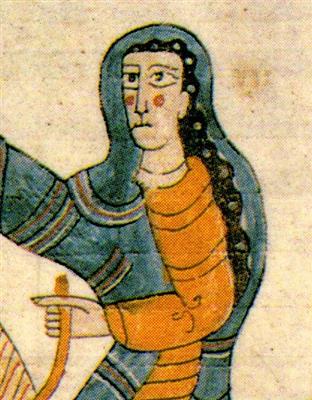
Ende is known to us by four words. In the colophon of the Gerona Beatus, completed on 6 July 975[1], she signed herself "Ende pintrix et Dei aiutrix": Ende, painter and helper of God. No other documentation survives. No birth date, no death date, no patron letters, no separate commissions. Just the inscription, and the manuscript.
Biography
The Gerona Beatus is a richly illustrated copy of the *Commentary on the Apocalypse* by the eighth-century monk Beatus of Liébana, a text that generated dozens of illuminated copies in early medieval Iberia. Ende worked alongside the monk Emeterius and the scribe Senior to produce the Gerona version, now held at the Girona Cathedral Treasury. Art historians have debated the precise extent of her contribution, but stylistic analysis suggests she was responsible for a significant portion of the illustrations.
The style is Mozarabic: intense and flat, built on saturated yellows, dark blues, and oranges, with figures arranged in stratified horizontal bands that distinguish heaven from the human world from the earthly ground. The Apocalypse subjects, including the beasts, the horsemen, and the fall of Babylon, are rendered with an urgency that reads clearly more than a thousand years later.
That a woman could sign professional work in tenth-century Christian Spain is itself remarkable. The "pintrix" designation was a title, not an afterthought. Whatever her exact role within the monastery, Ende understood herself as a practitioner, and she wanted the record to say so.
Notable Works
Tap to view larger.
Next stop
Browse the movements →
Every movement in the collection, from the Renaissance to Pop art.
Frequently Asked Questions
What is Ende known for?
Ende is known for signing the Gerona Beatus, completed on 6 July 975[1]. She identified herself as "Ende pintrix et Dei aiutrix" (Ende, painter and helper of God) in the manuscript's colophon.What is Ende's most famous work?
The illuminated manuscript *Liber Scivias* (Know the Ways) is generally considered Hildegard of Bingen's most famous work. However, the artwork within the manuscript is not by Hildegard herself. The artist was a nun named Ende. Ende is the earliest known named female artist in Europe. She collaborated with a monk named Emeterius on the *Beatus Apocalypse* of 975[1], also called the *Beatus of Girona*. This manuscript contains a commentary on the Book of Revelation by the Spanish monk Beatus of Liébana. Ende and Emeterius signed the manuscript, declaring themselves "painters". Ende may have been the principal artist on this project. Her work displays Mozarabic influences, seen in the flat patterns and bright colours. The *Beatus Apocalypse* is celebrated for its expressive figures and imaginative interpretations of the biblical text. The manuscript is now held in the Archivo Capitular de la Catedral de Girona, Spain. While the *Beatus Apocalypse* is not as widely recognised as the *Liber Scivias*, it is a significant example of early medieval Spanish art and a demonstration of female artistic skill during the period.What should I know about Ende's prints?
When considering Ende's prints, bear in mind a few aspects of fine-art printmaking. The practice of printmaking dates back to ancient Egypt and China, with wood blocks used to print patterns on textiles long before paper. As paper became readily available in Europe at the end of the fourteenth century, printmaking began to flourish. An 'original' print is an image conceived by the artist as a print and executed solely as a print, usually in a numbered edition, and signed. Each print in the edition is an original, printed from a plate, stone, screen, block or other matrix created for that purpose. Each print is inked and pulled individually; it is a multi-original medium. The number of prints in the edition is decided by the artist. The numbering provides an accounting for the number of prints in the edition. The artist's signature testifies to the authenticity of a print and their approval of a particular proof. Artists control quality by limiting the size of editions and numbering them, influencing the price and preventing prints from being pulled after the plate or stone has worn down.What style or movement did Ende belong to?
Ende was a female artist and manuscript illuminator active in tenth-century Spain. She is associated with the Mozarabic style, also known as the art of the Repoblación. This artistic style emerged and developed in Christian Spain during the centuries of Muslim rule, drawing on Visigothic, Islamic, and Early Christian traditions. Works in the Mozarabic style often display a combination of influences. They typically incorporate bright colours, flattened perspective, and stylised figures. Geometric patterns, interlace designs, and vegetal motifs are also common. The style flourished in various media, including manuscript illumination, metalwork, and architecture. Ende is one of the earliest named female artists from the medieval period in Europe. She is known for her work on the *Beatus* manuscript, also known as the *Gerona Beatus*, which she co-created with the monk Emeterius. The manuscript contains a commentary on the Book of Revelation by the eighth-century Spanish monk Beatus of Liébana. The *Gerona Beatus* is an important example of Mozarabic illumination, displaying the characteristics of the style.What techniques or materials did Ende use?
Ende was a tenth-century artist, a nun working in a scriptorium. Scriptoria were monastic workshops dedicated to the production of books; these centres of book production relied on the labour of trained scribes and artists. Ende is known as the earliest named female artist in Europe. She worked with En, a priest and painter, on the *Beatus* manuscript, also known as the *Gerona Beatus*, in 975[1]. The *Beatus* is a commentary on the Apocalypse written by the Spanish monk Beatus of Liébana in the eighth century. The *Gerona Beatus* is a large illuminated manuscript. Ende and En used parchment, a writing material made from animal skin. They would have employed quills and ink to create the text, while mineral and organic pigments would have been mixed with binders like egg tempera to create the illuminations. Gold leaf was also used to add luxurious details to the illustrations. The style is characterised by bright colours, strong outlines, and a combination of Mozarabic and Christian influences.What was Ende known for?
Ende was a female artist and Benedictine nun active in tenth-century Spain. She is known as one of the earliest named female manuscript painters in Europe. Ende is identified in the colophon of the *Beatus Apocalypse* manuscript (Gerona, ca. 975[1]), which she worked on with the monk Emeterius. The manuscript contains a series of illustrations depicting the Book of Revelation. The colophon states, "Ende pintrix et Dei adiutrix," meaning "Ende, painter and helper of God". The *Beatus Apocalypse* is an example of Mozarabic art, a style that developed in the Iberian Peninsula under Arab rule. The illustrations in the manuscript show a blend of Christian and Islamic artistic influences. Ende's role in the creation of this manuscript is significant, as it provides evidence of female artistic activity during this period.When did Ende live and work?
Ende was a Spanish artist; her dates are not precisely known. She worked as an illuminator, probably a nun, active in the mid-10th century. Her work is associated with the scriptorium of San Salvador de Tábara, a monastery in León, Spain. Ende is one of the earliest female manuscript painters known by name. She is known for her contribution to the Tábara Beatus, also called the Beatus of Tábara (c. 970), now held in the Archivo Histórico Nacional in Madrid. The Beatus is a commentary on the Apocalypse. Ende's contribution is significant because she is believed to be the only woman who is identifiable among the artists who produced the manuscript. Her presence suggests the participation of women in artistic and intellectual activities within monastic communities of the period.Where can I see Ende's work?
Ende was a female artist, a Benedictine nun, who illuminated manuscripts. She worked in the late tenth century, in what is now northern Spain. Unfortunately, little is known for certain about Ende's life; even her real name is not known. She is one of the earliest female manuscript painters from the medieval period to whom specific works can be attributed. Ende is known for her work on the *Beatus* manuscript (also known as the *Gerona Beatus*) of 975[1], now held at the Cathedral of Gerona, in Catalonia. This manuscript contains the *Commentary on the Apocalypse* by the Spanish monk Beatus of Liébana. The manuscript includes a colophon, a statement at the end of the book, which names her as a co-author, along with the monk Emeterius. The colophon states: "Ende pintrix et Dei adiutrix", which translates to "Ende, painter and helper of God".Where was Ende from?
Ende's exact place of origin is not definitively known. Some scholars suggest she may have originated from the north-eastern region of Spain. Others propose she was from areas in the north. Ende is known for her work on a manuscript, completed in 975[1], which is now in the Pierpont Morgan Library, New York. The manuscript features a commentary on the Apocalypse by Beatus of Liébana. The commentary itself was a popular work in mediaeval Spain. Several illuminated copies were made. The manuscript explicitly names her as a painter, a very rare instance of a female artist being identified in this period. The manuscript also names a monk, Emeterius, who may have been her collaborator. The codex is an important example of Mozarabic art, a style that blended Christian and Islamic artistic traditions in mediaeval Spain.Who did Ende influence?
August Endell, a designer and theorist, influenced artists with his abstract theories. In Munich, from 1894 to 1913, Theodor Lipps lectured on psychology; his theories of perception influenced Endell, Wilhelm Obrist, and others within Kandinsky's circle. Endell's cousin's letters reveal Endell's debt to Lipps. By 1897, Endell's ideas on abstract art were more radical than Obrist's. Endell thought that 'pure form-art' would apply psychological theories of perception to design. Endell prophesied a 'totally new art' that would excite the human spirit like music. He elaborated, naming the new art 'Formkunst', stating that monuments would represent fantasy forms. Endell's words were inspired by Obrist's abstract plaster models for monuments, such as Arch Pillar and Motion Study (circa 1895). Kandinsky encountered the idea of art that would 'move the human spirit' through fundamental elements (line, colour, form). This occurred at a formative time in his life. Even before leaving Russia, he recognised the power of colour after discovering a painting of a haystack by Monet.Who influenced Ende?
Ende, a Benedictine nun who worked in tenth-century Spain, is known for her contributions to illuminated manuscripts. The primary example is her work in the *Beatus* of Girona (Girona, Cathedral Treasury, Ms. 7 [11], also known as the *Beatus Apocalypse*), created circa 975[1]. Analysis of Ende's style suggests several possible influences. As a Mozarabic artist, she would have been familiar with Islamic artistic traditions present in Spain at the time. The *Beatus* manuscripts, in general, show influence from earlier Christian and Roman art. Some scholars suggest that the linear, decorative style of North African art may have played a role in the development of Mozarabic illumination. Specific influences on Ende are difficult to determine, given the limited amount of surviving work directly attributed to her. The artistic conventions of the monasteries in northern Spain, combined with broader stylistic trends in Mozarabic art, likely shaped her artistic output. The patron of the *Beatus* would also have had input.Who was Ende?
Ende was a female artist and illuminator. She is known for her work on illuminated manuscripts in 10th-century Spain. Associated with the scriptorium of the monastery of San Salvador de Tábara, in the province of León, Ende is one of the earliest female artists from mediaeval Europe whose name is known. Her contribution to art history lies primarily in her participation in the creation of the Tábara Beatus, also known as the Beatus of Tábara, an illuminated copy of the Commentary on the Apocalypse by Beatus of Liébana. The Tábara Beatus is celebrated for its Mozarabic style and its detailed illustrations of the Book of Revelation. Ende's work, along with that of the monk Emeterius, contributed to the manuscript's artistic and historical importance. The manuscript includes a colophon, or inscription, that names Ende as a painter; this is unusual for the period.
Sources
Editorial draws on the following primary and tertiary references for Ende.
- [1] wikipedia Wikipedia: Ende Used for: biography, birth dates, death dates, identifiers, movement attribution, nationality.
- [2] book guggenheim-refigur00kren Used for: biography.
- [3] book Janson, H. W. (Horst Woldemar), 1913-1982, History of art Used for: stylistic analysis.
- [4] book Masterpieces of western art : a history of art in 900 individual studies from the Gothic to the present day Used for: biography.
- [5] book Rolf Toman, Achim Bednorz, Romanesque _ architecture, sculpture, painting Used for: biography.
Editorial overseen by Solis Prints. Sources verified 2026-08-03. Click a source for details, or hover over [N] in the page above to preview.
Editorial standardsMethodologyCorrectionsAI disclosureAbout the editorial team