



Eric Gill
Gill Sans, the typeface used by the BBC, Penguin Books, and British Railways, was designed by a man who described himself not as a sculptor but as a carver. Arthur Eric Rowton Gill was born in Brighton in 1882[1] and trained at the Central School of Arts and Crafts under Edward Johnston, whose principles of formal lettering shaped everything Gill went on to make in stone, wood, and metal type.
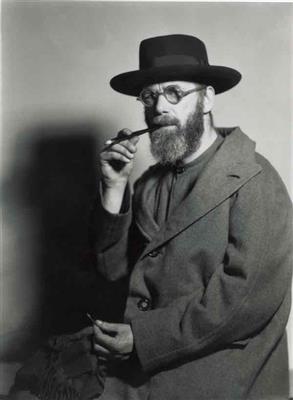
Biography
His first exhibition of stone carvings opened at the Chenil Gallery in January 1911[1]. Roger Fry, champion of Post-Impressionism, used Gill's work to advance his own arguments about direct carving and the expressive potential of simplified form. Gill's distinction between carving and sculpture placed him in continuity with craft traditions rather than with the fine-art hierarchy his contemporaries occupied.
His ecclesiastical commissions include the Stations of the Cross at Westminster Cathedral (1914[1]-18) and architectural reliefs on Broadcasting House, London. He converted to Roman Catholicism in 1913 and founded the Guild of St Joseph and St Dominic at Ditchling, a craft community structured on medieval workshop principles. The typefaces he designed for the Monotype Corporation, Perpetua (1925) and Gill Sans (1927), are still in active use globally.
The 1989 biography by Fiona MacCarthy revealed that Gill had sexually abused his daughters. The disclosures prompted lasting debate about the public display of his work, a debate that has not resolved itself.
Timeline
- 1882Arthur Eric Rowton Gill was born in Brighton.
- 1911His first exhibition of stone carvings opened at the Chenil Gallery.
- 1913Gill converted to Roman Catholicism.
- 1914He began work on the Stations of the Cross at Westminster Cathedral; the commission lasted until 1918.
- 1925Gill designed the typeface Perpetua for the Monotype Corporation.
- 1927Gill designed the typeface Gill Sans for the Monotype Corporation.
- 1940Gill died at 58. His biography, published in 1989, revealed he had sexually abused his daughters.
Notable Works
Tap to view larger.
Next stop
Browse the movements →
Every movement in the collection, from the Renaissance to Pop art.
Related Artists


.jpg!Portrait.jpg)


Frequently Asked Questions
What is Eric Gill known for?
Eric Gill is known for designing the Gill Sans typeface, used by the BBC, Penguin Books, and British Railways. He is also known for his stone carvings and ecclesiastical commissions, such as the Stations of the Cross at Westminster Cathedral and architectural reliefs on Broadcasting House, London.What is Eric Gill's most famous work?
Eric Gill was a letter-cutter, sculptor, and printmaker associated with the Arts and Crafts movement. Although he worked in various media, he is perhaps best known for his stone carving. After studying masonry and lettering around 1900[1], Gill carved his first nude figure in stone in 1910. His aesthetic was rooted in the Arts and Crafts tradition, defining the art of the craftsman as "simply the well-doing of what needs doing". Gill believed the best sculpture resulted from cooperation between artist and material. He described discovering form within stone as a revelatory experience. From 1914 onward, Gill produced many religious works. These included the Stations of the Cross for Westminster Cathedral. As his religious beliefs strengthened, he distanced himself from modernism, which he felt lacked a moral dimension. Gill criticised modernists for holding "a mirror up to the nature of the artist" rather than to nature itself.What should I know about Eric Gill's prints?
Eric Gill was known for his skill with the black line in engraving, adapting his prints to their type surroundings. Gill's prints, like other woodcuts, are made by producing identical impressions from a block or blocks. The artist decides how many prints to make for a limited edition. The physical characteristics of the wood itself do not limit the number of prints, as some blocks can produce hundreds of thousands of impressions. Each print in an edition is marked, usually in pencil, along the bottom margin. The print number and edition number appear on the bottom left; the title in the centre; and the signature on the right. Other notations can include 'A/P' for artist's proof, 'T/P' for early proofs, 'V2' for a variant edition using different colours, or 'Hors de Commerce' for a print not for sale. The proofing stage is a critical part of printmaking, allowing the artist to test the feel of the print and make important artistic decisions.What style or movement did Eric Gill belong to?
Eric Gill's career saw him associated with both the Arts and Crafts movement and early Modernism, though he ultimately distanced himself from the latter. Early in his career, Gill was closely aligned with Arts and Crafts principles. After moving to London in 1900[1], he studied masonry and lettering while also reading Ruskin and Morris. By 1904, he was a socialist and professional letter-cutter. His aesthetic, like that of W. R. Lethaby, prioritised the "well-doing of what needs doing" over self-expression. Gill believed the decline of craft was linked to a decline in religious belief, advocating for a spiritual revival and a socialism founded on the dignity of labour. Around 1912, Gill's work was considered part of the Modernist sphere; he exhibited in the Second Post-Impressionist Show. However, as his religious convictions deepened after 1913, he grew critical of Modernism, disliking its perceived lack of moral or didactic purpose. He felt modern artists were too focused on subjective feeling rather than objective representation. This divergence led to a separation between Gill and the Modernist avant-garde. In 1921 Gill established the Guild of St Joseph & St Dominic, a Catholic community of sculptors, stone carvers, and letter cutters.What techniques or materials did Eric Gill use?
Eric Gill was a letter cutter, engraver, and sculptor. He is particularly known for his skill with the black line in engraving, and his ability to adapt his engravings to their type surroundings. Gill designed initial letters and ornaments, and his familiarity with hand printing allowed his work to integrate with type. When creating lettering for woodblock prints, Gill would lay out the lettering on tracing paper, then flip it to reverse the layout before cutting. He would leave the drafted but uncut work for many days, refining the design. The reversed image could then be transferred to the block. The physical work of cutting letters involved using a sharp knife to outline the letters, with small curved gouges used for inner edges.What was Eric Gill known for?
Eric Gill (1882[1]-1940[1]) was an English artist, letter-cutter, stone mason, and typographer. He is known for his sculpture, typeface designs, and religious works. Gill began his career as an architect's assistant. He studied masonry at the Westminster Technical Institute and lettering at the Central School. By 1904[1], he was a professional letter-cutter, and in 1910, he carved his first nude figure in stone. His early work was supported by Bloomsbury and the Rothenstein family; he exhibited at the Chenil Gallery (1911), in the Second Post-Impressionist Show (1912), and at the Goupil Gallery (1914). After 1913, Gill combined his Arts and Crafts beliefs with Roman Catholicism. This influenced his art, as he believed it should unite man with God. From 1914 onwards, he produced many religious works, such as the Stations of the Cross for Westminster Cathedral. Although associated with early Modernism, his increasing focus on Christian art led to a separation from the avant-garde. Gill's views on art were rooted in the Arts and Crafts movement, emphasising the importance of labour and skill.When did Eric Gill live and work?
Eric Gill was born in Brighton on 22 February 1882[1]. He died in Uxbridge, England, on 17 November 1940[1]. Gill was a sculptor, typeface designer, stonecutter, and printmaker. He is associated with several locations and movements. Gill worked in London early in his career, and later moved to Ditchling, Sussex, where he founded an artistic community. In 1924[1], he moved to Wales, establishing a workshop at Capel-y-ffin. From 1928 to 1930, he lived and worked in Buckinghamshire, before returning to Pigotts, near High Wycombe. Gill's work encompasses a range of styles, from religious sculpture to lettering and typography. He designed several well-known typefaces, including Gill Sans and Perpetua, which are still in use today.Where can I see Eric Gill's work?
Examples of Eric Gill's work can be viewed at several locations. All Saints Church, Brockhampton, near Ross-on-Wye, Herefordshire, features Arts and Crafts furnishings. Belgrave Hall Museum, Leicester, has an Arts and Crafts dining room. Cheltenham Art Gallery & Museum holds an accessible collection related to the Arts and Crafts Movement in England. Court Barn Museum, Chipping Campden, Gloucestershire, has craft and design from the Arts and Crafts Movement onward. The Victoria and Albert Museum, London, displays Arts and Crafts work in its British galleries. Other locations include the William Morris Gallery, London; Manchester Art Gallery; and the National Museums of Scotland, Edinburgh. Kelmscott Manor, near Lechlade, Gloucestershire, was the country home of William Morris. There are cottages by Philip Webb and Ernest Gimson in the village; Gimson also designed the Village Hall.Where was Eric Gill from?
Eric Gill was English. In 1900[1], he relocated to London to begin his professional life as an architect's assistant. Soon after his arrival, he studied masonry at the Westminster Technical Institute. He also took lettering classes at the Central School under Edward Johnson. Gill became a professional letter-cutter by 1904. Around 1910, he carved his first nude figure in stone. During this period, he received patronage from Bloomsbury and the Rothenstein family. He exhibited at the Chenil Gallery (1911), in the Second Post-Impressionist Show (1912), and at the Goupil Gallery (1914). While some contemporaries described themselves as sculptors, Gill identified as a carver. Critics regarded him as a fine artist, and for a short time, he was viewed as a Modernist sculptor.Who did Eric Gill influence?
Eric Gill was a letter-cutter, stone mason, and typographer who worked in the early twentieth century. Gill's work was admired by members of the Bloomsbury Group, including Roger Fry, who connected Gill's emphasis on the surface of the stone with Bloomsbury's interest in form. Fry praised Gill's lettering in 1906[1], and in 1911, he commended Gill's 'impassioned expression'. Gill's attitudes were close to those of William Morris and W. R. Lethaby. Like Lethaby, Gill believed the artist's self-expression was of secondary importance to the execution of the work. Gill's aesthetic showed no traces of Post-Impressionism. Gill's religious belief that art should be a vehicle for religious expression grew, as did his dislike of Modernism. His work influenced sculptors such as Henry Moore.Who influenced Eric Gill?
Eric Gill's artistic development involved several influences. Early on, he was impacted by the Arts and Crafts movement, embracing its principles of craftsmanship and the dignity of labour. He studied masonry and lettering, and he read works by Ruskin and Morris. Gill's association with the Arts and Crafts ethos remained, even after his conversion to Roman Catholicism after 1913[1]. Critics like Roger Fry, associated with painting, also influenced Gill's early reception as a modern sculptor. Fry praised Gill's lettering and the emotional intensity of his sculptures, connecting his work to Bloomsbury's emphasis on form. Gill, however, grew critical of Modernism as his religious convictions deepened. Gill himself cited W. R. Lethaby's definition of the craftsman's art as "simply 'the well-doing of what needs doing.'" He shared the Arts and Crafts view that art should express joy in labour and unite man with God. His emphasis on "truth to materials" and the revelatory experience of carving from stone further shaped his artistic approach.Who was Eric Gill?
Eric Gill (1882[1]-1940[1]) was a British sculptor, typeface designer, and printmaker. Born in Brighton, he trained at the Central School of Arts and Crafts in London, where he studied lettering. Gill's early career focused on calligraphy and stone carving. He gained recognition for his lettering work, which led to commissions for war memorials and architectural inscriptions. A Roman Catholic convert, his religious beliefs influenced much of his artistic output. He created sculptures for Westminster Cathedral and other churches. Gill is perhaps best known for his typeface designs. He designed Gill Sans for Monotype in the late 1920s; it became one of the most popular sans-serif typefaces. Other notable typefaces include Perpetua and Joanna. His artistic practice extended to wood engraving and illustration. He produced illustrations for publications such as "The Four Gospels" and "The Canterbury Tales". Gill's work often combined religious, erotic, and social themes. His diaries, published posthumously, revealed controversial aspects of his personal life; these have affected the reception of his art.
Sources
Editorial draws on the following primary and tertiary references for Eric Gill.
- [1] wikipedia Wikipedia: Eric Gill Used for: biography, birth dates, death dates, identifiers, movement attribution, nationality.
- [2] book Etienne Gilson;, Painting and Reality Used for: biography.
- [3] book Mary Greensted, The Arts and Crafts Movement in Britain (Shire History) Used for: stylistic analysis.
- [4] book Tillyard, S. K, The impact of modernism, 1900-1920 : early modernism and the arts and crafts movement in Edwardian England Used for: biography.
Editorial overseen by Solis Prints. Sources verified 2026-09-27. Click a source for details, or hover over [N] in the page above to preview.
Editorial standardsMethodologyCorrectionsAI disclosureAbout the editorial team