



Erich Heckel
When four architecture students at the Technische Hochschule in Dresden decided in 1905[1] to build a new kind of art, Erich Heckel was the one who managed the paperwork. He became Die Brücke's business manager, finding the group exhibitions, recruiting members, and helping to forge the collective identity that would define German Expressionism for the next two decades.
Biography
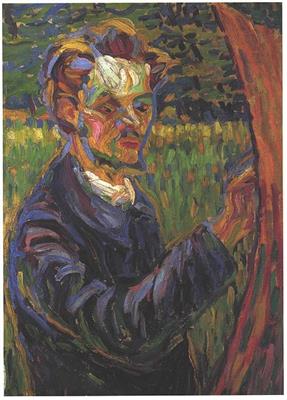
Born in Döbeln in 1883, Heckel made his early work from nudes, cabaret scenes, and landscapes, initially under the influence of Van Gogh, whose paintings had been shown at Galerie Arnold in Dresden just before the group formed. His brushwork retained traces of Jugendstil's sinuous line while pushing toward the harsher, angular colour contrasts that became the hallmark of Expressionist painting. As he stated directly: "The things and objects do not speak as much through their form or drawing as through the expression of colour."
During World War One, Heckel served with the Red Cross in Belgium, where he encountered James Ensor and Max Beckmann. His post-war work grew more spiritually isolated in tone, reflecting his engagement with Nietzsche and Dostoyevsky. He was also a prolific printmaker, producing over 1,000 prints in total, three-quarters of them between 1903[1] and 1923, most self-printed in small editions.
The Nazi regime confiscated 729 of his works as Degenerate Art and prohibited him from exhibiting. He fled to Switzerland in 1944[1]. After the war he taught at the Karlsruhe Academy and continued to paint until his death in Radolfzell in 1970[1].
Timeline
- 1905Became the business manager for Die Brücke, a group of architecture students in Dresden.
- 1905Began making early works of nudes, cabaret scenes, and landscapes, influenced by Van Gogh.
- 1914Served with the Red Cross in Belgium during World War One, encountering James Ensor and Max Beckmann.
- 1923Produced over 1,000 prints, with three-quarters made between 1903 and this year.
- 1944Fled to Switzerland after the Nazi regime confiscated 729 of his works and prohibited him from exhibiting.
- 1970Died in Radolfzell.
Notable Works
Tap to view larger.
Next stop
Browse the movements →
Every movement in the collection, from the Renaissance to Pop art.
Frequently Asked Questions
What is Erich Heckel known for?
Erich Heckel is known for being a painter and printmaker. He was also the business manager for Die Brücke, helping to find group exhibitions and recruit members. He is also known as a superb lithographer.What is Erich Heckel's most famous work?
Erich Heckel is best known as a printmaker and painter associated with German Expressionism. He was a member of the group Die Brücke (The Bridge) from its formation in Dresden in 1905[1]. Although Heckel produced work in several media, there is no single piece that overshadows all others. However, several paintings and prints are particularly well known. These include the painting "Two Nudes" (1909), now in the Brücke Museum, Berlin. Another is "Standing Child" (1910), in the collection of the Detroit Institute of Arts. Among his prints, the woodcut "Fränzi Reclining" (1910) is a strong example of the Die Brücke aesthetic, with bold lines and a simplified form. Heckel's work from the years before the First World War shows the influence of Edvard Munch and of the German Gothic style. His paintings and prints often feature figures in psychologically charged situations. After the war, Heckel's style became somewhat less angular and more naturalistic, but he remained a significant figure in German art.What should I know about Erich Heckel's prints?
Erich Heckel (1883-1970[1]) was a German painter and printmaker. He was a member of the Die Brücke group of expressionist artists, and he served as the group's business manager. Heckel made over 1,000 prints in his career, with most of them created between 1903[1] and 1923. He often printed them himself in small editions. After 1910, he occasionally worked with publishers based in Berlin, such as Paul Cassirer, Fritz Gurlitt, and J. B. Neumann. In the 1950s, he reprinted some of his early woodcuts. Heckel radically simplified compositions through printmaking. His early prints include nudes, cabaret scenes, and the natural world. During World War I, Heckel was stationed in Belgium with the Red Cross; there, he met James Ensor and Max Beckmann. The war and postwar years inspired many portraits, self-portraits, and natural scenes that embody spiritual isolation and melancholy. Examples of his prints include the 1907 lithograph *Windmill*, the 1908 etching *Boat in the Wind*, the 1909 woodcut *Italian Countryside*, and the 1914 etching *Antwerp*.What style or movement did Erich Heckel belong to?
Erich Heckel was a German Expressionist painter and printmaker. He belonged to the group Die Brücke (The Bridge), formed in Dresden in 1905[1]. Other members included Karl Schmidt-Rottluff, Ernst Ludwig Kirchner, and Fritz Bleyl. Die Brücke sought to create a new artistic style, one that would connect past traditions with modern experiences. Heckel's style is characterised by bold colours, distorted forms, and emotional intensity. The group was inspired by artists such as Edvard Munch, Vincent van Gogh, and the German Expressionist Emil Nolde. They were also interested in non-Western art, such as African sculpture, which influenced their approach to form and subject matter. Die Brücke relocated to Berlin in 1911, seeking a more cosmopolitan environment. Heckel's work from this period reflects the urban atmosphere of Berlin, with subjects including cityscapes and portraits. The group dissolved in 1913, but Heckel continued to work as an artist, and he later taught at the Akademie der Künste in Berlin.What techniques or materials did Erich Heckel use?
Erich Heckel, born in Döbeln in 1883, employed a range of techniques and materials throughout his career. He is known as a painter and printmaker. Early works often featured nudes, cabaret scenes, and open-air subjects. Heckel radically simplified and flattened compositions through printmaking. He produced over one thousand prints, with most self-printed in small editions before 1923[1]. Later, he collaborated with Berlin-based publishers. He also reprinted some early woodcuts in the 1950s. Heckel's paintings use broad brushstrokes and colour to create formal tensions. As he wrote in 1952, the expression of colour is more important than form or drawing. His style shows the influence of Jugendstil and Vincent van Gogh. Heckel often used strident colour, such as disquieting green skin tones set against reds. Examples of his materials include oil on canvas, watercolour, gouache, lead pencil, and oil crayon, as seen in *Woods in the Evening* (1919).What was Erich Heckel known for?
Erich Heckel (born in Dabeln, 1883; died in Radolfzell, 1970[1]) was a painter and printmaker associated with German Expressionism. He initially studied architecture, but then turned to painting. Heckel was a superb lithographer, but also worked in etching and woodcut. His artworks include "Windmill" (1907[1], lithograph), "Boat in the Wind" (1908, etching), "Elbe Tugboat" (1908, etching), "In the Theater" (1908, etching), "Man Harpooning" (1909, etching), "Reclining Woman" (1909, colour woodcut), "Italian Countryside" (1909, woodcut), "Countryside near Rome" (1909, woodcut), and "Girl Reclining" (1909, oil on canvas). Other works include "Tightrope Walker" (1910, etching), "Horsemen" (1911, etching), "Standing Child" (1911, colour woodcut), "Stralsund" (1912, woodcut), "White Horses" (1912, colour woodcut), and "Countryside in Alsen" (1913, colour woodcut). Heckel was part of a small group that wanted to break free from established artistic doctrines. They developed an intensely Expressionistic style called ‘Die Brücke’ (or ‘the bridge’). His work was influenced by Vincent van Gogh and the Fauves. In 1944, Heckel fled from Germany to Switzerland after the Nazis removed over 700 of his paintings from German museums.When did Erich Heckel live and work?
Erich Heckel was born in Döbeln, Germany, in 1883 and died in Radolfzell, West Germany, in 1970[1]. He was a painter and printmaker associated with German Expressionism. Heckel studied at the Realgymnasium at Chemnitz from 1897[1] to 1904. He then studied at the Technische Hochschule in Dresden from 1904 to 1905. In 1905, Heckel, along with fellow architecture students Karl Schmidt-Rottluff, Ernst Ludwig Kirchner, and Fritz Bleyl, formed the artist group Die Brücke (The Bridge). Heckel served as the group's business manager. In 1911, Heckel moved to Berlin with other members of Die Brücke. During World War I, he was stationed in Belgium with the Red Cross medical corps. After the war, in 1918, he returned to Berlin and joined socialist artist organisations, including the Novembergruppe. The Nazi regime prohibited Heckel from exhibiting his work, and confiscated over 700 of his pieces from public collections. His studio in Berlin was destroyed during World War II.Where can I see Erich Heckel's work?
Erich Heckel's paintings and prints are held in numerous collections, mostly in Germany. The Brücke Museum in Berlin is dedicated to the artists of the Brücke group, including Heckel. It holds many paintings, drawings, prints and documents. Other German museums with significant holdings include the Museum Ludwig in Cologne, the Staatsgalerie Stuttgart, and the Kunsthalle Hamburg. His work is also found in the collection of the Neue Nationalgalerie, Berlin. Outside Germany, Heckel's prints are fairly well represented in major collections. The British Museum has a collection of his prints, as does the Museum of Modern Art in New York, and the Art Institute of Chicago. These institutions occasionally display selections from their print collections. Catalogues of these collections are often available online.Where was Erich Heckel from?
Erich Heckel was German. He was born in Döbeln, Germany, in 1883. Heckel attended the Realgymnasium at Chemnitz from 1897[1] to 1904. From 1904 to 1905, he studied at the Technische Hochschule in Dresden. While there, he met Karl Schmidt-Rottluff, Fritz Bleyl, and Ernst Ludwig Kirchner. In 1905, Heckel and these three fellow architecture students formed the artists' group Die Brücke (The Bridge). Heckel served as the group's business manager. In 1911, he, along with other members of Die Brücke, relocated to Berlin. During World War I, Heckel was stationed in Belgium with the Red Cross medical corps. After the war, in 1918, he went back to Berlin and joined socialist artist organisations, including the Novembergruppe. In 1944, Heckel fled Germany for Switzerland after the Nazis removed over seven hundred of his paintings from German museums. He died in Radolfzell, West Germany, in 1970[1].Who did Erich Heckel influence?
Erich Heckel, born in 1883, was associated with Die Brücke, a group of German expressionist artists. Formed in Dresden in 1905[1], the group included Karl Schmidt-Rottluff, Ernst Ludwig Kirchner, and Fritz Bleyl; later, Max Pechstein and Emil Nolde joined. Heckel met Beckmann and Ensor around 1915. Heckel's early style, similar to Kirchner's between 1905 and 1908, retained elements of Jugendstil and possibly reflected the influence of Van Gogh, whose work was exhibited in Dresden in 1905. Heckel's work also bears some relation to that of the Fauves, including Derain, Matisse and Vlaminck. Heckel and Kirchner worked together on the Sonderbund chapel. Heckel's letters show that Die Brücke was exposed to international movements such as Futurism and Cubism.Who influenced Erich Heckel?
Erich Heckel, a painter and printmaker born in Döbeln in 1883, drew influence from various sources. His 1906[1] painting, *Seated Child*, shows a debt to Vincent van Gogh, whose works were exhibited at the Galerie Arnold in Dresden in 1905. The painting also shows the influence of the Jugendstil movement. Heckel's style is similar to that adopted by Ernst Ludwig Kirchner between 1905 and 1908. Heckel studied at the Technische Hochschule in Dresden from 1904 to 1905, alongside Karl Schmidt-Rottluff and Kirchner. In 1905, they formed Die Brücke (The Bridge), a group of artists who wished to free themselves from established artistic doctrines, and connect their art to the future. In 1906, Heckel met Max Pechstein and Emil Nolde. By 1915, Heckel had become friendly with James Ensor and Max Beckmann. Over 700 of Heckel's works were removed from German museums by the Nazis. He fled to Switzerland in 1944. Heckel died in Radolfzell, West Germany, in 1970[1].Who was Erich Heckel?
Erich Heckel (1883-1970[1]) was a German painter and printmaker associated with Expressionism. He was a founding member of the artists' group Die Brücke (The Bridge) in Dresden in 1905[1]. Other members included Karl Schmidt-Rottluff, Ernst Ludwig Kirchner, and Fritz Bleyl. Die Brücke sought to create a new artistic vocabulary, one that rejected academic traditions in favour of emotional expression. Heckel's early work included woodcuts and lithographs, media well-suited to the group's aesthetic. Their style involved simplified forms, bold colours, and distorted perspectives. These techniques aimed to convey feelings of alienation and anxiety in response to modern urban life. After moving to Berlin in 1911, Heckel's style became more abstract. During World War I, he served as a medical orderly. This experience influenced his later work, which often explored themes of suffering and trauma. After the war, Heckel continued to paint and make prints, and he also taught at the Academy of Art in Berlin. The Nazi regime condemned his work as degenerate, and he was forbidden to exhibit. After World War II, he continued to create art until his death in 1970.
Sources
Editorial draws on the following primary and tertiary references for Erich Heckel.
- [1] wikipedia Wikipedia: Erich Heckel Used for: biography, birth dates, death dates, identifiers, movement attribution, nationality.
- [2] book Beard, Lee, 1973- author, Butler, Adam, author; Van Cleave, Claire, author; Fortenberry, Diane, author; Stirling, Susan, author, Beard, Lee, 1973- author, Butler, Adam, author; Van Cleave, Claire, author; Fortenberry, Diane, author; Stirling, Susan, author - The Art Book_ New Edition, Mini Format Used for: biography.
- [3] book Starr Figura, German Expressionism: The Graphic Impulse Used for: biography, stylistic analysis.
- [4] book Post-impressionism : cross-currents in European painting Used for: biography.
Editorial overseen by Solis Prints. Sources verified 2026-10-07. Click a source for details, or hover over [N] in the page above to preview.
Editorial standardsMethodologyCorrectionsAI disclosureAbout the editorial team