



Erik Bulatov
For thirty years, Erik Bulatov painted canvases that looked, at first glance, like Soviet propaganda posters. "Glory to the U.S.S.R." floats in red letters above an open sky; a crowd surges forward beneath a slogan that might be a mobilisation cry or a commercial jingle. Bulatov always insisted there was no irony in the work: only a literal examination of how language arrests vision and how ideology fills space.
Biography
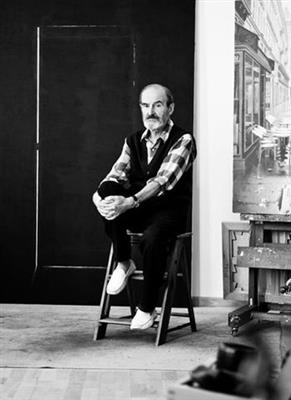
Born in Kazan in 1933[1], he trained at the Surikov Art Institute in Moscow, graduating in 1958. During the Soviet period he worked as a children's book illustrator alongside Oleg Vassiliev, producing commercially acceptable work while developing his real practice in private. In the 1960s he became part of the Sretensky Boulevard Group with Ilya Kabakov and Vladimir Yankilevsky, meeting privately since official exhibition venues were closed to them.
His paintings use the visual grammar of socialist realism: clear skies, monumental figures, declarative text. Where socialist realism deployed that grammar to assert certainty, Bulatov uses it to produce unease. The text in his canvases does not caption the image; it competes with it, laying a layer of language over a landscape that refuses to be fully contained by either.
After emigrating in 1990, Bulatov settled in Paris. His work entered the Guggenheim, the Centre Pompidou, and the Russian Museum. France awarded him the Chevalier des Arts et des Lettres in 2015. He died in Paris on 9 November 2025, aged 92.
Timeline
- 1933Born in Kazan.
- 1958Graduated from the Surikov Art Institute in Moscow.
- 1960Became part of the Sretensky Boulevard Group with Ilya Kabakov and Vladimir Yankilevsky; the group met privately.
- 1990Emigrated and settled in Paris.
- 2015Awarded the Chevalier des Arts et des Lettres in France.
- 2025Died in Paris at 92.
Notable Works
Tap to view larger.
Next stop
Browse the movements →
Every movement in the collection, from the Renaissance to Pop art.
Frequently Asked Questions
What is Erik Bulatov known for?
Erik Bulatov is known for paintings that, at first glance, resemble Soviet propaganda posters. However, Bulatov insisted that his work was a literal examination of how language arrests vision and how ideology fills space.Who was Erik Bulatov?
Erik Bulatov was a Soviet-era artist who trained at the Surikov Art Institute in Moscow. He worked as a children's book illustrator while developing his own artistic practice, and he was part of the Sretensky Boulevard Group with Ilya Kabakov and Vladimir Yankilevsky. After emigrating in 1990, Bulatov settled in Paris and his work entered prominent museums; he died in Paris in 2025.What was Erik Bulatov's art style?
His paintings employed the visual grammar of socialist realism, using clear skies, monumental figures, and declarative text. However, rather than asserting certainty, Bulatov used this grammar to create unease, with text competing with the image rather than captioning it.When was Erik Bulatov born?
Erik Bulatov was born in 1933[1].
Sources
Editorial draws on the following primary and tertiary references for Erik Bulatov.
- [1] wikipedia Wikipedia: Erik Bulatov Used for: biography, birth dates, death dates, identifiers, movement attribution, nationality.
- [2] book guggenheim-masterp00solo Used for: biography.
- [3] book Penelope J.E. Davies, Walter B. Denny, Frima Fox Hofrichter, Joseph Jacobs, Ann S. Roberts, David L. Simon, Janson's History of Art_ The Western Tradition (8th Edition) Used for: biography.
- [4] book Esanu, Octavian(Author), Transition in Post-Soviet Art : The Collective Actions Group Before and After 1989 Used for: biography, stylistic analysis.
- [5] book Untitled Used for: biography.
Editorial overseen by Solis Prints. Sources verified 2026-10-07. Click a source for details, or hover over [N] in the page above to preview.
Editorial standardsMethodologyCorrectionsAI disclosureAbout the editorial team