



Ernst Fuchs
Vienna in the years immediately after 1945 was an unlikely incubator for extravagant imagining, yet it produced one of the century's most singular painters. Ernst Fuchs, born on 13 February 1930[1], trained at the Academy of Fine Arts Vienna and became a founding figure of the Vienna School of Fantastic Realism, a movement that looked back to Dürer and Grünewald rather than to Paris.
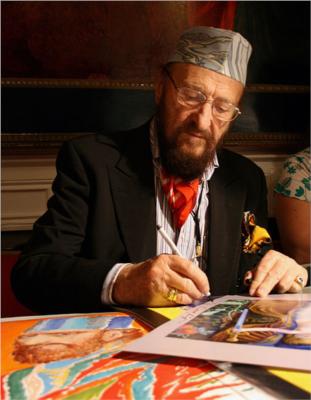
Biography
His technical obsession was the revival of mischtechnik: a layered process combining egg tempera underpainting with oil glazes and resin varnishes, producing the jewel-like luminosity associated with Northern Renaissance masters. The results were visions dense with religious, mythological, and erotic imagery. The Mysteries of the Holy Rosary cycle (1958-61) and his large Last Supper stand among the most sustained achievements of the postwar figurative revival.
Fuchs moved between Vienna, Paris, New York, and Rome, absorbing and deflecting influences without ever resolving into a conventional idiom. In 1972 he purchased the Villa Ernst Wagner, a historic building designed by Otto Wagner, and spent years restoring it. It opened as the Ernst Fuchs Museum in 1988 and remains his most visible legacy in Vienna.
Recognition came formally but slowly. France awarded him the Officier dans l'Ordre des Arts et des Lettres in 2000; Austria bestowed the Cross of Honour for Science and Art in 2009. A retrospective at the State Russian Museum in St Petersburg in 1993 signalled that his reputation had survived the century's many changes in taste. He died in Vienna on 9 November 2015 at the age of 85.
Timeline
- 1930Born in Vienna on 13 February. He later became a painter.
- 1945Studied at the Academy of Fine Arts Vienna.
- 1958Began work on The Mysteries of the Holy Rosary cycle (completed in 1961).
- 1972Purchased the Villa Ernst Wagner, designed by Otto Wagner.
- 1988The Villa Ernst Wagner opened as the Ernst Fuchs Museum in Vienna.
- 1993A retrospective of his work was held at the State Russian Museum in St Petersburg.
- 2000Awarded the Officier dans l'Ordre des Arts et des Lettres in France.
- 2009Awarded the Cross of Honour for Science and Art in Austria.
- 2015Died in Vienna on 9 November, at the age of 85.
Notable Works
Tap to view larger.
Next stop
Browse the movements →
Every movement in the collection, from the Renaissance to Pop art.
Frequently Asked Questions
What is Ernst Fuchs known for?
Ernst Fuchs is known for being a founding figure of the Vienna School of Fantastic Realism. He is also known for reviving mischtechnik, a layered process combining egg tempera underpainting with oil glazes and resin varnishes.What is Ernst Fuchs's most famous work?
It is difficult to name one single work as Ernst Fuchs's most famous. He produced art across many media, including painting, sculpture, drawing, graphics, stage design, and architecture. Fuchs is known as one of the founders of the Vienna School of Fantastic Realism, which began in 1946. Other members included Erich Brauer, Rudolf Hausner, Anton Lehmden, and Wolfgang Hutter. Later in life, Fuchs acquired a derelict villa, which he restored and transformed. He decorated it in accordance with his artistic vision. He also produced several books, including *Architectura Caelestis: Die Bilder des verschollenen Stils* ('Architecture Celestis: Pictures of the Lost Style') in 1966 and *Ahriman: Das Reich des Bösen* ('Ahriman: The Realm of Evil') in 1965.What should I know about Ernst Fuchs's prints?
Ernst Fuchs was part of the Austrian avant-garde art scene after World War II. He explored printmaking, and his early works had a visionary, late-Surrealist character. In 1951, Fuchs debuted as a print artist with stone and offset lithographs in the portfolio *Cave Canem*, alongside Arnulf Rainer and others. These prints displayed underwater scenes and organic shapes. Prints are made in limited editions, with each print numbered, such as 35/100; the first number is the print's sequence, and the second is the edition size. Artists often sign their prints in pencil, signifying their approval. Original prints are conceived and executed solely as prints, using a plate, stone, screen, or block. Each print is individually inked and pulled, making it a 'multi-original' medium, not a reproduction of existing work in another medium.What techniques or materials did Ernst Fuchs use?
Ernst Fuchs explored a variety of techniques and materials in his artistic practice. Fuchs is known for his skill with the Mischtechnik (mixed technique), an oil painting method involving layers of tempera and oil glazes popular in the fifteenth and sixteenth centuries. Beyond traditional painting, Fuchs experimented with other approaches. Max Ernst, a contemporary, employed collage, frottage, and grattage, among other methods, to move away from conventional artistic techniques. Collage involves combining existing visual elements, often from printed sources, to create new imagery. Frottage involves creating textures by rubbing a drawing tool over a textured surface. Grattage is a technique where paint is scraped away from the canvas to reveal underlying layers. These methods allowed for a departure from established artistic norms.What was Ernst Fuchs known for?
Ernst Fuchs (1930[1]-2015) was an Austrian painter, sculptor, printmaker, stage designer, and composer. He is best known as one of the founders of the Vienna School of Fantastic Realism. Fuchs studied at the Academy of Fine Arts, Vienna, beginning in 1945. Key influences included Gustav Klimt, Egon Schiele, and Max Pechstein. His early work was also shaped by his experience of the Second World War. He co-founded the Hundsgruppe group of artists in 1946, and the Vienna Art Club in 1948. In 1957, Fuchs converted to Roman Catholicism. Religious themes became prominent in his art. Fuchs moved to Israel in 1957, where he studied the techniques of the Old Masters. By 1961, he had returned to Vienna. Fuchs's style combines detailed realism with symbolic and mystical imagery. His paintings often feature mythological, religious, and allegorical subjects. He worked in a variety of media, including oil paint, tempera, and printmaking. He also designed stage sets and costumes for opera. Fuchs's work has been exhibited internationally, and he is represented in many public and private collections.When did Ernst Fuchs live and work?
Ernst Fuchs (1930[1]-2015) was an Austrian painter, sculptor, printmaker, stage designer, and composer. He is best known as one of the founders of the Vienna School of Fantastic Realism. Fuchs was born in Vienna. During the Second World War, he was baptised as a Catholic to save him from Nazi persecution, as his father was Jewish. He studied at St. Anna School of Drawing, then at the Academy of Fine Arts in Vienna. His early work was influenced by Gustav Klimt, Egon Schiele, and Max Pechstein. In 1957, Fuchs moved to Paris, where he experimented with surrealism and other abstract styles. By the late 1950s, he began developing his signature style, characterised by meticulous detail, luminous colour, and esoteric symbolism. Common subjects included religious themes, mythology, and personal visions. Fuchs returned to Vienna in 1972. There, he acquired and restored the derelict Otto Wagner Villa, transforming it into his private museum. He continued to work in a variety of media until his death in 2015.Where can I see Ernst Fuchs's work?
Ernst Fuchs's works can be found in numerous collections. These include the Fogg Art Museum (Harvard University, Cambridge, Massachusetts), the Neue Galerie am Landesmuseum Joanneum (Graz, Austria), and the Gemeente Museum (The Hague). Other locations include The Minneapolis Institute of Fine Arts, The Museum of Modern Art (New York), and the Museum of Art, Carnegie Institute (Pittsburgh). European museums holding Fuchs's art include the Ndrodni Galerie (Prague), the Graphische Sammlung Albertina (Vienna), and the Historisches Museum der Stadt Wien (Vienna). You can also find his work at the Niederosterreichisches Landesmuseum (Vienna), the Osterreichische Galerie (Vienna), and the Osterreichisches Museum fur Angewandte Kunst (Vienna). Some pieces are held at the Marlborough Fine Art, Ltd., in London. It is always advisable to check museum websites for current exhibitions.Where was Ernst Fuchs from?
Ernst Fuchs was born in Vienna, Austria, on 13 February 1930[1]. His early life was marked by the Second World War; his father, a Jewish man who converted to Catholicism to avoid persecution, fled to Shanghai. Fuchs was baptised as a Catholic during the war. After the war, Fuchs studied at St. Peter's Church, then at the Academy of Fine Arts in Vienna from 1946 to 1950. He co-founded the Vienna School of Fantastic Realism in 1948, along with artists such as Rudolf Hausner, Arik Brauer, Wolfgang Hutter, and Anton Lehmden. In 1957, Fuchs converted to Catholicism. Later, he lived and worked in various places, including Paris and Ein Hod, Israel. He eventually returned to Vienna, where he purchased and renovated the Otto Wagner Villa in 1972. The villa became the site of the Ernst Fuchs Private Museum, which opened in 1988. Fuchs died in Vienna on 8 November 2015.Who did Ernst Fuchs influence?
Assessing artistic influence is complex, going beyond simple imitation. Inspiration can come from technique, style, or intermittent exposure. Ernst Fuchs's artistic approach can be seen in his paintings, such as his depiction of an empty Last Supper table with a crucifix. The walls flanking the table include figures from another dimension: a phantom with a Southeast Asian face, a lion-headed man, and a skeleton. Other Austrian artists, such as Gustav Klimt (though not a direct pupil), had an impact on other artists. For example, Ubaldo Oppi took courses with Klimt in Vienna. Oppi based his realism, realised in analytical tones, on the preciousness of Klimt's work. Klimt's true legacy was assumed by Kokoschka and Schiele, the new generation of Austrian painters. The stylized forms become angular and tormented. The existential drama and uncertainty of values expressed by the figures explode across the surface in subdued tones and deformed physiognomy.Who influenced Ernst Fuchs?
Ernst Fuchs's artistic development occurred in a milieu shaped by many influences. The artist Josef Manes, who died the year Kupka was born, was a powerful influence. Manes had studied at the Prague Academy and in Munich. He stressed the validity of Czech culture and studied folk art. His work employed a melodic line and a metaphorical perception of nature. Kupka admired Manes' illustrations for a collection of old Czech poems, entitled Manuscripts. A photograph of Manes hung on his studio wall until the end of his life. Manes's follower, Mikulas Ales, also influenced Kupka. Ales had a decorative talent and believed that he could express his ideas only via monumental art. Klimt's personal style both echoed and influenced the prevailing Art Nouveau style. Klimt was the primary influence on the artistic development of Egon Schiele and became the artist’s close friend and mentor.Who was Ernst Fuchs?
Ernst Fuchs (1930[1]-2015) was an Austrian painter, sculptor, printmaker, stage designer, composer, poet, and architect. He is best known as one of the founders of the Vienna School of Fantastic Realism. Born in Vienna to a Jewish father and Catholic mother, Fuchs was baptised a Catholic to save him from Nazi persecution during the Second World War. After the war, he studied at the Academy of Fine Arts in Vienna, where he later taught. Fuchs's early work was influenced by artists such as Gustav Klimt and Egon Schiele. He developed a style characterised by its mystical and symbolic imagery, often drawing on religious, mythological, and psychoanalytic themes. His work frequently featured detailed figures, luminous colours, and a dreamlike quality. In the 1950s, Fuchs travelled extensively, living in Paris and other parts of Europe before returning to Vienna. He was interested in various artistic techniques, including oil painting, etching, and sculpture. He also designed stage sets and costumes for operas, including productions of Wagner's *Parsifal*. Fuchs's work has been exhibited internationally and is held in numerous public and private collections.Why are Ernst Fuchs's works important today?
Ernst Fuchs's art retains importance because of his synthesis of surrealism, fantastic realism, and occult symbolism. His work often explores themes related to esoteric traditions, reflecting a belief in hidden realities beyond the visible world. This approach connects him to a lineage of artists interested in dematerialising mundane appearances. Fuchs's connection to figures like Kurt Seligmann, who studied occultism, places him within a network that influenced the post-war avant-garde. His art can be seen as part of a broader alchemical-artistic phenomenon, where the artist's role involves reconciling opposites to recreate cosmic unity. His paintings and other works often incorporate symbolic forms and dense pigmentation, creating a sense of implicit motion and exploring the relationship between matter and atmosphere. Fuchs's diverse interests and his ability to recast experiences in near-abstract modes contribute to the continued relevance of his artistic vision.
Sources
Editorial draws on the following primary and tertiary references for Ernst Fuchs.
- [1] wikipedia Wikipedia: Ernst Fuchs Used for: biography, birth dates, death dates, identifiers, movement attribution, nationality.
- [2] book guggenheim-amsterdamparisdu00solo Used for: biography.
- [3] book guggenheim-refigur00kren Used for: biography.
- [4] book Masterpieces of western art : a history of art in 900 individual studies from the Gothic to the present day Used for: biography.
- [5] book Anfam, David A;Callen, Anthea. Techniques of the impressionists, Techniques of the great masters of art Used for: stylistic analysis.
Editorial overseen by Solis Prints. Sources verified 2026-09-30. Click a source for details, or hover over [N] in the page above to preview.
Editorial standardsMethodologyCorrectionsAI disclosureAbout the editorial team