



Ernst Meyer
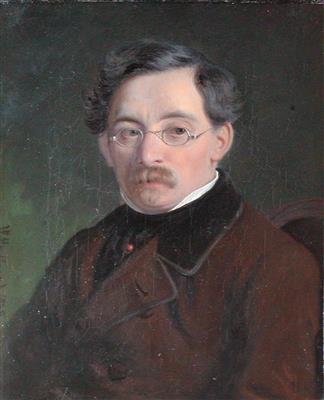
Born Ahron Meyer on 11 May 1797[1] in Altona, then part of the Duchy of Schleswig and now Hamburg, Ernst Meyer arrived at his vocation by way of failure. He trained at the Royal Danish Academy of Fine Arts from 1816[1], winning silver medals for history painting. But two attempts at the academy's gold medal came to nothing, and Meyer responded by removing all his works from the gallery and abandoning historical subjects altogether.
Biography
The decisive turn came in Rome around 1824[1], where the street life of Naples and the Italian south struck him with the force of revelation. He became a painter of genre scenes: fishermen returning to shore on Capri, local women in doorways, the domestic arrangements of Mediterranean coastal life. His 1833 painting of a Neapolitan fishing family was purchased by Crown Prince Christian VIII of Denmark, and Landing on Capri circulated so widely in reproduction that his name became synonymous with the subject.
Meyer's long Roman residence made him part of an international colony of Nordic artists who found in Italy the light and subject matter that northern climates could not provide. He was elected to the Danish Academy in 1842[1]. From around 1841 onward, a debilitating illness, possibly rheumatoid arthritis, progressively deformed his hands. Rather than give up, he shifted to watercolour, developing a refined palette of subtle hues that his critics considered an improvement on the oils.
He died in Rome on 31 January 1861[1] and was buried at Campo Verano. The arc of his life, from rejected history painter to celebrated genre specialist, speaks to the peculiar fertility of artistic setback.
Timeline
- 1797Born Ahron Meyer on 11 May in Altona, Duchy of Schleswig (now Hamburg).
- 1816Began training at the Royal Danish Academy of Fine Arts.
- 1824Moved to Rome, where he was inspired by the street life of Naples and southern Italy.
- 1833His painting of a Neapolitan fishing family was purchased by Crown Prince Christian VIII of Denmark.
- 1841Began suffering from a debilitating illness, possibly rheumatoid arthritis, which deformed his hands.
- 1842Elected to the Danish Academy.
- 1861Died in Rome on 31 January and was buried at Campo Verano; he was 63.
Notable Works
Tap to view larger.
Next stop
Browse the movements →
Every movement in the collection, from the Renaissance to Pop art.
Frequently Asked Questions
What is Ernst Meyer known for?
Ernst Meyer is known for his genre scenes of Italian coastal life. His 1833[1] painting of a Neapolitan fishing family was purchased by Crown Prince Christian VIII of Denmark, and Landing on Capri became very popular in reproduction.What is Ernst Meyer's most famous work?
It is difficult to name one single work as Ernst Meyer's most famous. He was born in 1891 near Cologne, and he died in France in 1976. Meyer is associated with Dada and Surrealism. Meyer did not have formal artistic training. He studied philosophy at the University of Bonn. He was interested in psychology and the art of the mentally unwell. In 1919, Meyer produced his first collages and co-founded the Cologne Dada movement. He was involved in Surrealist activities in the early 1920s. Meyer is known for collage novels, such as *La Femme 100 têtes* (1929). He also produced illustrated books, such as *Mr. Knife and Miss Fork* (1931). His collages used existing imagery. By juxtaposing and combining elements, he produced works with his personal stamp. Meyer also made frottages, and a series of these were published in his book *Histoire Naturelle* in 1926.What should I know about Ernst Meyer's prints?
Ernst Meyer (1887-1963[1]) was a German artist known for his printmaking, particularly within the Expressionist movement. Expressionist artists often favoured woodcuts for their directness and bold, graphic qualities. Meyer's prints, like those of other Expressionists, such as members of Die Brücke (The Bridge) group, aimed to convey inner emotion and agitation through a simplified, often angular style. These artists sought to revolutionise art by rejecting established forms in favour of a more direct and symbolic language. Printmaking during this period was seen as a means of artistic expression and a way to reach a wider audience, due to the ability to produce works in greater quantities at a lower cost. Artists like Kirchner found that working with woodcuts helped them to achieve more simplified and stable forms in their work. The emphasis was on the artistic content and the artist's intention, rather than technical refinement or rarity.What style or movement did Ernst Meyer belong to?
It is difficult to assign Ernst Meyer to a single style or movement. Styles are devices by which a work of art is created; each work has a style peculiar to itself, outside any general style of the time. Examining art from different ages, such as Chinese, Watteau, and Impressionist pictures, reveals different points of view. Despite these differences, the people who witnessed their creation understood them. Even when ages are rejected or ignored due to cultural differences, any new style, when vividly expressed, can initially be incomprehensible, like the style of a remote age. Styles in art are like styles in language; they are a matter of weighted preferences. When judging a style, one judges a tendency, and one may discern a tendency without being able to define it in any individual case.What techniques or materials did Ernst Meyer use?
Ernst Meyer (1797[1]-1861[1]) was a German painter, a major figure in the transition from late classicism to early realism. He is best known for his Italian genre paintings. Meyer began his artistic training at the Kunstakademie Düsseldorf. He then moved to Rome, where he spent much of his career. He initially worked in the studio of Bertel Thorvaldsen, the Danish sculptor. Meyer's early paintings show the influence of classicism, with an emphasis on clear lines and balanced compositions. However, Meyer gradually developed his own style, one characterised by a greater naturalism and attention to detail. He began to paint scenes from everyday life in Italy, depicting peasants, fishermen, and other ordinary people. His paintings are notable for their realistic portrayal of clothing, architecture, and the Italian countryside. Meyer worked primarily in oils, using a careful technique to create a smooth, polished surface. He also made use of glazing to achieve subtle effects of light and shadow.When did Ernst Meyer live and work?
Ernst Meyer was active as an artist in Berlin during the mid-19th century. In 1847[1], the Meyer family relocated to Ritterstrasse. The following year, after street fighting in Berlin, Meyer witnessed the bodies of citizens killed in the insurrection. He then started working on an oil painting, Lying in State of the Victims of the March Revolution, though it remained unfinished. From 1849, Meyer painted scenes from the life of Frederick the Great. He began The Flute Concert of Frederick the Great at Sanssouci, returning to it in 1851 and completing it in 1852. He finished The Round Table of Frederick II at Sanssouci in 1850. Meyer visited the Exposition Universelle in Paris in September, where his Round Table was exhibited. He also visited Courbet's solo exhibition.Where can I see Ernst Meyer's work?
Works by Ernst Meyer can be found in several European museums and collections. These include the Kunstmuseum and the Gottfried Keller Stiftung, both in Berne; the Kunstmuseum in Basle; the Kunsthaus in Zurich; and the Kunstmuseum in Winterthur. Meyer's pieces are also held at the Petit Palais in Geneva, as well as the Staechelin Foundation and the Thyssen-Bornemisza Collection. In Germany, one can find his works in the Brucke Museum and the Nationalgalerie, both located in Berlin. Other German locations include the Kunsthalle and Sammlung Bottcherstrasse in Bremen; the Ludwig Museum and Wallraf-Richartz Museum in Cologne; the Folkwang Museum in Essen; the Kunsthalle in Hamburg; the Niedersachsisches Landesmuseum in Hanover; the Stadtische Kunsthalle in Mannheim; the Bayerische Staatsgemaldesammlungen in Munich; and the Von der Heydt Museum in Wuppertal.Where was Ernst Meyer from?
Ernst Meyer was born in Altona, near Hamburg, in 1797[1]. At the time, Altona was the second-largest city in Denmark, as it was part of the Danish kingdom until 1864. Meyer's artistic training began at the Copenhagen Academy, where he studied with Christian August Lorentzen. Meyer's career soon took him beyond Denmark. He travelled to Berlin, Dresden, and Munich before settling in Rome in 1824[1]. Rome became his primary residence, and he associated with other artists working there, including Bertel Thorvaldsen. Meyer became a well-regarded figure in the artistic circles of Rome, known for his genre paintings and scenes of Italian life. Although he spent much of his adult life in Italy, Meyer retained his connection to his Danish background. His early training in Copenhagen shaped his artistic development, and his birthplace of Altona remained an important part of his identity. Meyer died in Rome in 1861[1].Who influenced Ernst Meyer?
Ernst Meyer's artistic development was shaped by several key figures and movements. The 1912 Sonderbund exhibition in Cologne, which showcased Fauvist, Expressionist, and Cubist works, had a considerable impact. August Macke, an Expressionist artist, mentored Meyer and introduced him to the Blue Rider group, leading to a meeting with Kandinsky in 1914. Meyer also encountered Robert Delaunay and Guillaume Apollinaire during their visit to Macke. These encounters reinforced Meyer’s artistic direction. Another significant influence was Hans Arp, whom Meyer met in 1914. Arp shared Meyer's interest in modern art and later established Dadaism in Zurich. Meyer also maintained contact with Luise Straus, an art history student, who kept him informed about the art world during the war. Meyer's early works show the impact of Expressionism, particularly Vincent van Gogh. He also drew inspiration from Manet, Gauguin, Goya, Macke, and Kandinsky. By 1919, Meyer was working with Arp in Cologne, exploring image metamorphosis and juxtaposition. Giorgio de Chirico's distorted perspectives and enigmatic style also influenced Meyer, particularly in works created around 1919.Why are Ernst Meyer's works important today?
Ernst Meyer (1797[1]-1861[1]) was a German painter, a figure in the transition from Neoclassicism to early Realism. He is remembered for his contributions to genre painting and his depictions of Italian peasant life. Meyer studied at the Copenhagen Academy. He later travelled to Munich and Italy, where he spent a considerable portion of his career. His time in Italy proved influential, shaping his artistic focus. He produced numerous paintings that documented the customs, costumes, and daily routines of the Italian people. These works offered viewers in Northern Europe a glimpse into the everyday existence of those living in the Italian countryside. Meyer's paintings are valued for their detailed observations and realistic portrayals. They provide insight into the social history of 19th-century Italy. His art is held in museum collections, including the Thorvaldsens Museum (Copenhagen) and the Hamburger Kunsthalle.What was Ernst Meyer's art style?
After abandoning history painting, Ernst Meyer became a painter of genre scenes. Later in his career, after developing an illness that deformed his hands, he shifted to watercolour, developing a refined palette of subtle hues.
Sources
Editorial draws on the following primary and tertiary references for Ernst Meyer.
- [1] wikipedia Wikipedia: Ernst Meyer Used for: biography, birth dates, death dates, identifiers, movement attribution, nationality.
- [2] book Allison Lee Palmer, Historical Dictionary of Neoclassical Art and Architecture Used for: stylistic analysis.
- [3] book Masterpieces of western art : a history of art in 900 individual studies from the Gothic to the present day Used for: biography.
- [4] book Neoclassicism and romanticism : architecture, sculpture, painting, drawings, 1750-1848 Used for: biography.
Editorial overseen by Solis Prints. Sources verified 2026-09-30. Click a source for details, or hover over [N] in the page above to preview.
Editorial standardsMethodologyCorrectionsAI disclosureAbout the editorial team