



Ethel Léontine Gabain
In 1948[1] Ethel Léontine Gabain competed in the fine art events at the London Olympics. The inclusion of art competitions in the Games had been a feature since 1912, and Gabain's entry placed her among the last generation of artists to take part before the discipline was removed after 1948. It is an unusual footnote for a British printmaker, but then Gabain's career was full of them.
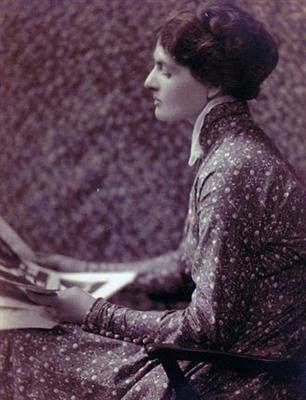
Biography
Born in Le Havre in 1883[1] to a French father and a Scottish mother, she trained at the Slade, at Raphaël Collin's studio in Paris, and then at the Central School of Arts and Crafts in London, where she learnt lithography from F. E. Jackson. Lithography became her medium of choice, and she became one of the rare artists of her era able to support herself entirely from print sales. In 1910[1] she was a founding member of the Senefelder Club, the organisation that did more than any other to revive serious lithographic practice in Britain.
Her lithographs have a tender, psychological quality that serves portraiture particularly well. She illustrated Jane Eyre in 1922[1] and The Warden in 1926, and painted oil portraits of stage actresses including Peggy Ashcroft and Flora Robson. Her portrait of Robson as Lady Audley won the De Laszlo Silver Medal in 1933. During the Second World War she was commissioned by the War Artists' Advisory Committee to document women's wartime roles.
She was elected to the Royal Society of British Artists in 1932[1] and served as President of the Society of Women Artists from 1940. She married the artist John Copley in 1913; their son Peter Copley became a well-known stage and screen actor. She died in 1950[1].
Timeline
- 1883Born in Le Havre to a French father and a Scottish mother.
- 1910Became a founding member of the Senefelder Club, in London.
- 1913Married the artist John Copley.
- 1922Illustrated Jane Eyre.
- 1926Illustrated The Warden.
- 1932Elected to the Royal Society of British Artists.
- 1933Her portrait of Flora Robson as Lady Audley won the De Laszlo Silver Medal.
- 1940Served as President of the Society of Women Artists.
- 1948Competed in the fine art events at the London Olympics.
- 1950Died in 1950.
Notable Works
Tap to view larger.
Next stop
Browse the movements →
Every movement in the collection, from the Renaissance to Pop art.
Related Artists



Frequently Asked Questions
What is Ethel Léontine Gabain's most famous work?
It is difficult to name Gabain's single 'most famous work' because her notability rests on her achievements as a whole, rather than one specific piece. She was a prolific painter and printmaker, with a wide-ranging body of work. Gabain is best known for her portraits, figure studies, and interiors. She often depicted women in domestic settings or engaged in everyday activities. Some of her well-known prints include 'The Striped Dress', 'Spanish Dancer', and 'Dans le Parc'. These works show her skill in lithography and her ability to capture character and mood. Gabain was also an accomplished painter, exhibiting regularly at the Royal Academy and other major venues. Her paintings often featured similar subjects to her prints, demonstrating her consistent artistic vision.What should I know about Ethel Léontine Gabain's prints?
Ethel Léontine Gabain (1877-1950[1]) was a French-British artist known for her prints, especially her lithographs. Although she worked in various media, including painting and drawing, her prints form a significant part of her artistic output. Gabain's prints often depict figures, particularly women, in domestic or theatrical settings. She had a talent for capturing light and shadow, which added depth to her compositions. As with many printmakers, Gabain often created her images as limited editions. The size of the edition is decided by the artist, and each print in the edition is considered an original, made from a plate or other material created for that purpose. Each print is individually inked and pulled. The edition claim is usually written as a pair of numbers on the bottom left margin of the print, with the print number above the edition size. The title of the print is written in the middle of the bottom margin, and the signature is on the right.What style or movement did Ethel Léontine Gabain belong to?
It is difficult to assign Ethel Léontine Gabain to one specific style. However, her work has links to several movements of the late 19th and early 20th centuries. The Pre-Raphaelites sought directness and simplicity, admiring the art of the 'Age of Faith'. Artists began to distrust convention, longing for art that was more than learned skill, something with the strength of human passion. Some, like Delacroix, looked to places such as Algiers for intense colour and freedom. Gauguin, working in Brittany and later Tahiti, moved away from Impressionism's replication of the eye's view. He abstracted scenes into patterns, using pure, unmodulated colour in flat planes defined by firm lines. He admired Japanese prints and other art forms, transforming Impressionism into expressive patterns of line, shape, and colour. He sought a life removed from materialistic Europe, reconnecting with nature. His colour and draughtsmanship aimed to reflect the unspoilt nature he saw in Tahiti.What techniques or materials did Ethel Léontine Gabain use?
Ethel Léontine Gabain was a painter and printmaker, known for her work in oils and lithography. As a painter, Gabain would have considered the possibilities and limits of her materials. She would have been the sole judge of how to use them. Oil paint is made from coloured pigments diluted in some liquid, then applied to a surface. The pigments themselves have a material effect on the nature of the work. Gabain also produced lithographs. This is a printmaking technique using a flat stone or metal plate. The artist draws an image on the surface with a greasy substance; non-image areas are treated to repel ink, while the image areas attract it. The surface is then inked and printed. The artist's hand changes the material qualities of a line, and the choice of material is conditioned by the effect the artist intends to achieve.When did Ethel Léontine Gabain live and work?
Ethel Léontine Gabain was born in France on 26 March 1883[1]; her family relocated to England in 1885[1]. She died in London on 30 January 1950[1]. Gabain began her artistic training at the age of seventeen at the Slade School of Fine Art in London. There, she studied alongside artists such as Stanley Spencer, Mark Gertler, and Dora Carrington. Later, she studied at the Central School of Arts and Crafts, where she learned lithography. Gabain was known for her portraits, figure studies, and depictions of theatrical subjects. She worked in a variety of media, including oils, pastels, and lithography, and she was elected to the Royal Society of British Artists in 1934. Gabain also served as President of the Society of Women Artists from 1940 to 1944.Where can I see Ethel Léontine Gabain's work?
It is difficult to say definitively where one can view work by Ethel Léontine Gabain. However, a survey of public collections that hold work by a similar artist, Rosalie Gascoigne, may provide some useful leads. Gascoigne's work from the 1970s onward is held in many Australian and New Zealand public collections. In Australia, these include the Art Gallery of New South Wales (Sydney), the Art Gallery of South Australia (Adelaide), the Art Gallery of Western Australia (Perth), the Canberra Museum and Art Gallery, the Heide Museum of Modern Art (Melbourne), and the Macquarie University Art Collection (Sydney). Outside Australia, Gascoigne's pieces are held by the Auckland Art Gallery Toi o Tāmaki (New Zealand), the Museum of New Zealand Te Papa Tongarewa (Wellington), the Tate (United Kingdom), and the Metropolitan Museum of Art (New York).Who did Ethel Léontine Gabain influence?
Ethel Léontine Gabain's artistic influence is difficult to measure precisely. Gauguin's influence can be charted through personal contact, the transmission of his ideas by friends, the circulation of his original works and graphic reproductions, and verbal tradition. Gauguin's colour symbolism impacted early abstract art. He also contributed to primitivism and the solidification of the picture plane during the late 19th and early 20th centuries. The magazine *La Revue Blanche* spread news of Gauguin beyond France. His woodblock prints affected Munch and artists of Die Brücke. Nolde's journey to New Guinea recalls Gauguin's voyages. Ideas and artworks get separated from their originators, stretched, or mixed into new forms. Gauguin's role as a disseminator of colour symbolism to early abstract art is clear. He is also present in primitivism's subsequent developments and as a contributor to solidifying the picture plane during the late 19th and early 20th centuries.Who influenced Ethel Léontine Gabain?
It is difficult to identify specific influences on Ethel Léontine Gabain. One source notes that Althea (unspecified last name) visited Henri Matisse's studio in Venice during her student days. Althea admired the work of Matisse, Pablo Picasso, Georges Braque, Vincent van Gogh, and Paul Gauguin. However, this source refers to Althea's unique sense of colour, and her lack of outside influence. It also mentions William Ohly, an artist and collector who owned two London galleries: the Abbey Arts Centre and the Berkeley Gallery. Althea met Ohly through a fellow student. She also met many new artists within the Abbey community, including the sculptor Phillip King and the Scottish painter Alan Davie. At the British Museum, Althea studied African textiles and other artefacts. However, the source concludes that Althea went her own way, with little influence from outside artists. Her study of African artefacts was one particular stimulus within the general spectrum of her textile designs.Who was Ethel Léontine Gabain?
Ethel Léontine Gabain (1877-1941[1]) was an artist who moved between artistic circles in London and France. She and her partner, fellow artist Nan Hudson, maintained residences in both countries. They often hosted friends at their homes. From 1920[1] to 1929, many members of the Bloomsbury Group visited them at the Château d’Auppegard in Offranville, Normandy. Gabain had a studio in the château after 1926. Gabain and Hudson socialised with local French people and donated to a hospital fund in Veules-les-Roses. In London, Gabain and Hudson acted as mediators among groups of artists. They collaborated on exhibitions and debated membership conditions in the London Group of painters. Gabain exhibited with the Women’s International Art Club and, after 1920, with the Goupil Gallery Winter Salons. In 1921, two of her works were accepted by the New English Art Club. Gabain knew Desmond MacCarthy and Roger Fry well, and she often entertained them. Her Chelsea home was near Henry James's residence on Cheyne Walk, and she often visited him during the last years of his life.Why are Ethel Léontine Gabain's works important today?
Ethel Léontine Gabain (1877-1941[1]) was a French-British artist known for her prints, paintings, and drawings. Her work is significant for several reasons. Gabain captured inter-war society, particularly women. Her portraits and genre scenes provide insights into the lives and roles of women during this period. She often depicted women in both domestic and professional settings, reflecting the changing status of women in the early 20th century. Gabain was a skilled printmaker, especially in lithography. Her mastery of this medium allowed her to create works with tonal range and detail. Her technical skill contributed to the revival of lithography as a fine art form in Britain. Gabain's art also has a personal dimension. As a woman artist in a male-dominated art world, her success is noteworthy. She exhibited widely and gained recognition during her lifetime, paving the way for future generations of female artists. Her work offers a female perspective on the art and society of her time.How did Ethel Léontine Gabain die?
Ethel Léontine Gabain died in 1950[1].What is Ethel Léontine Gabain known for?
Gabain is known for her lithographs, which allowed her to support herself through print sales, a rarity for artists of her time. She is also known for her portraits, including those of stage actresses and her work documenting women's roles during the Second World War.
Sources
Editorial draws on the following primary and tertiary references for Ethel Léontine Gabain.
- [1] wikipedia Wikipedia: Ethel Léontine Gabain Used for: biography, birth dates, death dates, identifiers, movement attribution, nationality.
- [2] book Massey, Anne,Seago, Alex, Pop Art and Design Used for: biography.
- [3] book Martin Gascoigne, Rosalie Gascoigne: A Catalogue Raisonné Used for: biography.
Editorial overseen by Solis Prints. Sources verified 2026-09-30. Click a source for details, or hover over [N] in the page above to preview.
Editorial standardsMethodologyCorrectionsAI disclosureAbout the editorial team