



Eugène Burnand
The French state acquired Eugène Burnand's most celebrated painting directly from the 1898[1] Salon de la Société nationale des beaux-arts: 'The Disciples Peter and John Running to the Sepulchre on the Morning of the Resurrection', now in the Musée d'Orsay. The oil on canvas (134 x 82 cm) shows the two apostles running at full stride, John's hands clasped, his expression a compound of terror and hope. It is as much a study of physical urgency as a religious painting.
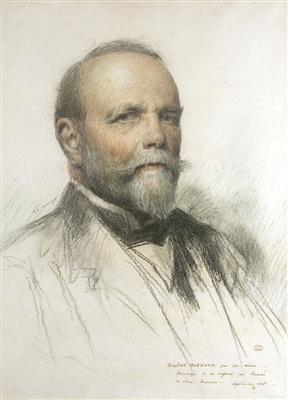
Biography
Burnand's path to religious subjects was indirect. Born in Moudon, Vaud, to a family prosperous enough to support an architectural training before painting, he studied under Barthélemy Menn in Geneva and later under Jean-Léon Gérôme in Paris. His early work owed more to Millet and Courbet than to ecclesiastical tradition: Provençal and Camargue landscapes, cattle on summer pastures, the outdoor life of rural France observed with careful naturalism.
The turn came in 1884[1], when he completed twenty-five etchings for an illustrated edition of Frédéric Mistral's Provençal epic 'Mireille', producing the drawings during long stays in the region. Recognition came quickly. That same year his 'Bull in the Alps', painted over two months near Arolla in the Herens Valley, confirmed his standing as the foremost Swiss animal painter of his generation.
By the mid-1890s, after moving to Fontfroide-le-Haut, his work had shifted decisively toward biblical narrative. The transition surprised some critics who had followed him as a naturalist, but the Disciples painting demonstrated that the same attentiveness he brought to an animal's posture could be directed at human spiritual experience.
Timeline
- 1850Born in Moudon, Vaud.
- 1884Completed twenty-five etchings for an illustrated edition of Frédéric Mistral's Provençal epic 'Mireille'.
- 1884His painting 'Bull in the Alps' confirmed his standing as a Swiss animal painter.
- 1890Moved to Fontfroide-le-Haut around this time.
- 1898His painting 'The Disciples Peter and John Running to the Sepulchre on the Morning of the Resurrection' was acquired by the French state from the Salon de la Société nationale des beaux-arts.
- 1921Died at 71.
Notable Works
Tap to view larger.
Next stop
Browse the movements →
Every movement in the collection, from the Renaissance to Pop art.
Related Artists


Frequently Asked Questions
What is Eugène Burnand's most famous work?
It is difficult to name one single work as Eugène Burnand's most famous. He produced paintings, drawings, and illustrations throughout his career, and his notability varied by region and period. Burnand was born in 1850[1] and trained at the École des Beaux-Arts in Paris. He exhibited regularly at the Salon, winning medals in 1880[1], 1885, and 1889. His early works often depicted rural scenes and peasant life, reflecting an interest in naturalism. Later, he explored religious and allegorical themes. Some of his better-known paintings include "The Disciples Peter and John Running to the Sepulchre on the Morning of the Resurrection" (1898), which gained international attention for its realistic depiction of the biblical scene. Other recognised works are "Departure of the Fishermen" and portraits such as those of his family members. His illustrations for books, including "La Chanson des Heures," were also well regarded. Burnand's style evolved over time, moving from academic realism towards a more personal and expressive approach. He is remembered for his technical skill and his ability to capture human emotion in his art.What style or movement did Eugène Burnand belong to?
Eugène Burnand's artistic style is often associated with Naturalism, a late nineteenth-century movement that sought to portray subjects, particularly rural life, with accuracy and objectivity. Naturalist artists moved away from idealised or romanticised depictions, instead focusing on the realities of everyday existence. However, Burnand's work also shows some influence from other movements. Some of his compositions and use of colour reflect an awareness of Impressionism, although he did not fully adopt its techniques. His interest in realism and his focus on depicting the lives of ordinary people connect him to the Realist movement as well. Burnand's style is not easily categorised into one specific movement. His art represents a blend of Naturalism with elements of Realism and Impressionism. He developed his own approach to painting, often focusing on religious and rural themes.What techniques or materials did Eugène Burnand use?
Eugène Burnand's artistic techniques involved a combination of traditional methods and personal innovations. Examination of paintings by masters such as Leonardo da Vinci and Hieronymus Bosch shows some of the traditional techniques available to artists of Burnand's time. Bosch, for example, often worked on panels prepared with a chalk ground and an oil film. He would sketch the under-drawing with a brush using thin black paint. In contrast to earlier Netherlandish painting, Bosch applied only one thin coat of paint in most cases. Painters at the time were taught to prepare their palette in advance, using mainly earth colours plus Prussian blue, black and lead white. They would then add turpentine to an earth-colour mixture, and with this transparent tint rework and strengthen the charcoal contours using a fine sable-hair brush. Later, Pierre Bonnard used a finely grained canvas with a commercially prepared white ground. Some areas of his paintings were built up in several thin layers. Others were painted in thicker layers with emphatic brushwork and some impasto.When did Eugène Burnand live and work?
Eugène Burnand was a Swiss artist, born in Moudon, Switzerland, on 30 August 1850[1]. He died in Paris on 21 February 1921[1]. Burnand's career spanned the late 19th and early 20th centuries, a period of significant artistic change. Burnand exhibited at the Salon des Artistes Français, alongside artists such as Adler, Brangwyn, and Chabas. He was also part of the Swiss section at the Exposition Universelle. His inclusion in these exhibitions places him within the context of the Post-Impressionist period. He was active during a time when artists like Renoir, Monet, and Redon were also exhibiting. Toulouse-Lautrec died in 1901[1], marking a shift in the art world as Burnand continued his work.Where can I see Eugène Burnand's work?
Eugène Burnand's work can be found in numerous museums and collections. In Switzerland, these include the Kunstmuseum in Basle, the Kunstmuseum in Berne, the Gottfried Keller Stiftung in Berne, the Petit Palais in Geneva, the Kunstmuseum in Winterthur, and the Kunsthaus in Zurich. His pieces are also held in the Staechelin Foundation and the Thyssen-Bornemisza Collection. Outside Switzerland, museums with Burnand's art include the Musée des Arts Décoratifs in Paris, and the Musée des Beaux-Arts in Nancy, France. In the United States, you can find his works at the Metropolitan Museum of Art in New York, the Los Angeles County Museum of Art, the Minneapolis Institute of Arts, the Museum of Modern Art in New York, the Charles Hosmer Morse Museum of American Art in Winter Park, Florida, the Virginia Museum of Fine Arts in Richmond, and the Wolfsonian in Miami Beach. In Canada, the Royal Ontario Museum in Toronto holds some of his pieces. In the UK, you may find his work at the Brighton Museum & Art Gallery, the Geffrye Museum in London, the Manchester Art Gallery, the National Museums of Scotland in Edinburgh, and the Victoria & Albert Museum in London.Who did Eugène Burnand influence?
Eugène Burnand's influence can be seen in the work of Ferdinand Hodler (1853[1]-1918[1]), a Swiss painter known for his boldly simplified depictions of Swiss scenery. Hodler's style has a poster-like clarity, which suggests the impact of Japanese art on European artists of the time. The Japanese approach proved well-suited to advertising. Émile Bernard (1868-1941) and Maurice Denis (1870-1943) were both influenced by Paul Cézanne. Bernard met Cézanne and formed a strong opinion of his work. Denis's major statement of 1907 was based on direct observations and conversations with Cézanne during a visit to Aix in 1906. Bernard's work was initially indebted to Cézanne; however, he needed to move beyond this influence to achieve his own mastery. Bernard directed his attention to the critical issue of whether Cézanne's art was spontaneous or controlled.How did Eugène Burnand die?
Eugène Burnand died in 1921[1].What is Eugène Burnand known for?
Burnand is best known for his painting 'The Disciples Peter and John Running to the Sepulchre on the Morning of the Resurrection', which is now in the Musée d'Orsay. He also gained recognition as an animal painter, particularly for his work 'Bull in the Alps'.What was Eugène Burnand's art style?
Burnand began his career painting in a naturalistic style, influenced by Millet and Courbet, with subjects such as Provençal and Camargue scenes, cattle, and rural life. Later in his career, his art shifted towards biblical narratives, while maintaining his attention to detail and naturalism.When did Eugène Burnand die?
Eugène Burnand died in 1921[1] at the age of 71.Who was Eugène Burnand?
Eugène Burnand was a Swiss painter who achieved considerable recognition during his lifetime, with the French state acquiring one of his paintings for the Musée d'Orsay. He initially trained in architecture before studying painting under Barthélemy Menn and Jean-Léon Gérôme. Burnand is known for his naturalistic depictions of rural life and, later, his biblical narratives.
Sources
Editorial draws on the following primary and tertiary references for Eugène Burnand.
- [1] wikipedia Wikipedia: Eugène Burnand Used for: biography, birth dates, death dates, identifiers, movement attribution, nationality.
- [2] book Brodskaya Nathalia, Brodskaya Nathalia - Symbolism Used for: biography.
- [3] book Post-impressionism : cross-currents in European painting Used for: biography.
- [4] book Post-impressionism : cross-currents in European painting Used for: biography.
Editorial overseen by Solis Prints. Sources verified 2026-10-07. Click a source for details, or hover over [N] in the page above to preview.
Editorial standardsMethodologyCorrectionsAI disclosureAbout the editorial team