



Eugène Jansson
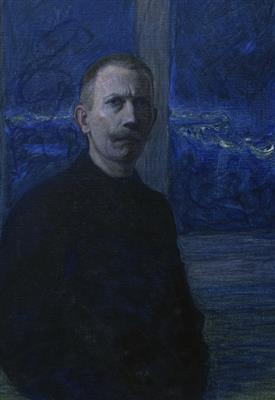
Scarlet fever at fourteen left Eugène Jansson with damaged hearing and eyesight, chronic kidney problems, and a lifelong need to manage his health through physical activity. Swimming became a practice as much as a discipline, and it eventually shaped the second and most controversial phase of his career. But that came later. In the 1890s, Jansson was known for something else entirely: the blue hour over Stockholm.
Biography
His early paintings of Riddarfjärden and the city's nocturnal waterways earned him the epithet 'blåmålaren' (the blue painter). Working with limited funds that prevented the Paris study trips taken by many Swedish contemporaries, he taught himself from the influence of Munch, Whistler, and van Gogh, arriving at a palette of deep indigo and slate that gave Stockholm's nights a specifically Northern quality. Banker Ernest Thiel became his major patron from 1898[1], stabilising the finances that had constrained him.
After 1907[1] the work shifted. Jansson began painting nudes at naval bathhouses in Stockholm, studies of young men swimming and exercising that are now understood as expressions of his homosexuality at a time when it could not be named openly. His brother later destroyed personal letters, likely to protect the family from scandal. Homosexuality remained illegal in Sweden until 1944, thirty years after Jansson's death.
Contemporary scholars describe him as Sweden's first openly gay artist, though that recognition arrived long after his death from a cerebral haemorrhage in 1915[1]. His night cityscapes hang in Swedish museums; the later figure paintings, long treated as peripheral, are now reconsidered as central to his identity and output.
Timeline
- 1862Born in Sweden.
- 1876Contracted scarlet fever at 14, resulting in lasting health problems.
- 1890Became known as 'blåmålaren' (the blue painter) for his nocturnal paintings of Stockholm.
- 1898Ernest Thiel became his major patron, providing financial stability.
- 1907Began painting nude figures at naval bathhouses in Stockholm.
- 1915Died of a cerebral haemorrhage at 53.
Notable Works
Tap to view larger.
Next stop
Browse the movements →
Every movement in the collection, from the Renaissance to Pop art.
Related Artists




Frequently Asked Questions
What is Eugène Jansson's most famous work?
It is difficult to name a single "most famous work" by Eugène Jansson, as fame is subjective and fluctuates. However, certain paintings are more frequently reproduced and discussed than others. Jansson was a Swedish painter known for his nocturnal views of Stockholm, often featuring the play of light on water. These atmospheric depictions capture the mood of the city at twilight and night. He also painted scenes of male bathers, often rendered in a Symbolist style with homoerotic undertones. Without specific titles or evidence of critical reception, it is hard to determine which work is definitively the "most famous". It is more accurate to state that Jansson is best known for his cityscapes and his paintings of bathers, both of which contribute to his artistic reputation.What should I know about Eugène Jansson's prints?
Eugène Jansson (1862[1]-1915[1]) was a Swedish painter known for his depictions of Stockholm, particularly nocturnal scenes and male figures. While Jansson was primarily a painter, prints of his work were made and collected. In the late 19th century, there was a growing appreciation for prints as valuable historical documents and works of art. Collectors, referred to as "iconophiles", actively sought out posters and prints, recognising their importance in reflecting everyday life and culture. These collectors often aimed to make their collections accessible to the public, contributing to a broader understanding of visual culture. During this period, there was also a revival of interest in copperplate engraving, etching, dry-point, and mezzotint. Artists and engravers collaborated to produce prints that were considered fine works of art. To ensure quality and exclusivity, plates were often destroyed after a limited number of prints were made, typically between 200 and 400.What style or movement did Eugène Jansson belong to?
Eugène Jansson was a Swedish painter whose work has been associated with several styles, including symbolism and expressionism. These movements overlapped and shared some characteristics, such as an emphasis on subjective experience and emotional expression. Jansson's paintings often explored themes of urban life, male figures, and nocturnal scenes, rendered in a distinctive palette of blues and purples. These colour choices contributed to the evocative and melancholic mood of his work. While Jansson never formally belonged to a specific group, his artistic approach aligns with the broader currents of modernism that moved away from representational accuracy in favour of emotional impact. His focus on simplified forms, combined with his symbolic use of colour, places him within the context of late 19th- and early 20th-century art movements that paved the way for abstraction.What techniques or materials did Eugène Jansson use?
Eugène Jansson is best known for his paintings of Stockholm, and he employed a distinctive approach to capture the city's atmosphere. He favoured oil paints, applying them in ways that suited his artistic goals. Jansson often worked with a limited palette, focusing on blues, violets, and greys to convey the light and mood of twilight or night. This monochromatic tendency creates a sense of stillness and quiet contemplation in his work. He built up layers of paint, creating subtle variations in tone and texture. The brushwork is often visible, adding a tactile quality to the surfaces. His technique involved simplification of form; he reduced architectural details to their essential shapes. Figures are often depicted as silhouettes or simplified forms, contributing to the overall sense of anonymity and urban isolation. Jansson's approach was not about photographic realism; he used paint to evoke emotional responses to the urban environment.What was Eugène Jansson known for?
Eugène Jansson (1862[1]-1915[1]) was a Swedish painter known for his depictions of Stockholm. He moved to the city at a young age, and it became the main subject of his art. Jansson's earlier works often portrayed scenes of everyday life in Stockholm, including street scenes and depictions of the city's working class. Later in his career, he became known for his almost monochromatic blue paintings of Stockholm's Riddarfjärden bay. These paintings often captured the city at dusk or dawn, with an emphasis on light and atmosphere. Although he also produced portraits and nude studies, it is his cityscapes that define his artistic output. His paintings offer a view into Stockholm at the turn of the 20th century, capturing the mood of the city.When did Eugène Jansson live and work?
Eugène Jansson (1862[1]-1915[1]) was a Swedish painter known for his depictions of Stockholm. He was born in Stockholm, where he spent most of his life. Jansson's early work included city views and genre scenes, often painted in a realistic style. During the 1890s, his style shifted towards a moodier, more Symbolist approach, characterised by nocturnal settings and a blue colour palette. These paintings frequently featured the Stockholm waterfront and scenes of everyday life. Around the turn of the century, Jansson began painting groups of male figures, often nude or semi-nude, in athletic poses or engaged in activities such as swimming. These works have been interpreted as expressions of homoerotic desire and as celebrations of the male body. His later works returned to cityscapes, but with a more simplified and abstract style. Jansson remained in Stockholm until his death in 1915[1].Where can I see Eugène Jansson's work?
Eugène Jansson's works can be viewed in several museums. Within France, these include the Musée des Arts Décoratifs, Musée du Louvre, Musée Gustave Moreau, Musée National d’Art Moderne (Centre Georges Pompidou), Musée d’Orsay, and Musée du Petit Palais, all located in Paris. Other French museums that hold his work are the Musée des Beaux-Arts in Dijon, Musée des Beaux-Arts in Nancy, and Musée des Beaux-Arts in Nantes. Outside of France, museums with Jansson's pieces include the Musées Royaux des Beaux-Arts de Belgique in Brussels, and the Koninklijk Museum voor Schone Kunsten in Antwerp. Other possible locations are the Art Gallery of New South Wales (Sydney), the Kunsthistorisches Museum (Vienna), and the Art Gallery of Ontario (Toronto).Where was Eugène Jansson from?
Eugène Jansson was a Swedish painter, born in Stockholm in 1862[1]. He spent almost his entire life in the city. His upbringing occurred in a working-class area; his family resided on Södermalm, an island and district in central Stockholm. Jansson's connection to Stockholm is a frequent subject in discussions of his art. Many of his paintings depict the city, often in twilight or at night. These works frequently show views of Stockholm's waterways and buildings, rendered in a distinctive blue palette. Although Jansson travelled within Sweden and made trips to Germany, France, Italy, and Spain, he always returned to Stockholm. He died there in 1915[1]. His artistic output remains closely associated with his native city, offering a particular vision of Stockholm at the turn of the century.Who did Eugène Jansson influence?
Eugène Jansson's influence is complex. He did not have direct students or a formal school. However, his work resonated with later artists, particularly those interested in depicting urban life and male figures. His paintings of Stockholm, often bathed in blue light, prefigured certain aspects of Nordic modernism. Artists exploring similar themes of urban alienation and the beauty of the everyday may have found inspiration in his distinctive style. Jansson's focus on atmosphere and mood, rather than precise detail, also connects him to later symbolist and expressionist movements. While a direct line of influence is difficult to trace, Jansson's unique vision and his sensitive portrayals of working-class men have secured his place in Swedish art history. His paintings continue to be studied by those interested in the development of modernism in Scandinavia and the representation of masculinity in art.Who influenced Eugène Jansson?
Eugène Jansson (1862[1]-1915[1]) was a Swedish painter known for his nocturnal views of Stockholm and his homoerotic depictions of male figures. His artistic development involved several influences, most notably from Swedish and French art. Early in his career, Jansson was influenced by Swedish artists such as Ernst Josephson and Carl Larsson. Josephson's expressive portraiture and Larsson's scenes of Swedish domestic life provided initial inspiration. Later, Jansson encountered the work of French artists. He admired Pierre Puvis de Chavannes's muted colour palettes and simplified forms. These aspects are visible in Jansson's atmospheric cityscapes. Jansson also engaged with the work of Edvard Munch. Similar to Munch, Jansson explored themes of isolation and anxiety in his paintings. However, Jansson's approach was often more subtle and symbolic. While Jansson never achieved the same level of international recognition as Munch, he remains an important figure in Swedish modernism. His unique vision combines elements from various sources into a distinctive style.Who was Eugène Jansson?
Eugène Jansson (1862[1]-1915[1]) was a Swedish painter known for his depictions of Stockholm, particularly nocturnal scenes and views of the city's waterways. Initially, Jansson painted interiors and portraits. However, he is best known for his later work, which often featured athletic male figures and cityscapes bathed in blue light. These paintings sometimes evoke a sense of melancholy or isolation. Jansson's artistic style evolved over time. Some art historians see the influence of symbolism in his atmospheric city scenes. Others note a connection to early expressionism in his handling of colour and form. Although he remained in Sweden throughout his career, Jansson was aware of artistic developments elsewhere in Europe. His work can be seen as part of a broader trend in late 19th- and early 20th-century art that explored urban life and modern experience.Why are Eugène Jansson's works important today?
It is difficult to say why Eugène Jansson's works are important today, as opinions on his art have been mixed. Some have praised his contributions, while others have been more critical. Negative comments have included 'weak colourist', 'stilted', 'austere', 'severe', 'laborious', 'cold', and 'tedious'. Some critics felt his 'best works are extremely dry'. Despite such criticisms, Jansson's art has maintained a degree of recognition. The continuous analysis, criticism, and praise from artists and commentators have kept his work relevant. Unlike some artists who fade into obscurity only to be rediscovered later, Jansson has remained more or less acclaimed, though the intensity of this acclaim has varied. This ongoing discussion and evaluation of his work contribute to his significance in art history.
Sources
Editorial draws on the following primary and tertiary references for Eugène Jansson.
- [1] wikipedia Wikipedia: Eugène Jansson Used for: biography, birth dates, death dates, identifiers, movement attribution, nationality.
- [2] book Brodskaya Nathalia, Brodskaya Nathalia - Symbolism Used for: biography.
- [3] book Bernard Denvir, World of Art_ Post-Impressionism Used for: biography.
- [4] book Bernard Denvir, World of Art_ Post-Impressionism Used for: biography.
Editorial overseen by Solis Prints. Sources verified 2026-09-22. Click a source for details, or hover over [N] in the page above to preview.
Editorial standardsMethodologyCorrectionsAI disclosureAbout the editorial team