



Eva Gonzales
Eva Gonzalès grew up in one of the most culturally connected households in Paris. Her father Emmanuel was a novelist and founding president of the Société des gens de lettres; her mother was a musician. She was moving through literary and artistic circles as a teenager, and had identified her vocation as a painter by the age of sixteen.
Biography
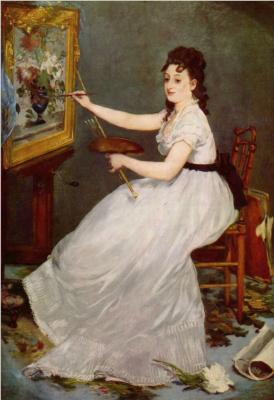
Barred from the École des Beaux-Arts on account of her sex, she trained with Charles Chaplin, a society portraitist who ran a studio specifically for women. In February 1869[1] she became the student and model of Édouard Manet, his only formally acknowledged pupil. She was twenty. When Manet exhibited his portrait of her at the 1870 Salon, critics attacked the canvas with a venom that said more about their anxiety over her position than about the painting itself; during the Franco-Prussian War siege that followed, Manet wrote to her from the besieged city expressing deep admiration.
She showed at the Salon throughout her career, following Manet's example rather than joining the independent Impressionist exhibitions. Her work moved from portraiture toward more atmospheric subjects: domestic interiors, theatre boxes, figures caught in quiet absorption. Une loge aux Théâtre des Italiens (1874[1]) was described as one of the most provocative paintings of its day when it was finally shown in 1879, having been rejected five years earlier. Her Nanny and Child (1878) struck critics with its harmonious greens and blues and quietly open narrative.
She died in May 1883[1], days after giving birth to her son, aged thirty-six. Retrospectives followed at the Salons de La Vie Moderne in 1885 and the Salon d'Automne in 1907, securing her place alongside Mary Cassatt, Berthe Morisot, and Marie Bracquemond as one of the central women painters of nineteenth-century French Impressionism.
Timeline
- 1849Born in Paris to Emmanuel Gonzalès, a novelist, and a musician mother.
- 1865Identified painting as her vocation at sixteen.
- 1869Became a student and model of Édouard Manet, aged 20.
- 1870Manet exhibited his portrait of her at the Salon; it was heavily criticised.
- 1874Painted "Une loge aux Théâtre des Italiens".
- 1878Painted "Nanny and Child".
- 1879"Une loge aux Théâtre des Italiens" was exhibited after being rejected five years earlier.
- 1883Died in May, days after giving birth to her son, aged 34.
Notable Works
Tap to view larger.
Where to See Eva Gonzales
3 museums worldwide.
-
1 works
Collection Rau for UNICEF
Remagen, Germany
-
1 works
Kunsthalle Bremen
Bremen, Germany
Tue 10:00–21:00, Wed–Sun 10:00–17:00/18:00 (seasonal), closed Mondays · €12–€15 adults
-
 1 works
Musée des beaux-arts de Marseille
Marseille, France
Tue–Sun 09:00–18:00, closed Mondays

Next stop
Browse the movements →
Every movement in the collection, from the Renaissance to Pop art.
Related Artists


Frequently Asked Questions
What is Eva Gonzales's most famous work?
It is difficult to name one single work as Eva Gonzales's most famous. However, several paintings are well known and frequently discussed. Gonzales was a student of Édouard Manet, and her work often shows the influence of Impressionism and Realism. She frequently depicted women in domestic or intimate settings. One notable painting is "Enfant de troupe" (1870[1]), which portrays a young boy in military uniform. Another is "Nanny and Child" (1877-78), a portrait of a woman holding a child. "La Toilette" (1875) is another significant work. It depicts a woman in her private space, getting ready. This painting is admired for its intimate portrayal of the subject and its delicate handling of light and colour. These paintings, among others, contribute to Gonzales's recognition as a talented artist of her time, even though her career was cut short by her early death at the age of 38.What style or movement did Eva Gonzales belong to?
Eva Gonzales was associated with Impressionism, although her work also shows the influence of Realism. She became a student of Édouard Manet in 1869[1], and he greatly affected her style and subject matter. Gonzales often depicted scenes of contemporary life, particularly portraits of women and domestic settings. Like other Impressionists, she was interested in capturing the effects of light and atmosphere in her paintings. However, her technique often involved more structured compositions and a greater emphasis on line than some of the more radical Impressionists like Monet or Renoir. While Gonzales exhibited with the Impressionists, she maintained a distinct artistic identity. Some critics have noted a certain formality in her work, setting it apart from the fleeting, spontaneous quality found in some Impressionist paintings. Her premature death at the age of 34 cut short a promising career.What was Eva Gonzales known for?
Eva Gonzales (1849[1]-1883[1]) was a French Impressionist painter. She is known as one of only a few female artists to exhibit regularly with the Impressionists. Gonzales began her formal training relatively late, at the age of sixteen, when she started studying drawing with Charles Chaplin. In 1869[1], she became a pupil of Édouard Manet. Gonzales's early work shows the influence of Manet, particularly in its use of a limited palette and its focus on contemporary subjects. Gonzales exhibited at the Salon for the first time in 1870, and she continued to show her work there throughout her career. She also exhibited with the Impressionist group in 1879. Her work includes portraits, still lifes, and genre scenes. Gonzales often depicted women in domestic settings, reading, sewing, or caring for children. She also painted portraits of other artists and writers, including Émile Zola. Gonzales's career was cut short by her death at the age of 34, from complications of childbirth. Despite her short career, she produced a substantial body of work and is recognised as an important figure in the Impressionist movement.When did Eva Gonzales live and work?
Eva Gonzales was born in Paris on 19 April 1847. She came from a cultured background; her father was a novelist. Gonzales began her formal art training relatively late, in 1865[1], when she started studying with the society portraitist Charles Chaplin. In February 1869, she became a pupil of Édouard Manet; this was around the time that Manet was painting "La Grenouillère". Gonzales posed for Manet in 1869-1870[1], and he began a portrait of her at the easel. Gonzales exhibited at the Salon from 1870 onwards. Her work was often compared to that of Manet and Berthe Morisot, another female Impressionist. Gonzales married the engraver Henri Guérard in 1879. She died in Paris on 5 May 1883[1], shortly after giving birth to a son. She was only 36 years old. A memorial exhibition of her work took place in 1885.Where can I see Eva Gonzales's work?
To view works by Eva Gonzales, visit museums that hold collections of Impressionist and Post-Impressionist art. These include institutions in both Europe and North America. The Musée des Arts Décoratifs, in Paris, displays fine and applied arts. Other French museums include the Musée des Beaux-Arts in Nancy and the Musée d’Art et d’Industrie in Roubaix. In Belgium, the Brangwyn Museum in Bruges may have relevant holdings. Spanish venues include the Museu d’Art Modern (MNAC) in Barcelona, and the Museo Art Nouveau y Art Deco in Salamanca. The Museu Calouste Gulbenkian is located in Lisbon, Portugal. In the United Kingdom, collections can be found at the Brighton Museum & Art Gallery, Manchester Art Gallery, the National Museums of Scotland (Royal Museum) in Edinburgh, and the Victoria & Albert Museum in London. North American museums include the Los Angeles County Museum of Art (LACMA), the Metropolitan Museum of Art in New York, and the Minneapolis Institute of Arts.Where was Eva Gonzales from?
Eva Gonzales was from Paris. She was born there on 19 April 1849[1]. Gonzales came from a cultured background. Her father was a novelist, and her mother was a musician. This environment encouraged her artistic interests from a young age. Gonzales became a student of Charles Chaplin, a well-regarded portrait painter, in 1865[1]. Later, in 1869, she became a student of Édouard Manet, whose work had a considerable effect on her own style. Gonzales exhibited at the Salon, the official art exhibition of the Académie des Beaux-Arts in Paris. Gonzales married the graphic artist Henri Guérard in 1879. She died in Paris on 5 May 1883[1], shortly after the birth of her son.Who did Eva Gonzales influence?
Eva Gonzales's connections to other artists are complex. The sculptor Julio Gonzalez felt a strong aesthetic connection with the Spanish artist Luis Fernandez. Fernandez's 1932 article in *A. C. Documentos de Actividad Contemporanea* defended Gonzalez's work, interpreting the sculptor's shift after the 1920s as a return to his Hispanic roots after a period influenced by French art. The article featured photographs of Gonzalez's sculptures, including *Composition*, *The Kiss I*, and *Couple/The Embrace*. Gonzalez's abstract principles, particularly between 1930 and 1935, inspired many artists. His focus on translating abstract ideas of colour and light, with references to the human image, influenced his sculpture in the 1930s. Alberto Magnelli's mid-1930s work with split and piled stones also impacted Gonzalez's concepts. Gonzalez created a lineage in modern sculpture that includes Picasso, David Smith, Mark di Suvero, and Eduardo Chillida. His contribution was the use of iron and steel as mediums.How did Eva Gonzales die?
Eva Gonzalès died in May 1883[1], aged thirty-six, just days after giving birth to her son.What is Eva Gonzales known for?
Eva Gonzalès is known for her paintings of domestic interiors, theatre boxes, and figures in quiet absorption. Her painting, Une loge aux Théâtre des Italiens (1874[1]), caused controversy when it was exhibited in 1879, and her Nanny and Child (1878) was noted for its harmonious colours and open narrative.What was Eva Gonzales's art style?
Gonzalès's work shifted from portraiture to more atmospheric subjects, such as domestic scenes and figures in quiet moments. Her paintings are associated with French Impressionism, though she exhibited at the Salon rather than with the Impressionists directly.When did Eva Gonzales die?
Eva Gonzales died in 1883[1] at the age of 34.
Sources
Editorial draws on the following primary and tertiary references for Eva Gonzales.
- [1] wikipedia Wikipedia: Eva Gonzales Used for: biography, birth dates, death dates, identifiers, movement attribution, nationality.
- [2] book 2019-05-01 Used for: biography.
- [3] book Penny Olsen, Collecting Ladies: Ferdinand Von Mueller and Women Botanical Artists Used for: biography.
- [4] book Landauer, Susan, The not-so-still life : a century of California painting and sculpture Used for: biography.
Editorial overseen by Solis Prints. Sources verified 2026-09-30. Click a source for details, or hover over [N] in the page above to preview.
Editorial standardsMethodologyCorrectionsAI disclosureAbout the editorial team