



Evelyn De Morgan
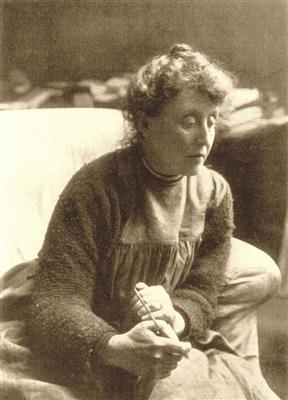
Evelyn De Morgan was born Mary Evelyn Pickering on 30 August 1855[2] in London, into a family with art already in its bloodlines. Her uncle was the painter John Roddam Spencer Stanhope, connected to the Pre-Raphaelite circle, and from a young age she received encouragement unusual for a Victorian girl with serious artistic ambitions. By fifteen she was taking drawing lessons; by seventeen she was enrolled at the Slade School of Art, one of the first women admitted, where she won the Slade Scholarship and multiple prizes.
Biography
Extended visits to Florence anchored her sense of form and allegory in the Renaissance masters, Botticelli above all. This Italian influence gives her paintings their particular quality: figures that feel simultaneously classical and unsettling, drawn from antiquity but saturated with personal meaning. Aurora Triumphans (1886[2]), The Love Potion (1903), and Helen of Troy (1898) place women at the centre of mythological narratives not as passive subjects but as bearers of hidden knowledge and autonomous will.
In 1887[2] she married William De Morgan, the ceramicist and later novelist, and the two formed an uncommon partnership. Both were ardent spiritualists, co-producing automatic writings that were published separately. Evelyn's convictions ran alongside vigorous public politics: she supported women's suffrage and was a committed pacifist, producing more than fifteen paintings in response to the Boer War and the First World War, images that turn the conventional imagery of battle into sustained lament.
She exhibited continuously from her debut at the Dudley Gallery in 1876[2] until a one-woman show of 25 works in Wolverhampton in 1907, after which ill health curtailed her practice. She died on 2 May 1919[2]. Works are held in the De Morgan Collection in Guildford, the Walker Art Gallery, and several National Trust properties; a major retrospective ran from April 2025 to January 2026 at the Guildhall Art Gallery.
Timeline
- 1855Born Mary Evelyn Pickering on 30 August in London. Her uncle was the painter John Roddam Spencer Stanhope.
- 1872Began taking drawing lessons at 15.
- 1872Enrolled at the Slade School of Art at 17, where she won the Slade Scholarship and multiple prizes.
- 1886Painted "Aurora Triumphans".
- 1887Married William De Morgan, a ceramicist and later novelist.
- 1898Painted "Helen of Troy".
- 1903Painted "The Love Potion".
- 1907Held a one-woman show of 25 works in Wolverhampton.
- 1919Died on 2 May.
Notable Works
Tap to view larger.
Next stop
Browse the movements →
Every movement in the collection, from the Renaissance to Pop art.
Frequently Asked Questions
What is Evelyn De Morgan known for?
Evelyn De Morgan is known for placing women at the centre of mythological narratives, portraying them not as passive subjects but as bearers of hidden knowledge and autonomous will. She also produced paintings in response to the Boer War and the First World War, turning conventional battle imagery into lament. Her paintings include Aurora Triumphans (1886[2]), The Love Potion (1903), and Helen of Troy (1898).What was Evelyn De Morgan's art style?
Evelyn De Morgan's art style was influenced by the Renaissance masters, especially Botticelli, which she encountered during extended visits to Florence. Her paintings have a classical feel, with figures drawn from antiquity but imbued with personal meaning. This Italian influence gave her work a distinctive quality.When did Evelyn De Morgan die?
Evelyn De Morgan died in 1919[2] at the age of 64.Who was Evelyn De Morgan?
Evelyn De Morgan, born Mary Evelyn Pickering, was a painter with connections to the Pre-Raphaelite circle through her uncle, John Roddam Spencer Stanhope. She received artistic training at the Slade School of Art and exhibited her work from 1876[2] until 1907. She was married to ceramicist William De Morgan.
Sources
Editorial draws on the following primary and tertiary references for Evelyn De Morgan.
- [1] museum Williamson Art Gallery and Museum Used for: museum holdings.
- [2] wikipedia Wikipedia: Evelyn De Morgan Used for: biography, birth dates, death dates, identifiers, movement attribution, nationality.
- [3] book Getty, Getty - Julia Margaret Cameron Complete Photographs Used for: biography.
- [4] book Engen, Rodney K, Pre-Raphaelite prints : the graphic art of Millais, Holman Hunt, Rossetti and their followers Used for: biography.
- [5] book Hodge, Susie, 1960- author, The short story of women artists : a pocket guide to movements, works, breakthroughs, & themes Used for: biography.
Editorial overseen by Solis Prints. Sources verified 2026-10-07. Click a source for details, or hover over [N] in the page above to preview.
Editorial standardsMethodologyCorrectionsAI disclosureAbout the editorial team