



Fede Galizia
She completed her first documented portrait at age twelve, an achievement that prompted the Milanese writer Paolo Morigia to name her as one of the remarkable talents of his city. Born in Milan in 1578[2] to Nunzio Galizia, a miniaturist, Fede Galizia was working professionally before most artists had completed their apprenticeship. She trained in her father's workshop, learning the precision and attention to surface that would define her mature style.
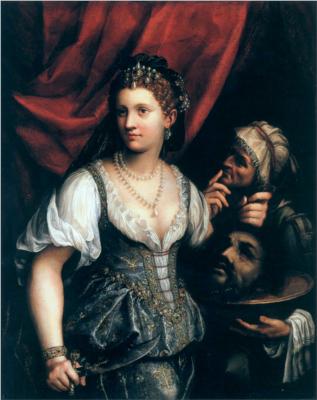
Biography
Galizia is best known today for two bodies of work: devotional paintings depicting Judith with the severed head of Holofernes, and a series of fruit still lifes that place her among the earliest specialists in that genre in Italian[2] painting. Her Judith compositions, the first of which dates to around 1596[2], present the biblical heroine with an unflinching directness that sits apart from more theatrical treatments of the subject. The still lifes, typically showing glass bowls, peaches, and cherries arranged on marble ledges, are notable for their clarity of observation and their sense of tactile weight.
Whether Galizia or the Bergamasque painter Ambrogio Figino arrived at the autonomous still life first remains a matter of scholarly dispute, but her fruit compositions were produced in parallel with the earliest Dutch and Flemish experiments in the genre. Working without court patronage and remaining unmarried throughout her life, she operated as an independent professional in a field where that was unusual for a woman.
She died in 1630[2], almost certainly during the plague epidemic that devastated Milan that year. Her reputation faded for centuries, but scholarly interest in early modern women artists revived her standing considerably from the 1970s onward.
Timeline
- 1578Born in Milan to Nunzio Galizia, a miniaturist.
- 1590Completed her first documented portrait at 12.
- 1596Created her first painting of Judith with the head of Holofernes.
- 1600Produced fruit still lifes, becoming one of the earliest specialists in the genre in Italian painting.
- 1630Died in Milan, likely during the plague epidemic, at 52.
Notable Works
Tap to view larger.
Next stop
Renaissance →
Explore the artists and ideas of Renaissance.
Related Artists


Frequently Asked Questions
What is Fede Galizia's most famous work?
It is difficult to name one single work as Fede Galizia's 'most famous'. She was a prolific artist active in the late 16th and early 17th centuries, and her artistic output covered both portraiture and still life. Galizia is recognised as one of the earliest artists to develop the still life genre. She is known for her paintings of fruit, often featuring a simple arrangement of a few pieces against a neutral background. These paintings display a close observation of detail. Her still life works include "Still Life with Peaches in a Pierced Porcelain Basket" and "Still Life with Fruit". In addition to still life, Galizia also painted religious subjects and portraits. Her portraits, such as that of Paolo Morigia, demonstrate her skill in capturing likenesses and character. The range of her subject matter makes it difficult to single out one definitive work as her most well-known.What should I know about Fede Galizia's prints?
Fede Galizia (1578[2]-1630[2]) was an Italian[2] painter of the early Baroque period, celebrated for her still-life works and portraits. Though she was a painter, prints were often made after paintings at the time. Prints from this period were often produced as engravings or etchings. Multiple artists were usually involved in the print-making process. For example, Philips Galle made engravings after Pieter Bruegel the Elder; Galle was the engraver, and Bruegel was the original artist. Similarly, Cornelis Cort made engravings after paintings by Frans Floris. Hieronymus Cock was a prominent publisher of prints during this era. The prints were often produced in series or sets; one example is a series on the history of Solomon, engraved by Philips Galle and Dirck Volckertsz. Coornhert after designs by Frans Floris. These prints served various purposes, from disseminating religious stories to circulating artistic ideas. The dimensions of these prints varied, but many were approximately 300 x 400 mm.What style or movement did Fede Galizia belong to?
Fede Galizia was active during a period of transition between the late Renaissance[2] and the early Baroque styles. The Renaissance, meaning "rebirth", saw artists return to classical models. Realism became more important, as artists worked to depict three-dimensional forms and employed perspective. However, by the late 16th century, some artists began to move away from the Renaissance ideals of balance and proportion. This led to Mannerism (roughly 1530-1580[2]), where artists intentionally distorted figures and space. The Baroque period (roughly 1600[2]-1750) saw artists favouring drama and strong emotion. Michelangelo da Caravaggio introduced a trend toward naturalism, using models from the streets and dramatic contrasts of light and shadow. Galizia's career began in the late 1500s. While the Renaissance emphasis on realism is present in her work, her attention to detail and naturalistic style also anticipate the Baroque.What techniques or materials did Fede Galizia use?
Fede Galizia was an Italian[2] painter of the late Renaissance[2] and early Baroque periods, who is best known for her still-life paintings. Galizia employed oil paint, applying it in thin layers. This technique allowed light to reflect from the ground layer, creating luminosity, especially in flesh tones. The ground layer, typically white chalk, provided an absorbent base, though it yellowed over time because of the oil medium. For her underdrawings, Galizia sometimes used red chalk to sketch the initial composition. This method allowed for a loose indication of shapes and positioning, and it was followed by more detailed work. The red underdrawing could be incorporated into the final work, adding detail to facial expressions. Galizia's palette was varied, including white, red, and brown. She used these colours to create highlights, shadows, and a sense of depth in her compositions. Her brushwork was precise, capturing details such as the texture of fruit and the folds of drapery.What was Fede Galizia known for?
Fede Galizia (1578[2]-1630[2]) was an Italian[2] Renaissance[2] painter. She is best known for her still-life paintings, a genre in which she was a pioneer, and for portraits. Born in Milan, Galizia was the daughter of miniaturist Nunzio Galizia. Her father trained her, and she was accomplished at a young age. She began her career as a portrait painter. Galizia's still-life works are celebrated for their precision and detail. Her compositions often feature fruit, such as peaches, apples, and pears, arranged in a simple, elegant manner. These paintings display a remarkable attention to detail and a keen observation of nature. She was able to create realistic depictions of fruit and other objects. Galizia received commissions from prominent patrons. Her success as an artist helped pave the way for other women artists in a male-dominated art world.When did Fede Galizia live and work?
Fede Galizia was born in Milan, sometime around 1578[2]. Her father, Nunzio Galizia, was also a painter; he moved to Milan from Trento. Galizia was a precocious artist, and she was already working as a portrait painter by the age of twelve. She received recognition as a painter of miniatures. However, she is better known for her still-life paintings; these make her one of the earliest Italian[2] artists to work in this genre. Galizia received commissions for religious works, as well as portraits. Her earliest dated work is a Saint Stephen, from 1602[2]. Her painting of Judith with the Head of Holofernes (1596, though other dates are given) is in Sarasota, Florida. A later version of Judith is in Milan. Fede Galizia died in Milan in 1630[2], a victim of the plague.Where can I see Fede Galizia's work?
Unfortunately, the provided text passages do not contain information about where to view works by Fede Galizia. The passages focus on the locations of works by Nicolas Poussin, with mentions of various museums and collections around the world, such as the National Gallery of Scotland, the Hermitage Museum, and the National Gallery of Art in Washington, D.C. Without specific references to Galizia's work, I cannot provide a detailed list of locations. To find where her paintings are exhibited, it is best to consult art databases, museum websites, or catalogues raisonnés dedicated to her oeuvre. These resources will offer the most accurate and up-to-date information on the current locations of her works.Where was Fede Galizia from?
Fede Galizia was born in Milan in 1578[2]. Her father, Annunzio Galizia, was a painter of miniatures who had relocated from Trento. It is likely that Annunzio trained his daughter, Fede. By the age of twelve, contemporary sources suggest that Galizia was already a working painter, and was considered a talented artist at that early age. Galizia died in 1630[2], a victim of the plague. Although she is best known for her still-life paintings, Galizia also painted portraits and histories. Her paintings are often described as being in the style of Caravaggio. One example is her *Judith and Holofernes* of 1597[2] (Sarasota, Ringling Museum). Another is her *Majolica Basket of Fruit* (1610; private collection), which recalls Caravaggio’s *Basket of Fruit* (c. 1597).Who did Fede Galizia influence?
It is difficult to identify the specific artists who were directly influenced by Fede Galizia, but her work exists within a context of broader artistic influence. The art of Caravaggio had a significant impact on numerous artists from various European countries. These included Dutch painters such as Hendrick ter Brugghen, Gerrit van Honthorst, and Dirck van Baburen; French artists like Simon Vouet, Valentin de Boulogne, and Georges de La Tour; and Spanish painters Francisco Ribalta, Jusepe de Ribera, and Diego Velázquez. Their artistic output is considered inconceivable without Caravaggio's example. Several artists, including Orazio Gentileschi, Bartolomeo Manfredi, Lionello Spada, Gerrit van Honthorst, Valentin de Boulogne, and Hendrick Ter Bruggen, created versions of "The Crowning", each with a slightly different focus. These paintings are seen as creative commentaries on Caravaggio's original work.Who influenced Fede Galizia?
Fede Galizia (1578[2]-1630[2]) was likely trained by her father, Annunzio Galizia, a painter of miniatures from Trento. Contemporary sources suggest that she was painting by the age of 12. Though she is often described as a Mannerist painter, her works have qualities associated with the Baroque style. Specifically, her paintings recall the style of Caravaggio. Her *Judith and Holofernes* of 1597[2] has half-length figures set close to the foreground, emerging from a dark background. The composition uses gestures to ensure the narrative is easily understood. Some believe the figure of Judith is a self-portrait, though there is no proof of this. Her still lifes also reflect Caravaggio's influence, as demonstrated by her *Majolica Basket of Fruit* (1610), which recalls Caravaggio’s *Basket of Fruit* of about 1597.Who was Fede Galizia?
Without specific reference material, I cannot provide a detailed biography of Fede Galizia. However, I can offer some general information about women artists of her era. During the late 16th and early 17th centuries, several women achieved recognition as painters, often specialising in portraiture. Lavinia Fontana, for example, gained considerable fame and patronage in Bologna. According to her biographer Carlo Cesare Malvasia (writing between 1616[2] and 1693), she was in great demand for portraits among the city's elite women. Fontana's success suggests that, while societal constraints existed, talented women artists could, and did, establish successful careers and achieve celebrity in their own lifetimes. Fontana painted Holy Family with Saints Margaret and Francis in 1578[2].Why are Fede Galizia's works important today?
Fede Galizia (1578[2]-1630[2]) was an Italian[2] Renaissance[2] painter. She is remembered today for her pioneering role as a female artist in a male-dominated art world, and for her accomplished still-life paintings. Galizia's artistic output spanned portraiture, religious subjects, and still life. She gained recognition early in her career; some sources claim she was painting portraits professionally by the age of twelve. Her skill in capturing detail and texture, particularly in still-life compositions, set her apart from many of her contemporaries. Her still-life works are especially notable for their simple arrangements and balanced compositions. They often feature fruit, such as peaches or apples, arranged in a sparse, yet visually pleasing manner. These paintings are considered among the earliest examples of still-life art by an Italian artist, predating many similar works by male artists. Galizia's art offers insight into the cultural and social context of the late Renaissance. Her success challenged gender norms and paved the way for future generations of female artists. Her paintings provide a valuable perspective on the artistic practices and patronage systems of her time.
Sources
Editorial draws on the following primary and tertiary references for Fede Galizia.
- [1] wikidata Wikidata: Q2428749 Used for: identifiers.
- [2] wikipedia Wikipedia: Fede Galizia Used for: biography, birth dates, death dates, identifiers, movement attribution, nationality.
- [3] book Artemisia Gentileschi, Delphi Complete Works of Artemisia Gentileschi (Illustrated) (Delphi Masters of Art Book 34) Used for: biography.
- [4] book Lilian H. Zirpolo, Historical Dictionary of Baroque Art and Architecture Used for: biography.
- [5] book Hodge, Susie, 1960- author, The short story of women artists : a pocket guide to movements, works, breakthroughs, & themes Used for: biography.
Editorial overseen by Solis Prints. Sources verified 2026-09-16. Click a source for details, or hover over [N] in the page above to preview.
Editorial standardsMethodologyCorrectionsAI disclosureAbout the editorial team