



Federico Zandomeneghi
Federico Zandomeneghi arrived in Paris in 1874[2] as a political fugitive turned painter, carrying the lessons of Florentine Macchiaioli landscape work and a restless temperament shaped by Risorgimento upheaval. Born in Venice on 2 June 1841[2] into a dynasty of sculptors (his grandfather had completed the Titian monument at the Frari), he enrolled at the Accademia di Belle Arti at fifteen before fleeing Austrian conscription in 1859. A brief attempt to join Garibaldi's forces in 1860 ended in imprisonment.
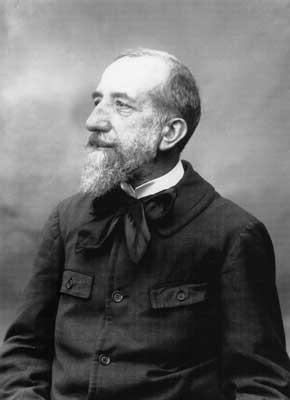
Biography
In Florence during the 1860s he haunted the Caffè Michelangiolo alongside Fattori, Signorini, and the other Macchiaioli, absorbing their commitment to painting outdoors from direct observation. By the early 1870s he had produced his first major work, the large Roman scene "I poverini sui gradini dell'Ara Coeli" (1872[2]), which earned him recognition at home. Paris, however, became his permanent stage.
Degas took to him quickly, and the friendship defined his mature career. Zandomeneghi participated in four Impressionist group exhibitions: 1879[2], 1880, 1881, and 1886, one of only a handful of non-French painters to be admitted to that circle. He shared Degas's preoccupation with the figure in domestic and social interiors, though critics consistently noted a warmer, more sentimental register in his work. Women at café tables, at their toilette, reading in quiet rooms, these were his subjects.
In the early 1890s he turned increasingly to pastel, a medium that suited both his palette and his interest in texture. Durand-Ruel began exhibiting his work in the United States, bringing commercial success that had long eluded him. He died in Paris on New Year's Eve 1917[2], having spent over four decades in the city that had made him.
Timeline
- 1841Born in Venice on 2 June. He came from a family of sculptors.
- 1856Enrolled at the Accademia di Belle Arti at fifteen.
- 1859Fled Austrian conscription.
- 1860Briefly joined Garibaldi's forces, which led to imprisonment.
- 1872Produced his first major work, "I poverini sui gradini dell'Ara Coeli", a large Roman scene.
- 1874Moved to Paris.
- 1879Participated in the Impressionist group exhibition.
- 1890Turned increasingly to pastel.
- 1917Died in Paris on New Year's Eve, aged 76.
Notable Works
Tap to view larger.
Where to See Federico Zandomeneghi
1 museum worldwide.
-
 2 works
Gallerie d'Italia – Milano
Milan, Italy
Tue–Sun 9:30–19:00, closed Mondays · €12 adults
Next stop
Browse the movements →
Every movement in the collection, from the Renaissance to Pop art.
Related Artists


Frequently Asked Questions
What is Federico Zandomeneghi's most famous work?
It is difficult to name one single work as Federico Zandomeneghi's 'most famous'. He is best known for his paintings and pastels of everyday life, particularly those depicting women in domestic settings or engaged in leisure activities. Zandomeneghi's style aligned with the Impressionist movement, focusing on capturing fleeting moments and the effects of light. He exhibited with the Impressionists in Paris, and his work shares similarities with that of Edgar Degas and Pierre-Auguste Renoir. Rather than one specific piece, it is the collection of his images of modern Parisian life that defines his artistic contribution. These works often portray intimate scenes, using delicate colours and a soft, diffused light to create a sense of immediacy and atmosphere.What should I know about Federico Zandomeneghi's prints?
Federico Zandomeneghi (1841[2]-1917[2]) was an Italian Impressionist painter. Although he is not as widely recognised as some of his contemporaries, prints of his works offer insight into the late 19th-century art market. The late 1800s saw a surge in interest in fine-art etchings. Print publishers, particularly in Britain, began issuing specialist magazines to meet demand. While magazines had previously included the odd etching, publications like *The Etcher* (1879[2]-1883[2]) and *English Etchings* (1881-1891) focused specifically on the medium. Continental printmaking had a rich tradition, and publishers often turned to talented reproductive etchers from abroad, who were more affordable than British artists. By 1880, the Printsellers’ Association did not require declaration of proof impressions for etchings, so edition details are incomplete compared to other methods like mezzotint. Prints provided a way for collectors to advertise their collections. Illustrated books, such as *Theatrum Pictorium* (1660), communicated the nobility of painting and the glory of the collector.What style or movement did Federico Zandomeneghi belong to?
Federico Zandomeneghi (1841[2]-1917[2]) was an Italian Impressionist painter. He is known for his depictions of modern Parisian life. Zandomeneghi moved to Paris in 1874[2]. There, he encountered artists like Edgar Degas, Pierre-Auguste Renoir, and Mary Cassatt. These relationships led him to adopt Impressionism. This style emphasised capturing fleeting moments and the effects of light. While associated with the Impressionists, Zandomeneghi maintained a distinct style. His work often featured a more intimate and domestic focus, particularly on women in everyday settings. He used pastels extensively, which gave his work a soft, delicate quality. Unlike some Impressionists who focused on outdoor scenes, Zandomeneghi frequently painted interior settings. He participated in several Impressionist exhibitions in the 1870s and 1880s. His involvement in these exhibitions cemented his place within the movement. Although he was Italian, his artistic career was principally French. He contributed to the development and diffusion of Impressionism.When did Federico Zandomeneghi live and work?
Federico Zandomeneghi (1841[2]-1917[2]) was an Italian artist who spent much of his career in Paris. Born in Venice, he came from a family of sculptors; his grandfather Luigi Zandomeneghi created the monument to Titian. His father, Pietro Zandomeneghi, was also a sculptor. Zandomeneghi initially trained in Venice and then at the Academy of Fine Arts in Milan. Early in his career, he associated with the Macchiaioli group, Florentine painters who reacted against academic conventions. He fought with Garibaldi's army in 1866[2]. By 1874, Zandomeneghi had moved to Paris, where he associated with Impressionist artists such as Edgar Degas, Pierre-Auguste Renoir, and Mary Cassatt. He participated in several Impressionist exhibitions between 1879 and 1886. Although Italian, Zandomeneghi became known for paintings and pastels depicting modern Parisian life, particularly women in domestic settings. He is buried in the Cimetière de Montmartre, Paris.Where can I see Federico Zandomeneghi's work?
It is difficult to pinpoint specific locations for viewing works by Federico Zandomeneghi. However, some museums and galleries known to hold paintings by Nicolas Poussin may be a starting point for research. In the United Kingdom, The National Gallery in London holds several paintings. These include The Adoration of the Golden Calf, The Adoration of the Shepherds, The Annunciation, Cephalus and Aurora, Landscape with a Man Killed by a Snake, Landscape with a Man Washing His Feet at a Fountain, and The Nurture of Bacchus. The Wallace Collection, also in London, has A Dance to the Music of Time. The Dulwich College Picture Gallery has Landscape with a Roman Road, The Nurture of Jupiter, The Return of the Holy Family from Egypt, Rinaldo and Armida, The Triumph of David, Venus and Mercury, and The Virgin Protecting the City of Spoleto. Outside the UK, the Prado in Madrid has Apollo and the Muses on Parnassus, Landscape with Buildings, Landscape with St Jerome, Meleager and Atalanta Hunting, St Cecilia, and The Triumph of David. The National Gallery of Victoria in Melbourne has The Crossing of the Red Sea. The Minneapolis Institute of Arts has The Death of Germanicus. The Pushkin Museum of Fine Arts in Moscow has The Continence of Scipio and Landscape with Hercules and Cacus.Where was Federico Zandomeneghi from?
Federico Zandomeneghi was Italian. Although he spent a significant portion of his career in Paris, associating with Impressionist artists, he was born in Venice in 1841[2]. Zandomeneghi came from an artistic family. His father, Pietro Zandomeneghi, was a sculptor, providing Federico with his earliest artistic training. His grandfather, Luigi Zandomeneghi, was also a noted sculptor. Federico initially studied at the Academy of Fine Arts in Venice, and later in Milan. Early in his career, he was involved with the Italian liberation movement, which caused a temporary pause in his artistic pursuits. Later, he gravitated towards the Macchiaioli group, Italian painters whose work prefigured some of the aims and techniques of the Impressionists. In 1874[2], Zandomeneghi moved to Paris, where he would remain for the rest of his life. There, he became friends with artists such as Edgar Degas, Pierre-Auguste Renoir, and Mary Cassatt, exhibiting with the Impressionists in several of their exhibitions.Who did Federico Zandomeneghi influence?
Federico Zandomeneghi's artistic impact is complex. He is often considered among the Italian Impressionists, although his style also aligns with Post-Impressionism. Zandomeneghi's focus on modern life, particularly women in domestic settings, echoes the concerns of Edgar Degas and Pierre-Auguste Renoir. His use of pastel and broken colour shows an understanding of Impressionist techniques. Yet, his work maintains a distinctive Italian sensibility. It is difficult to identify direct pupils or a formal school of followers. However, Zandomeneghi's participation in the Parisian art scene exposed his work to a broad audience. This undoubtedly affected younger artists. His stylistic choices, particularly his use of pastel and intimate subject matter, may have resonated with artists interested in depicting modern life with a degree of psychological depth. His work provides an example of an Italian artist synthesising Impressionist ideas with his own artistic background. This cross-cultural exchange is an important element of late 19th-century art.Who influenced Federico Zandomeneghi?
It is difficult to summarise the influences on Federico Zandomeneghi's art. However, a review of art history reference indexes suggests some possible names. Paul Gauguin, Jean-Baptiste Greuze, Francisco José Goya y Lucientes, Henri Fantin-Latour, and Vincent van Gogh are listed in connection with Zandomeneghi. Other artists listed include Eugène Fromentin, James Ensor, and Thomas Gainsborough. Without more context, it is hard to assess the nature of any influence. The listing of a name does not necessarily mean a direct artistic connection. It could refer to similarities in style, subject matter, or technique; or it could simply mean that the artists were contemporaries or exhibited in the same circles. Further research would be needed to determine the specific ways in which these, or other, artists might have affected Zandomeneghi's artistic development.Who was Federico Zandomeneghi?
Federico Zandomeneghi (1841[2]-1917[2]) was a Venetian artist who spent much of his career in France. He initially aligned himself with the Macchiaioli group in Florence from 1862[2] to 1874. Afterward, he relocated to Paris. By the late 1870s, Zandomeneghi was a regular at the Café de la Nouvelle-Athènes, where he encountered Edgar Degas and Camille Pissarro. Gradually adopting Impressionism, he exhibited with the Impressionists in 1879, 1880, 1881, and 1886, largely due to Degas's encouragement. During the 1880s, he resided near Renoir, Suzanne Valadon, and Toulouse-Lautrec in the rue Tourlaque. Durand-Ruel promoted Zandomeneghi in the early 1890s; however, his reputation in France remained in the shadow of Degas and Renoir. Recognition in Italy only came posthumously. Zandomeneghi excelled in depicting Parisian middle-class women, with male figures rarely appearing in his compositions. His painting Conversation, from about 1892, is considered one of his best, part of a series showing women reading, chatting, or listening to music. The work displays the influence of Renoir in its depiction of women, and of Degas in its unusual composition.Why are Federico Zandomeneghi's works important today?
Federico Zandomeneghi (1841[2]-1917[2]) was an Italian Impressionist painter. Although overshadowed by his French contemporaries, his contributions to the movement offer a unique perspective. Zandomeneghi moved to Paris in 1874[2], where he encountered Impressionism. He exhibited with the group in several exhibitions, including those of 1879, 1880, 1881, and 1886. Unlike some Impressionists who concentrated on outdoor scenes, Zandomeneghi often depicted intimate, domestic interiors and portraits of women. These works provide insights into the lives of Parisian women during the late 19th century. His style combined Impressionist techniques with a distinct Italian sensibility. His use of pastel is notable. He captured subtle nuances of light and colour. While influenced by artists like Degas, Zandomeneghi developed his own approach to composition and subject matter. His works offer a valuable contribution to the Impressionist movement, showing its international reach and diverse interpretations. They provide a view into a specific social context.How did Federico Zandomeneghi die?
Federico Zandomeneghi died in Paris on New Year's Eve in 1917[2]. He had lived in the city for over four decades.What is Federico Zandomeneghi known for?
Federico Zandomeneghi is known for his association with the Impressionist group and his paintings of figures in domestic and social interiors. He participated in four Impressionist group exhibitions between 1879[2] and 1886. His work often depicted women at café tables, at their toilette, or reading in quiet rooms.
Sources
Editorial draws on the following primary and tertiary references for Federico Zandomeneghi.
- [1] museum Gallerie d'Italia – Milano Used for: museum holdings.
- [2] wikipedia Wikipedia: Federico Zandomeneghi Used for: biography, birth dates, death dates, identifiers, movement attribution, nationality.
- [3] book Neoclassicism and romanticism : architecture, sculpture, painting, drawings, 1750-1848 Used for: biography.
- [4] book Post-impressionism : cross-currents in European painting Used for: biography.
- [5] book Post-impressionism : cross-currents in European painting Used for: biography.
Editorial overseen by Solis Prints. Sources verified 2026-09-30. Click a source for details, or hover over [N] in the page above to preview.
Editorial standardsMethodologyCorrectionsAI disclosureAbout the editorial team