

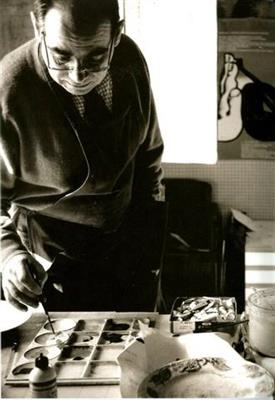
Ferenc Pinter
Ferenc Pinter was born in 1931[1] in Alassio on the Italian Riviera, to a Hungarian father and an Italian mother, and spent much of his life moving between those two identities. In 1940[1] the family relocated to Budapest, where he grew up and attempted to enter the Academy of Fine Arts, only to be rejected for refusing to align himself with the communist cultural orthodoxy then dominant in Hungary. He taught himself instead.
Biography
After the Hungarian Revolution of 1956[1], Pinter fled to Milan. Within days of arriving, he had been commissioned to paint an 80-square-metre mural for Radio Marelli, a commission that announced both his ambition and his facility at scale. By 1960 he had joined Mondadori, the Italian publishing house, with which he would collaborate for 32 years. He produced covers and interior illustrations for the Segretissimo crime series, for the Italian translations of Agatha Christie and Maigret, and for the mass-market Oscar Mondadori imprint: work that gave him wide popular reach but was rarely classified as fine art.
His preferred medium was tempera, which suited the precision and surface richness his illustration work demanded. In 1989[1] he channelled that precision into the project for which he is perhaps best remembered outside illustration circles: 22 paintings representing the Major Arcana of the Tarot, published by Lo Scarabeo of Turin with a foreword by the art historian Federico Zeri. The 56 Minor Arcana followed between 2000 and 2002, completing a deck that drew on Renaissance and Mannerist precedents with considerable iconographic care.
He died in Milan on 28 February 2008[1].
Timeline
- 1931Born in Alassio, on the Italian Riviera, to a Hungarian father and an Italian mother.
- 1940Relocated to Budapest with his family.
- 1956Fled to Milan after the Hungarian Revolution.
- 1956Commissioned to paint an 80-square-metre mural for Radio Marelli in Milan.
- 1960Joined Mondadori publishing house in Italy.
- 1989Published 22 paintings representing the Major Arcana of the Tarot, with Lo Scarabeo of Turin.
- 1992Ended his 32-year collaboration with Mondadori.
- 2000Began work on the 56 Minor Arcana, completing them in 2002.
- 2008Died in Milan on 28 February, aged 77.
Notable Works
Tap to view larger.
Next stop
Browse the movements →
Every movement in the collection, from the Renaissance to Pop art.
Frequently Asked Questions
What is Ferenc Pinter's most famous work?
Ferenc Pinter (born 1931[1]) is best known for his paintings of Hungarian rural life and the natural world. While no single work has achieved overwhelming international fame, his oeuvre is well regarded within Hungary. Pinter's paintings often depict scenes from the Great Hungarian Plain (Alföld), featuring agricultural workers, animals, and the vast open skies of the region. His style blends realism with elements of impressionism, using colour and light to evoke the atmosphere of the Hungarian countryside. He has also produced numerous still life works and portraits. Although Pinter's work is not widely represented in major international collections, he has had many solo exhibitions in Hungary. His paintings are held in the collections of various Hungarian museums and private collections. He is considered an important figure in 20th- and 21st-century Hungarian art, particularly for his contribution to the tradition of rural genre painting.What should I know about Ferenc Pinter's prints?
Ferenc Pinter (born 1931[1]) is a Hungarian-Canadian artist known for his printmaking. He studied at the Hungarian Academy of Fine Arts in Budapest, an institution with a long history of artistic training. Pinter's studies there provided him with a strong foundation in traditional techniques. After the Hungarian Revolution of 1956[1], Pinter left Hungary. He emigrated to Canada, where he continued his artistic practice. His work often explores themes of memory, displacement, and cultural identity, reflecting his personal experiences as an émigré. Pinter's prints often feature detailed compositions and a careful attention to light and shadow. He frequently employs techniques such as etching and aquatint to achieve a range of tonal effects. These methods allow him to create images with considerable depth and texture. His subject matter includes figurative studies, still lifes, and scenes inspired by both European and Canadian settings. Pinter's prints are included in numerous public and private collections.What style or movement did Ferenc Pinter belong to?
It is difficult to assign Ferenc Pinter to a single style or movement based on the passages provided. The texts discuss movement in art, particularly dance and acrobatics, as forms of expression. They also touch on the analysis of movement, gesture, and their psychological effects. One passage mentions Abstract Expressionism and Art Informel, both of which involve improvisation and free brushstrokes. The passages also refer to the Bauhaus school, which aimed to integrate art and design into daily life with a simple, geometrical style. The passages suggest a connection between poetics, gesture, and movement, linking writing to other artistic forms. The analysis of movement is explored through various means, including graphic notes, photography, drawing, and musical scores. The goal is to understand the inner impression and psychological effect of movement on the human soul. Without more specific information, it is impossible to definitively place Pinter within a particular artistic movement.What techniques or materials did Ferenc Pinter use?
Ferenc Pinter (born 1931[1]) is known for his work in graphic art, particularly his linocuts and woodcuts. These are relief printing techniques, where the artist carves an image into a block of linoleum or wood. The raised areas receive ink, while the carved-away areas remain blank. The block is then pressed onto paper, transferring the inked image. Pinter's prints often feature strong contrasts between black and white, achieved through careful cutting and inking. The nature of linocut and woodcut printing lends itself to bold lines and simplified forms, characteristics visible in Pinter's style. These techniques allow for the creation of multiple impressions from a single block, making printmaking a medium for wider distribution of his artistic vision. The specific types of inks and papers Pinter employed are less well documented, but he likely used oil-based inks common in printmaking for their rich colour and durability.What was Ferenc Pinter known for?
Ferenc Pinter (dates unknown) was known for his geometric abstract works, often executed in tempera on paper or masonite. Later in his career, he also used acrylic on canvas. His pieces frequently took the form of studies or were part of numbered series such as "Opus". For example, "Study 353 B" dates to 1930, while "Opus 36" is from 1942[1]. Other works include "ME43B", "Study 102", and "ME 23". Some pieces have two dates, such as "ME43B, 1932-73", and "Opus 6, 1942-52". Many of Pinter's works are relatively small, around 4 x 6 inches, though some are much larger. Several of his works are in the collection of the Solomon R. Guggenheim Museum in New York. These include "ME 429" (1938), "Opus 36" (1942), "Opus 91" (1958), and "Opus 70" (1959).Where can I see Ferenc Pinter's work?
It is difficult to pinpoint exactly where to view works by Ferenc Pinter. However, several museums and galleries across Europe and North America feature art from related movements and periods, such as Art Deco and Post-Impressionism. These collections may include works with similar themes, styles, or techniques. In Switzerland, consider visiting the Kunstmuseum in Basle, or the Kunsthaus in Zurich. In Berne, both the Kunstmuseum and the Gottfried Keller Stiftung may hold relevant pieces. The Musée d’Art et d’Histoire in Geneva also has collections of interest. Elsewhere in Europe, the Museo Nacional del Prado in Madrid and the National Gallery of Scotland in Edinburgh may be of interest. In the United States, the Metropolitan Museum of Art in New York, and the Los Angeles County Museum of Art (LACMA) hold relevant collections.Where was Ferenc Pinter from?
Ferenc Pinter was born in Kispest, Austria-Hungary, in 1931[1]. Kispest was a separate town at the time; it became part of Budapest in 1950[1] as District XIX. Pinter studied at the Academy of Fine Arts in Budapest. He was part of a generation of Hungarian artists whose careers began after the Second World War. These artists often worked within the socialist realist style that was favoured by the state. However, many also sought to incorporate other influences into their work. Pinter emigrated from Hungary after the 1956 revolution. He moved to Paris, where he lived and worked for the rest of his life. He became known for his paintings and prints, often featuring abstract or semi-abstract compositions. His work was exhibited in galleries and museums throughout Europe. Pinter died in Paris in 2008[1].Who did Ferenc Pinter influence?
Ferenc Pinter's direct artistic influence is not well documented. However, the broader artistic movements to which he belonged had international reach. The New York School, particularly figures like Cage, Boulez, and Stockhausen, impacted the course of avant-garde music in Europe. Their notational innovations redefined the role of the performer, who became a creator as well as an interpreter. Figures such as Earle Brown acted as a bridge, influencing European composers like Luciano Berio and Witold Lutoslawski. The free approach to art-making that Carl Jung described also affected the art world after 1945[1]. The New York School's Abstract Expressionism broke new ground and shaped the art world internationally for two decades. Peggy Guggenheim offered opportunities to both emigrant and unknown painters, building relationships with artists such as Pollock, Kline, de Kooning and Motherwell.Who influenced Ferenc Pinter?
It is difficult to identify specific influences on Ferenc Pinter, as information about his artistic development is scarce. However, we can consider the broader artistic context of his time and place. Pinter was born in Hungary, a nation with a rich artistic heritage. Hungarian art in the 20th century was characterised by diverse styles, including those who embraced academic traditions and those who experimented with modernism. Artists associated with the group known as The Eight, active in the early 20th century, introduced cubist and expressionist ideas into Hungarian art. Later generations of Hungarian artists had to negotiate socialist realism, the official style promoted by the communist regime after World War II. Without more specific biographical information, it is impossible to say whether Pinter aligned himself with any of these movements or whether he drew inspiration from other sources, such as folk art or international trends. Further research into Pinter's life and work would be needed to determine the specific influences that shaped his artistic vision.Why are Ferenc Pinter's works important today?
Ferenc Pinter (born 1931[1]) is a Hungarian-Canadian artist known for his printmaking and painting. His works often explore themes of urban life, nature, and the human figure. Pinter's artistic approach combines traditional techniques with modern sensibilities. He uses etching, aquatint, and other printmaking methods to create images with detailed textures and tonal variations. His paintings, often in watercolour or acrylic, display a similar attention to detail and a careful consideration of light and shadow. Although Pinter's art is not associated with a single, easily defined movement, his focus on craftsmanship and his engagement with contemporary subjects have earned him recognition. His prints and paintings are held in numerous public and private collections, including the National Gallery of Canada. He has also received several awards for his work. Pinter's art provides a view into the artist's personal experiences and observations, offering viewers a chance to connect with the world around them in new ways.How did Ferenc Pinter die?
Ferenc Pinter died in Milan on 28 February 2008[1].What is Ferenc Pinter known for?
Pinter is best known for his illustration work with Mondadori, including covers for the Segretissimo crime series and Italian translations of Agatha Christie. Outside of illustration circles, he is remembered for his 22 paintings representing the Major Arcana of the Tarot, published in 1989[1].
Sources
Editorial draws on the following primary and tertiary references for Ferenc Pinter.
- [1] wikipedia Wikipedia: Ferenc Pinter Used for: biography, birth dates, death dates, identifiers, movement attribution, nationality.
- [2] book Beard, Lee, 1973- author, Butler, Adam, author; Van Cleave, Claire, author; Fortenberry, Diane, author; Stirling, Susan, author, Beard, Lee, 1973- author, Butler, Adam, author; Van Cleave, Claire, author; Fortenberry, Diane, author; Stirling, Susan, author - The Art Book_ New Edition, Mini Format Used for: biography.
- [3] book guggenheim-guhe00solo Used for: biography.
- [4] book Masterpieces of western art : a history of art in 900 individual studies from the Gothic to the present day Used for: biography.
Editorial overseen by Solis Prints. Sources verified 2026-08-03. Click a source for details, or hover over [N] in the page above to preview.
Editorial standardsMethodologyCorrectionsAI disclosureAbout the editorial team