

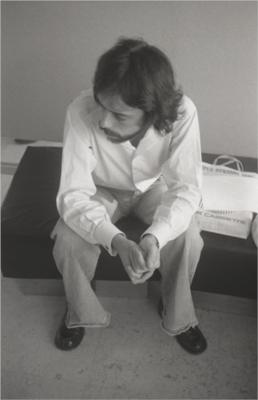
Fernando Calhau
Fernando Calhau arrived at minimalism from two directions at once: a Portugal that was politically suffocating under the Estado Novo, and a London where pop art, conceptual practice, and the Art and Language movement were redefining what a picture could do. Born in 1948[1], he studied painting at the Lisbon School of Fine Arts and learned printmaking at Gravura, the engravers' cooperative that also served as a conduit for American art magazines. It was through the pages of Art in America that he first encountered minimalist and pop creative practices.
Biography
In 1973[1], supported by a Gulbenkian Foundation grant, Calhau moved to London to study printmaking with Barto dos Santos at the Slade School of Fine Art. The works he made in London — photo-etchings of grass, soil, sea — were resolutely quiet, their silence a strategic refusal of the commercial advertising and political propaganda that saturated urban culture on both sides of the Channel. For the critic Ernesto de Sousa, it was precisely that silence, that willingness to leave empty space, that gave Calhau's practice its rupturing force.
His methods were also linguistically charged. A screen print from 1969[1] to 1970 placed the Portuguese flag's green and red bands alongside the phrase natureza morta — meaning both still life and dead nature — turning a painting term into a political diagnosis of stalled Portugal. Later photo-etchings played with visual-verbal echo: Untitled #714 inscribes 'high sea' and 'I see' in two corners, their sounds converging into a loop that destabilises fixed perception.
Calhau was among the first artists to introduce photography in Portugal as a serious creative medium, reframing the camera not as documentation but as a way of renegotiating memory and reality. He died in 2002[1], aged fifty-three, leaving a body of work that has been slowly reappraised as one of the most formally rigorous contributions to Portuguese conceptual art.
Timeline
- 1948Born in Portugal.
- 1969Created a screen print placing the Portuguese flag's green and red bands alongside the phrase natureza morta.
- 1970Continued working on the screen print with the Portuguese flag and the phrase natureza morta.
- 1973Moved to London at 25 to study printmaking with Barto dos Santos at the Slade School of Fine Art, supported by a Gulbenkian Foundation grant.
- 1973Created photo-etchings of grass, soil, and sea in London.
- 2002Died at 53. His work has been reappraised as a contribution to Portuguese conceptual art.
Notable Works
Tap to view larger.
Next stop
Browse the movements →
Every movement in the collection, from the Renaissance to Pop art.
Frequently Asked Questions
What should I know about Fernando Calhau's prints?
Fernando Calhau's prints, like those of many artists, exist in a complex marketplace with specific terminology. It is important to understand the differences between an original print, a limited edition, and a reproduction. The Professional Art Dealers Association of Canada defines an original print as an image conceived and executed solely as a print, usually in a numbered edition, and signed by the artist. Each print is made individually from a plate, stone, screen or block created for that purpose. The artist determines the number of prints in the edition, and sequential numbering accounts for all of them. In contrast, a reproduction is a copy of artwork initially conceived in another medium, such as painting or watercolour, and is usually made using photomechanical means. Numbering and signing a reproduction does not change its essence; it remains a reproduction, not an original print. Understanding these distinctions helps in appreciating the artistic intent and value of Calhau's prints, and in navigating the marketplace.What style or movement did Fernando Calhau belong to?
Fernando Calhau (1948[1]-2002[1]) was a Portuguese artist who worked across several media. He is often associated with conceptual art and experimental practices that emerged in the latter half of the 20th century. Calhau's work engaged with ideas around language, communication, and the nature of art itself. He explored these themes through photography, film, video, and installation, often incorporating text and found objects into his pieces. His approach was characterised by a critical examination of systems and structures; this places him within a broader context of conceptual art that questioned traditional artistic conventions. While not fitting neatly into any single category, Calhau's output shares affinities with movements such as Arte Povera and Fluxus, both of which challenged established norms and embraced unconventional materials and methods. His interest in process and dematerialisation aligns him with conceptual tendencies that prioritised the idea behind the artwork over its physical form. Calhau's contribution lies in his exploration of these concepts within a Portuguese context, contributing to the development of experimental art in the country.What techniques or materials did Fernando Calhau use?
Fernando Calhau's practice involved a range of techniques and materials. Painters have traditionally employed diverse materials, including natural pigments in fresco, egg tempera, watercolour, and oil paint. Contemporary materials include acrylics, household emulsions, and mixed media, which combines various materials in a single artwork. Sculptors have historically used wood, marble, and bronze. Contemporary sculptors also incorporate non-art materials such as cardboard, plastic, and everyday household items. Techniques include applying oil paint thickly in impasto or thinly in glazes. Brushwork varies from fine and disguised to thickly applied with a palette knife or stencilled. Sculptural techniques include carving, modelling in clay, casting (such as the lost-wax process), assemblage, and the use of readymades and found objects. The cost of materials often determined an artwork's value, with expensive pigments like malachite, azurite, cinnabar, and Egyptian blue being highly prized.What was Fernando Calhau known for?
Fernando Calhau (1948[1]-2002[1]) was a Portuguese artist who worked across several media. He is best known for his photography, experimental film, and video art. Calhau’s work often explored themes of language, communication, and perception. He began his artistic career in the 1970s, a period of political and social change in Portugal following the Carnation Revolution. During this time, Calhau participated in various exhibitions and artistic events. His early work included photography and film, often incorporating text and image to create conceptual pieces. In the 1980s and 1990s, Calhau continued to develop his artistic practice, experimenting with new technologies and media. He produced a number of video installations that explored the relationship between the viewer, the image, and the space. Calhau also created public art projects, including interventions in urban environments. His work has been exhibited in Portugal and internationally, and he is considered an important figure in the development of contemporary art in Portugal.When did Fernando Calhau live and work?
Fernando Calhau was a Portuguese artist who came to prominence in the late 1960s and 1970s. In 1968[1], he had his first solo exhibition at the Gravura cooperative in Lisbon, where he showed white engravings exploring the effects of metal on paper. Calhau graduated in painting from the Lisbon School of Fine Art in 1973. From 1973 to 1974, he studied printmaking with Barto dos Santos at the Slade School of Fine Art in London, supported by a grant from the Gulbenkian Foundation. While in London, he saw exhibitions of Pop art and Conceptual art, including a cycle of Andy Warhol's films at the Institute of Contemporary Arts in 1974. This period allowed him to experiment with photo-etching, photographing nature and working with seriality and reproducibility. After the 1974 revolution in Portugal, Calhau's work was part of a revision of Portuguese artistic production. He was included in the exhibition "Alternative Zero" in 1977, which presented artists experimenting with new artistic expressions. Calhau's film *Destruction* (1975) used a Super 8 camera to capture the artist painting a black cross inside a black frame, eventually covering the image with black strips, culminating in a black square.Where can I see Fernando Calhau's work?
Fernando Calhau's work can be viewed in several public collections. These include the Calouste Gulbenkian Museum, the Serralves Museum, and the National Museum of Contemporary Art (all in Portugal). His pieces are also held in various private collections, mainly in Portugal and other parts of Europe. Calhau's artistic output includes painting, drawing, and printmaking. He is known for his abstract style, often employing geometric forms and a restricted colour palette. His prints frequently explore themes of space, light, and movement. Exhibitions of Calhau's work have been held regularly since the 1970s. These exhibitions have taken place in galleries and museums across Portugal, as well as in other European countries such as Spain and France. Catalogues of these exhibitions, when available, provide further information about the specific works displayed and their locations. Contacting the museums listed above directly is a good way to learn about specific pieces on display.Where was Fernando Calhau from?
Fernando Calhau was Portuguese. He graduated in painting from the Lisbon School of Fine Art in 1973[1]. During his early career, Calhau was associated with the Gravura (Engraving), a cooperative in Lisbon. There, he held his first solo exhibition in 1968, presenting white engravings that explored the effects of metal on paper. Calhau's artistic development was influenced by international trends such as minimalism and pop art, which he encountered through magazines at the Gravura. His work often employed minimal expressive means, such as the black square, and explored seriality and repetition. In the 1970s, Calhau received a grant from the Gulbenkian Foundation to study printmaking at the Slade in London from 1973 to 1974. This period in London allowed him access to new techniques, such as photosensitive sealing films for transferring photographic images to metal plates. His time in London also exposed him to a broader artistic context, which influenced his later work.Why are Fernando Calhau's works important today?
Fernando Calhau's work is significant for its engagement with contemporary issues and its innovative approach to perception. His art coincided with a period of revision in Portuguese art after the 1974[1] revolution, as artists experimented with new forms of expression. Calhau's work was included in the exhibition ‘Alternative Zero’ in 1977, which presented artists who were exploring performance, installation, and video. Calhau's artistic journey took him to London, where he studied printmaking at the Slade in 1973 and 1974, supported by a Gulbenkian Foundation grant. Before this, he trained in painting and printmaking in Lisbon, where he was exposed to pop and minimalist practices. His London works responded to the challenges of the contemporary environment. His photo-etchings, which often focused on a single object, offered a silent contrast to the commercial and political noise of the time. One such work, *Untitled #714* (1974), uses image and text to explore the instability of perception. Calhau's art proposed a secluded experience that engaged with memory, not immediate stimuli. He also introduced photography as a creative tool, reconfiguring our relationship with reality.How did Fernando Calhau die?
Fernando Calhau died in 2002[1] at the age of fifty-three.What is Fernando Calhau known for?
Fernando Calhau is known for introducing photography as a serious creative medium in Portugal. He reframed the camera as a tool for renegotiating memory and reality, rather than simply for documentation. His work often combined visual and verbal elements, creating loops that destabilised fixed perception.What was Fernando Calhau's art style?
Calhau's art style evolved from minimalism, influenced by pop art and conceptual practices. His works often featured quiet, understated imagery, such as photo-etchings of grass, soil, and sea. He also incorporated linguistic elements into his art, creating visual-verbal echoes that challenged fixed perceptions.When did Fernando Calhau die?
Fernando Calhau died in 2002[1] at the age of 54.
Sources
Editorial draws on the following primary and tertiary references for Fernando Calhau.
- [1] wikipedia Wikipedia: Fernando Calhau Used for: biography, birth dates, death dates, identifiers, movement attribution, nationality.
- [2] book guggenheim-newimagesfromspa00ro Used for: biography.
- [3] book guggenheim-refigur00kren Used for: biography.
Editorial overseen by Solis Prints. Sources verified 2026-09-30. Click a source for details, or hover over [N] in the page above to preview.
Editorial standardsMethodologyCorrectionsAI disclosureAbout the editorial team