

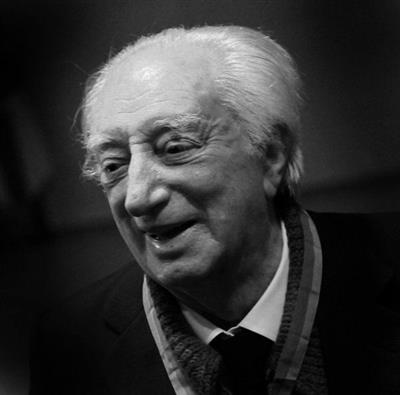
Fernando Lanhas
Fernando Lanhas began painting on pebbles in 1949[1]. It sounds eccentric until you understand his practice: he had already developed a precise chromatic system derived from the natural tones of dried stones, and painting directly on them was a logical extension of a project that treated colour as something discovered rather than invented. He later abandoned the method, worried it had industrialised his palette. That scruple tells you something about how seriously he took his work.
Biography
Born in Porto in 1923[1] as Fernando Resende da Silva Magalhães Lanhas, he trained as an architect at the Escola Superior de Belas Artes do Porto, graduating in 1947[1] with a museum project that scored 19 out of 20. He had started painting three years earlier, participating in the Independent Exhibitions (1944-1950[1]) that placed him among the first wave of Portuguese geometric abstractionists. His key work from that period, O2-43-44 (begun 1943, completed 1944), demonstrated what he was after: total two-dimensionality, autonomous colour surfaces, a construction that felt logically inverted from anything that had come before in Portuguese painting.
The breadth of his intellectual life was unusual even by the standards of a polymathic century. Alongside architecture and painting he worked as an archaeologist, astronomer, poet, and museologist, directing the Ethnographical and Historical Museum of Porto from 1973[1] to 1993. He served as Secretary General for the Geography of Colour exhibition at the Centre Georges Pompidou in Paris in 1977. He represented Portugal at the Venice Biennale (1954) and at the São Paulo Biennial five times (1955, 1957, 1959, 1961, and 1975).
He received the Grande Prémio Amadeu de Souza-Cardoso in 1997[1]. His professional archive, covering architectural projects, research panels, and interdisciplinary materials, was donated to the Marques da Silva Foundation. He died in Porto on 4 February 2012[1].
Timeline
- 1923Born in Porto as Fernando Resende da Silva Magalhães Lanhas.
- 1944Participated in the Independent Exhibitions, placing him among the first Portuguese geometric abstractionists.
- 1944Began and completed the painting "O2-43-44".
- 1947Graduated as an architect from the Escola Superior de Belas Artes do Porto with a museum project.
- 1949Began painting on pebbles, developing a chromatic system from natural stone tones.
- 1954Represented Portugal at the Venice Biennale.
- 1973Became director of the Ethnographical and Historical Museum of Porto.
- 1977Served as Secretary General for the Geography of Colour exhibition at the Centre Georges Pompidou in Paris.
- 1993Ended his term as director of the Ethnographical and Historical Museum of Porto.
- 1997Received the Grande Prémio Amadeu de Souza-Cardoso.
- 2012Died in Porto, aged 88.
Notable Works
Tap to view larger.
Next stop
Browse the movements →
Every movement in the collection, from the Renaissance to Pop art.
Frequently Asked Questions
What is Fernando Lanhas's most famous work?
It is difficult to name one single "most famous work" by Fernando Lanhas, as his notability rests more on his overall contribution to Portuguese abstract art and his theoretical writings. He is known for a long career exploring geometric abstraction and constructivism. Lanhas began exhibiting his work in the 1940s and was associated with the second wave of modernism in Portugal. He moved away from figurative art, investigating the relationships between form, colour, and space. His paintings often incorporate mathematical and architectural principles, reflecting his interest in the underlying structures of the world. While no single piece has achieved the level of popular recognition of some other artists, Lanhas's body of work is respected for its intellectual rigour and its contribution to the development of abstract art in Portugal. He also designed the iconic logo for the Calouste Gulbenkian Foundation.What should I know about Fernando Lanhas's prints?
Fernando Lanhas (1923[1]-1993[1]) was a Portuguese artist and architect. He is known for his abstract geometric paintings and prints. Lanhas began his artistic career in the 1940s, initially influenced by Surrealism. He soon moved toward abstraction. His work often incorporates geometric shapes, lines, and symbols. These elements create a sense of order and structure. He explored themes related to space, time, and the cosmos. His prints are characterised by a minimalist aesthetic, often using a limited colour palette. Lanhas's prints are often based on his paintings and drawings. He worked in various printmaking techniques, including lithography and screen printing. These methods allowed him to reproduce his designs with precision. His prints are included in several public collections. These include the Calouste Gulbenkian Foundation in Lisbon and the Serralves Museum in Porto. They offer a more accessible way to engage with his artistic vision.What style or movement did Fernando Lanhas belong to?
Fernando Lanhas (1923[1]-2005[1]) was a Portuguese artist whose work resists easy categorisation. He began his artistic journey within a Surrealist aesthetic, influenced by Joan Miró. However, he soon moved towards abstraction, developing a personal visual language that incorporated geometric forms and symbolic elements. He explored Constructivism, a movement favouring abstraction and industrial materials, and also showed interest in Informalism, an approach rejecting geometric abstraction in favour of gesture and material. Lanhas's association with these various tendencies reflects his experimental approach and his desire to create a unique artistic identity. His work is best understood as a synthesis of diverse influences, resulting in a distinctive form of abstract expressionism. He moved between different styles, incorporating elements that suited his artistic vision, rather than adhering strictly to any single movement.What techniques or materials did Fernando Lanhas use?
Although specific details regarding Fernando Lanhas's techniques are scarce, we can discuss the intersection of technical knowledge and artistic expression. Artists make choices that exist outside the constraints of their materials. Understanding the techniques and processes used by artists is essential; so is understanding the relationship between the qualities of a medium, technique, and the aesthetic decisions made by the artist. This understanding keeps art history engaged with the work itself. Some artists use artist-quality paints to ensure satisfying colour saturation, permanence, and stability. When painting, some artists favour filberts and flats, ranging from small to large hog hair brushes, avoiding synthetic brushes due to their lack of springy resistance against the canvas. Grounds such as gessoed MDF, primed canvas stuck to MDF, and primed canvas are used. Some artists prime and stretch their own canvases to guarantee the quality they want.What was Fernando Lanhas known for?
Fernando Lanhas (1923[1]-1993[1]) was a Portuguese artist and architect, best known for his abstract paintings and contributions to Portuguese modernism. He worked across painting, drawing, and printmaking, also exploring photography and film. Lanhas began his artistic career in the 1940s, initially influenced by Surrealism before moving toward geometric abstraction. His work often incorporates symbols and forms inspired by prehistoric art, Portuguese tiles (azulejos), and mathematical concepts. He studied architecture in Porto, and his architectural training informed his artistic compositions, which frequently feature structured, geometric arrangements. In the 1950s, Lanhas participated in the renewal of religious art, designing stained glass windows for the Church of Marco de Canaveses. He was also involved with the Grupo dos Independentes, a group of artists who sought to promote abstract art in Portugal. Throughout his career, Lanhas explored the relationship between art and science, incorporating mathematical and geometric principles into his artistic practice. He exhibited widely both in Portugal and internationally, and his work is held in numerous public and private collections.When did Fernando Lanhas live and work?
Fernando Lanhas was born in Porto, Portugal, on 16 January 1923[1]. He died in the same city on 31 January 1993[1]. Lanhas began training as an artist in the 1940s. He studied at the Escola de Belas Artes do Porto between 1943 and 1947. During this period, he was associated with other artists and intellectuals connected to the magazine, *Álgebra*. He also studied in Paris, where he encountered the work of Paul Klee and Joan Miró. These artists, plus Piet Mondrian, would exert a strong influence on his work. Lanhas's early paintings explored geometric abstraction. Later, he incorporated signs and symbols relating to the history of Portugal. In the 1960s, he began a series of works based on aerial views of Porto. He also experimented with film.Where can I see Fernando Lanhas's work?
Fernando Lanhas's work can be viewed in several public collections, primarily in Portugal. The Serralves Museum of Contemporary Art in Porto holds a collection of his paintings and drawings. These works provide insight into his geometric abstraction and surrealist-influenced periods. The Calouste Gulbenkian Museum in Lisbon also includes pieces by Lanhas. Their collection offers a broader view of 20th-century Portuguese art, placing Lanhas within this context. Additionally, smaller regional museums throughout Portugal sometimes feature his work in temporary exhibitions or as part of their permanent displays. These include the Soares dos Reis National Museum, also in Porto. For those interested in his architectural work and public art projects, various locations in Porto display examples. These include buildings with tile panels designed by Lanhas, demonstrating his integration of art into the urban environment. Viewing his work in person allows for a better understanding of his techniques and the scale of his artistic vision.Who did Fernando Lanhas influence?
Fernando Lanhas’s artistic output and theories had an impact on later Portuguese artists, particularly those working in abstract and geometric modes. Although not forming a school in a strict sense, his ideas about space, form, and the integration of art with architecture resonated with a younger generation. Lanhas's teaching at the Escola Superior de Belas Artes do Porto (ESBAP) provided direct contact with emerging artists. His interdisciplinary approach, combining art with interests in mathematics, philosophy, and urbanism, encouraged students to think beyond traditional artistic boundaries. This is evident in the work of figures associated with the Porto School of Architecture, where a similar concern with geometric form and spatial relationships can be observed. Several artists working in the 1980s and 1990s, such as José Loureiro, explored similar avenues of geometric abstraction. Loureiro’s work, like Lanhas’s, often incorporates mathematical principles and a concern with the relationship between the artwork and the surrounding space. While direct lines of influence are difficult to trace definitively, Lanhas’s presence in the Portuguese art scene helped to legitimise and encourage non-figurative approaches.Who influenced Fernando Lanhas?
Fernando Lanhas (1923[1]-1993[1]) was a Portuguese artist and architect. His artistic development involved several phases and influences. Early in his career, Lanhas was associated with Surrealism. He then moved towards geometric abstraction. His contact with the Swiss artist Max Bill, a former Bauhaus student, was important. Bill's concrete art principles affected Lanhas's exploration of mathematical forms. Lanhas was also influenced by pre-historic art. He studied cave paintings and engravings, particularly those in Portugal. These ancient forms and symbols appear in his work. This interest connects him to other artists who drew inspiration from early human art. His architectural background also shaped his artistic vision. Lanhas applied architectural concepts, such as structure and space, to his paintings and drawings. He synthesised different influences, from modern abstraction to ancient art, creating a unique visual language.Who was Fernando Lanhas?
Fernando Lanhas (1923[1]-1993[1]) was a Portuguese artist, architect, and researcher. He is associated with the second wave of Portuguese modernism. Lanhas began his artistic career in the 1940s, initially working in a neo-realist style. By the 1950s, his work became increasingly abstract. He explored geometric forms and the use of colour to create dynamic compositions. His paintings often suggest a sense of movement and spatial ambiguity. In addition to his work as a painter, Lanhas also had a significant interest in architecture. He designed several buildings, including the Chapel of the Senhor dos Milagres in Vila Nova de Famalicão. His architectural designs often incorporated elements of modernism and functionalism. Lanhas also conducted research into prehistoric art and rock engravings, particularly in the north of Portugal. This research influenced his artistic practice, with motifs from ancient art appearing in his later work. He was associated with the Centro de Arte Contemporânea (CAC) in Porto.Why are Fernando Lanhas's works important today?
Fernando Lanhas (1923[1]-1993[1]) was a Portuguese artist and architect who explored geometric abstraction and pre-historic art. His work gained attention for its engagement with international trends, while remaining rooted in a Portuguese context. Lanhas's importance stems from his contribution to a generation of artists seeking to redefine Portuguese art after decades of dictatorship, censorship, and cultural isolation. The "Alternative Zero" exhibition in 1977, featuring Lanhas, aimed to detach Portuguese creative practice from its history of political repression. This exhibition presented artists experimenting with new artistic expressions and indicated that Portuguese art aligned with international contemporary trends. Lanhas's art proposed a secluded experience that played with memory, not immediate stimuli. His work encouraged a new awareness and critical thinking, presenting photography as a mechanism that reconfigured our relationship with reality. By exploring new creative routes, Lanhas contributed to a new imaginary that claimed an all-encompassing revolution.How did Fernando Lanhas die?
Fernando Lanhas died in Porto on 4 February 2012[1].
Sources
Editorial draws on the following primary and tertiary references for Fernando Lanhas.
- [1] wikipedia Wikipedia: Fernando Lanhas Used for: biography, birth dates, death dates, identifiers, movement attribution, nationality.
- [2] book guggenheim-beforepicassoaft00swee Used for: biography.
- [3] book guggenheim-latinamericanpai00catl Used for: biography.
- [4] book guggenheim-youngereuropeanp00swee Used for: biography.
Editorial overseen by Solis Prints. Sources verified 2026-09-30. Click a source for details, or hover over [N] in the page above to preview.
Editorial standardsMethodologyCorrectionsAI disclosureAbout the editorial team