



Filippo Palizzi
Filippo Palizzi came from a family with an unusual density of painters. Born in Vasto in 1818[3], the fifth of thirteen children of a lawyer and an amateur musician, he was one of four brothers who all pursued art professionally. He followed his brother Giuseppe to Naples in 1836[3] and enrolled at the Royal Institute of Fine Arts the following year, studying landscape under Gabriele Smargiassi — a relationship that ended badly over differences in artistic philosophy and politics. He made his first exhibition appearance in 1839, and the Duchess of Berry bought one of his works.
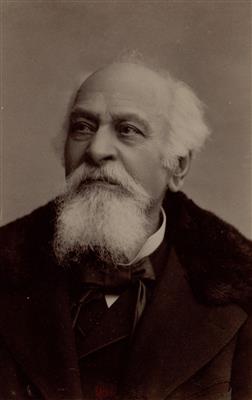
Biography
Palizzi became associated with the realist wing of Italian painting, developing a specialty in rural genre scenes with animals — goats above all, observed with the patient attention of someone who had spent time in the Neapolitan countryside rather than theorising about it. When his brother Giuseppe returned from Paris in 1844[3] with Barbizon School paintings, the encounter confirmed the direction Filippo was already taking: naturalistic observation, outdoor light, the unglamorous texture of agricultural life.
His reputation grew steadily through the mid-century. He exhibited at the Exposition Universelle in Paris in 1855[3] and won a gold medal there in 1867. In 1873 he served as a judge at the Vienna World's Fair. From 1878 to 1880 he served as President of the Naples Academy, restructuring curricula and bringing in new faculty under the recommendation of Francesco De Sanctis. In 1881 he became the first director of the Industrial Arts Museum, where he established a ceramics workshop that he ran until 1891.
Shortly before his death, he donated 120 of his own works, along with works by his brothers, to the Academy gallery. He died in Naples on 11 September 1899[3]. His paintings are held at the Galleria Nazionale d'Arte Moderna in Rome and the Museo di Capodimonte in Naples.
Timeline
- 1818Born in Vasto, Italy, the fifth of thirteen children. His father was a lawyer and amateur musician.
- 1836Followed his brother Giuseppe to Naples.
- 1837Enrolled at the Royal Institute of Fine Arts, studying under Gabriele Smargiassi.
- 1839Made his first exhibition appearance. The Duchess of Berry bought one of his works.
- 1844Encountered Barbizon School paintings brought back from Paris by his brother Giuseppe, confirming his artistic direction.
- 1855Exhibited at the Exposition Universelle in Paris.
- 1867Won a gold medal at the Exposition Universelle in Paris.
- 1873Served as a judge at the Vienna World's Fair.
- 1878Served as President of the Naples Academy, restructuring curricula and bringing in new faculty.
- 1881Became the first director of the Industrial Arts Museum, establishing a ceramics workshop.
- 1899Died in Naples on 11 September, aged 81. He donated 120 of his works to the Academy gallery shortly before his death.
Notable Works
Tap to view larger.
Where to See Filippo Palizzi
2 museums worldwide.
-
 9 works
Galleria Nazionale d'Arte Moderna e Contemporanea di Roma
Rome, Italy
Tue–Sun 9:00–19:00, closed Mondays · €17 adults
-
1 works
Gallerie d'Italia – Milano
Milan, Italy
Tue–Sun 9:30–19:00, closed Mondays · €12 adults

Next stop
Browse the movements →
Every movement in the collection, from the Renaissance to Pop art.
Related Artists




Frequently Asked Questions
What is Filippo Palizzi's most famous work?
Without specific references to confirm a single, universally recognised 'most famous work', it's challenging to pinpoint one particular piece by Filippo Palizzi. His artistic output spanned various subjects, and his notability rests more on his contribution to the Neapolitan school of painting and his influence on Italian art. He is known for genre scenes, animal paintings, and his realistic depictions of rural life in Southern Italy. To determine a single 'most famous work' would require analysing critical reception, exhibition history, and public recognition, none of which are available in the provided material. Therefore, it's more accurate to acknowledge Palizzi's broader impact rather than isolating a single piece as his most famous.What style or movement did Filippo Palizzi belong to?
Filippo Palizzi (1818[3]-1899[3]) was an Italian painter associated with the Realist movement. He moved away from the academic Neoclassical style dominant in Italian art schools during the early 19th century. Palizzi's work focused on direct observation of nature and everyday life. He often depicted rural scenes, animals, and the lives of peasants in the Neapolitan countryside. This focus aligns him with Realism, which sought to portray subjects truthfully and without idealisation. He was part of a group of artists who gathered at the Caffè Greco in Rome, discussing new approaches to art. While not formally organised, this group shared an interest in painting en plein air (outdoors) and capturing the realities of the world around them. Palizzi's dedication to depicting the natural world, combined with his rejection of academic conventions, places him firmly within the Realist tradition in Italian painting. His brother, Giuseppe Palizzi, was also a painter of the Realist school; both brothers' art shares similar themes.What was Filippo Palizzi known for?
Filippo Palizzi (1818[3]-1899[3]) was an Italian artist. He is best known for animal paintings and genre scenes of rural life, especially in the Abruzzo region. Palizzi began his formal training at the Naples Institute of Fine Arts. He initially focused on historical and religious subjects, in line with academic traditions. However, he soon moved toward more naturalistic depictions of the world around him. A stay in Paris exposed him to new artistic currents. He developed an interest in painting outdoors (en plein air) to capture the effects of light and atmosphere. Palizzi's work often featured detailed studies of animals, which he rendered with scientific accuracy and sensitivity. His genre scenes offer insights into the daily lives of peasants and farmers, portraying their customs and traditions. He aimed to depict the realities of rural existence with empathy.When did Filippo Palizzi live and work?
Filippo Palizzi was born in Vasto, Abruzzo, in 1818[3]. He died in Naples in 1899[3]. Palizzi's family relocated to Naples in 1830[3], where he began his artistic training. He initially studied at a private art school, and later at the Royal Institute of Fine Arts. Palizzi is associated with the School of Posillipo, a group of Neapolitan artists known for their naturalistic paintings. He travelled extensively throughout Europe, visiting Paris, London, and the Netherlands. These travels exposed him to new artistic trends, which influenced his work. He was involved in the promotion of Realism in Italian art, often depicting scenes of rural life, animals, and the Italian countryside. His work gained recognition during his lifetime, and he participated in several national and international exhibitions.Where can I see Filippo Palizzi's work?
Filippo Palizzi's paintings are held in several Italian museums. The Museo di Capodimonte in Naples has a collection of his works; this reflects his connection to the Neapolitan School. The Galleria Nazionale d'Arte Moderna e Contemporanea in Rome also possesses examples of his art. These holdings provide access to a range of his output. Other galleries with his paintings include the Pinacoteca di Brera in Milan and the Galleria d'Arte Moderna in Florence. These collections allow viewers to see his work in different regional contexts. Smaller museums and private collections may also contain pieces by Palizzi. However, the institutions mentioned offer the most reliable access to his artistic production. Catalogues and online resources from these museums can help in locating specific paintings. Examining these collections gives a good overview of Palizzi's career and artistic style.Where was Filippo Palizzi from?
Filippo Palizzi was from Italy. More specifically, he was born in Vasto, a town in the Abruzzo region. Vasto is located on the Adriatic coast. Palizzi's artistic training took place at the Institute of Fine Arts in Naples. He began his studies there in 1837[3]. Naples, a major cultural centre in southern Italy, provided Palizzi with exposure to a range of artistic influences. He became associated with the Posillipo School, known for its paintings. Palizzi's brothers, Giuseppe, Francesco Paolo, and Nicola also became painters. They each developed their own styles and contributed to the artistic environment of 19th-century Italy. Filippo Palizzi is considered an important figure in the development of modern Neapolitan painting.Who did Filippo Palizzi influence?
It is difficult to summarise Palizzi's influence. However, we can look at the influence of some artists who were active in similar locations and times. Caravaggio, for example, influenced many artists. These include Dutch painters Hendrick ter Brugghen, Gerrit van Honthorst, Dirck van Baburen, and Rembrandt van Rijn; French painters Simon Vouet, Valentin de Boulogne, and Georges de La Tour; and Spanish painters Francisco Ribalta, Jusepe de Ribera, and Diego Velázquez. Their work is inconceivable without his example. Interest in Caravaggio accompanied the rise of modern art in the twentieth century. Art historian Roberto Longhi was especially important in bringing Caravaggio to the public's attention and raising his critical fortune among twentieth-century scholars. Titian influenced Annibale Carracci (1560-1609[3]). Born and trained in Bologna, Carracci visited Venice in 1585. He travelled to Rome in 1595 to execute frescoes in the Palazzo Farnese; these brought a new sense of structure and order to painting in Rome. Along with Caravaggio (1571-1610), he helped initiate the Baroque style in that city. Titian and Rubens were influential in the development of the art of Anthony Van Dyck (1599-1641).Who influenced Filippo Palizzi?
It is difficult to specify precise influences on Filippo Palizzi. However, some general statements can be made about artistic influence during the Italian Renaissance. During the Renaissance, artists often looked to both classical antiquity and the work of their immediate predecessors for inspiration. The authority of artists such as Donatello and Ghiberti gave them unmatched prestige. Their influence, along with that of Flemish masters, helped to set the course of Florentine painting. Creative imitation was common, with artists assuming the historicity of their own time. They often retained something of their influences, with some displaying melancholy, others modesty, and still others a vivacity of spirit. One approach was to carefully study the most admired works, particularly those by Michelangelo and Raphael, to extract the best qualities and match the sublime ideas of those minds.How did Filippo Palizzi die?
Filippo Palizzi died in Naples on 11 September 1899[3].What is Filippo Palizzi known for?
Filippo Palizzi is known for his realist paintings, particularly rural genre scenes featuring animals. He developed a special interest in painting goats, demonstrating a close observation of rural life in the Neapolitan countryside.What was Filippo Palizzi's art style?
Palizzi's art style aligned with the realist movement in Italian painting, emphasising naturalistic observation and the depiction of outdoor light. His style was further influenced by the Barbizon School paintings that his brother Giuseppe brought back from Paris, reinforcing his focus on the textures of agricultural life.When did Filippo Palizzi die?
Filippo Palizzi died in 1899[3] at the age of 81.
Sources
Editorial draws on the following primary and tertiary references for Filippo Palizzi.
- [1] museum Gallerie d'Italia – Milano Used for: museum holdings.
- [2] museum Galleria Nazionale d'Arte Moderna e Contemporanea di Roma Used for: museum holdings.
- [3] wikipedia Wikipedia: Filippo Palizzi Used for: biography, birth dates, death dates, identifiers, movement attribution, nationality.
- [4] book Neoclassicism and romanticism : architecture, sculpture, painting, drawings, 1750-1848 Used for: biography.
- [5] book Post-impressionism : cross-currents in European painting Used for: biography.
- [6] book Post-impressionism : cross-currents in European painting Used for: biography.
Editorial overseen by Solis Prints. Sources verified 2026-09-30. Click a source for details, or hover over [N] in the page above to preview.
Editorial standardsMethodologyCorrectionsAI disclosureAbout the editorial team