

Grégoire Huret
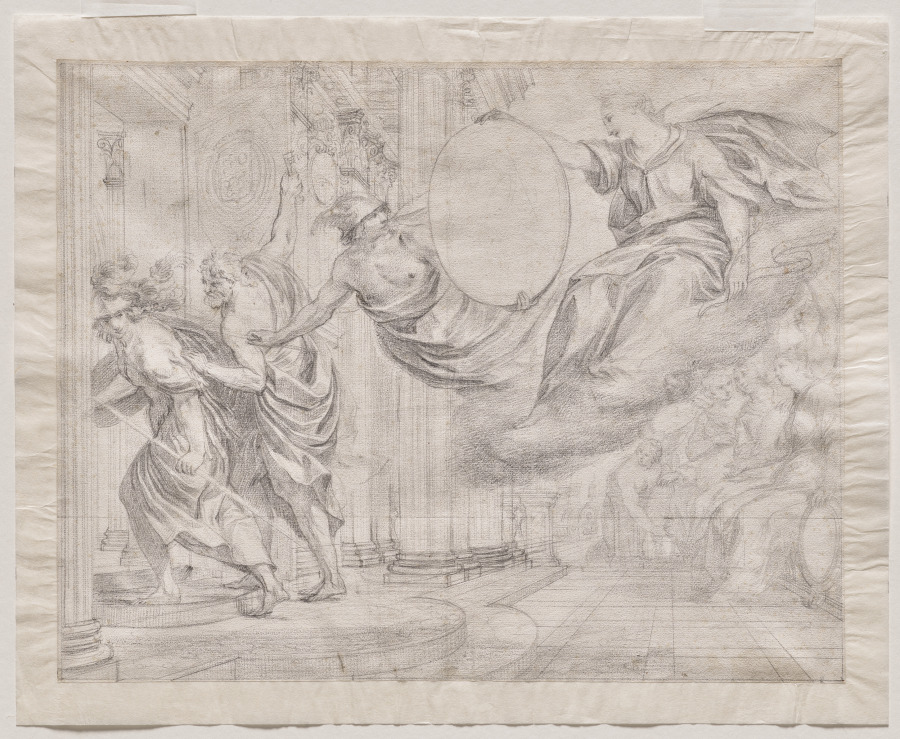
Grégoire Huret was more than a printmaker; he was a theorist who published a significant treatise on perspective in 1670. He argued against the rigid mathematical systems of his contemporaries. He believed that the eye should dictate the composition rather than strict geometry. This practical approach allowed him to create complex scenes, such as his allegories to honour Cardinal Richelieu, without losing visual clarity. His writing sought to simplify the rules of art for future students.

Biography
His work often features sharp contrasts and clear linework. In portraits such as Jacques Boyceau or Cardinal de Coislin, Huret uses engraving to define texture and form with precision. He avoided the soft transitions common in later styles. His religious works, including the Flagellation of Christ, demonstrate a mastery of light and shadow. He used these elements to direct the viewer through a scene.
Modern collectors value Huret for his technical skill and the formal structure of his compositions. His prints provide a sense of order and historical weight to a room. The monochrome palette of his engravings fits well with contemporary interiors. These works offer a connection to the intellectual world of seventeenth-century France through their disciplined execution.
Notable Works
Tap to view larger.
Next stop
Browse the movements →
Every movement in the collection, from the Renaissance to Pop art.
Frequently Asked Questions
When was Grégoire Huret born?
Grégoire Huret was born in 1606 and died in 1670.What is Grégoire Huret known for?
Grégoire Huret is known for grégoire Huret was a seventeenth-century French engraver and theorist known for his precise portraits and complex allegorical works that prioritise visual clarity over rigid mathematical perspective.


