

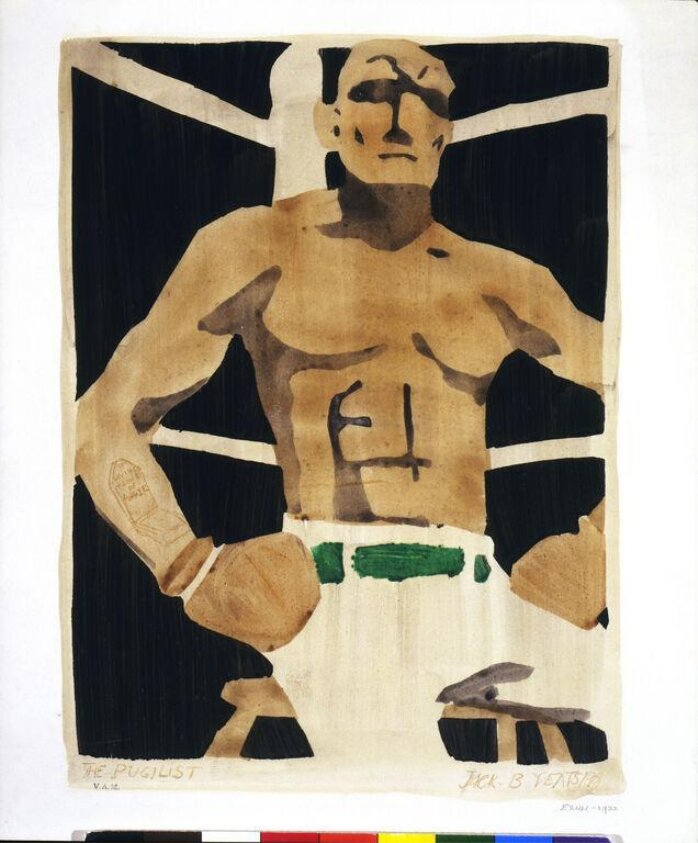
1871–1957
Jack Butler Yeats

Notable Works
Tap to view larger.
Next stop
Browse the movements →
Every movement in the collection, from the Renaissance to Pop art.
Frequently Asked Questions
What is Jack Butler Yeats's most famous work?
It is difficult to name Jack Butler Yeats's single "most famous" work, but several paintings are particularly well known. *The Circus Dwarf*, circa 1911, is an oil on canvas that reflects Yeats's early interest in the circus, which he had seen as a boy in Sligo. The painting's style, with its strong lines and flattened effect, is attributed to Yeats's background in black-and-white illustration, poster design, and admiration for Japanese prints. The painting, with its Expressionistic qualities, was sent to the Armory Show in New York in 1913. Another notable work is *The Basin in Which Pilate Washed his Hands*, from 1951. This oil painting is characterised by spontaneous strokes of bright colour applied in a loose, Expressionistic style. The passionate freedom of Yeats's style and his bold approach to the subject are striking. The forms emerge and dissolve from the mass of the background. Yeats began his career as an illustrator and watercolour artist, not taking up oil painting until 1910. His style became increasingly free, with more violent use of colour. He was greatly influenced by the Irish Troubles, which were reflected in the subject matter of his later work.What should I know about Jack Butler Yeats's prints?
Jack Butler Yeats made prints using various methods. These included woodcuts, etchings, and other hand-pulled techniques. Such original prints are produced by the artist, who creates the artwork directly on the plate, woodblock, stone, or screen. Each print made this way is considered an original. They are often sold through specialist print galleries, frame shops, and fine art galleries. Editions of prints can be either open or limited. The decision to limit an edition is usually the artist's choice, not because of technical limits. A limited edition is defined by a claim, written in pencil at the foot of each print, giving the print number and the edition number. The title is written in the middle of the bottom margin, and the signature is on the right. Though there are no firm rules, these conventions are widely followed. Legislation requires commercial descriptions to be truthful, so claims add value when accurate.What style or movement did Jack Butler Yeats belong to?
Jack Butler Yeats (born in London, 1871; died in Dublin, 1957) began his career as an illustrator and watercolour artist. He did not start painting in oils until 1910, at the age of 44. His style is often linked to Expressionism, a movement that values individual expression and imagination over accurate representation. This is seen in the "slashing strokes of bright colour" and "passionate freedom" of his style. Forms in his paintings often seem to emerge and dissolve from the background simultaneously. Yeats's connection to Expressionism is also noted through comparisons to Oskar Kokoschka, an Austrian painter. However, Yeats's subject matter remained distinctly Irish, often reflecting the Irish Troubles in his later work. Before his mature style emerged, Yeats's earlier work showed the influence of his black-and-white illustrations, poster designs, admiration for Japanese prints, and stencil patterns. These account for the strong linear style and flattened effect seen in paintings such as *The Circus Dwarf* (circa 1911). The bright, strong colouring in that work may reflect the influence of the Fitzroy Street Group, whose work he saw when exhibiting at the Allied Artists' Association from 1909.What techniques or materials did Jack Butler Yeats use?
Jack Butler Yeats was primarily an oil painter, but he also produced works in watercolour, pencil, and other media. Yeats's oil painting technique involved applying thin washes of colour, often building up layers to create depth and texture. He sometimes used thinned paint, with colours like brown for the ground and blue for the sky, leaving white priming for highlights. He would then glaze down the colours as he worked. His early works may appear thickly painted, but cleaning often reveals thin glazes and scumbles. He employed a limited colour range, and his palette remained relatively consistent over the years. For supports, Yeats favoured canvas, sometimes applying thin grounds to preserve the texture. He was known to use heavy canvases.What was Jack Butler Yeats known for?
Jack Butler Yeats (1871-1957) was an Irish artist celebrated for his expressive paintings of Irish life, mythology, and the landscape. Initially working as an illustrator, he developed a distinctive style characterised by loose brushwork and a move away from conventional representation. Yeats's early work included illustrations for books and periodicals, often depicting scenes of everyday life in Ireland. He also created drawings of theatrical and sporting events. Over time, his style evolved, becoming more painterly and emotionally charged. His later paintings are particularly admired for their subjective and almost dreamlike quality. He used colour to convey mood and atmosphere, and his subjects often reflect themes of memory, loss, and the human condition. Yeats's work defies easy categorisation, but it is generally associated with Expressionism. He is considered one of the most important figures in 20th-century Irish art.When did Jack Butler Yeats live and work?
Jack Butler Yeats was born on 29 August 1871 in London. He was the son of the barrister and artist John Butler Yeats, and brother to William Butler Yeats, the poet. Yeats spent much of his childhood in Sligo, Ireland, with his maternal grandparents. He later moved back to London to study at various art schools, including the Westminster School of Art. Yeats began his career as an illustrator, contributing to publications such as *Punch* and *The Boy's Own Paper*. He also worked as a cartoonist. By the early 20th century, he began to focus more on painting, developing a distinctive style characterised by expressive brushwork and a concern with Irish subjects. He exhibited with the Guildhall's Irish Painters group in 1904 and 1905. Yeats continued to paint and exhibit throughout his life, becoming one of Ireland's most important and celebrated artists. He died in Dublin on 16 March 1957.Where can I see Jack Butler Yeats's work?
Jack Butler Yeats's work can be viewed in several galleries and museums, primarily in the United Kingdom and Ireland. In Scotland, examples can be found at the National Gallery of Scotland and the Scottish National Gallery of Modern Art, both in Edinburgh, as well as the Glasgow Art Gallery and Museum. In England, Leeds City Art Gallery and the Fitzwilliam Museum in Cambridge hold works. London's Tate Gallery is another location to view paintings. The National Museum of Wales in Cardiff also has pieces. Outside the UK, the National Museum of Ireland, Decorative Arts and History, in Dublin has examples. These collections provide opportunities to study the artist's style and development.Where was Jack Butler Yeats from?
Jack Butler Yeats was born in London in 1871. However, from 1879 to 1887, Yeats resided with his maternal grandparents in Sligo, Ireland. Later, he received formal art instruction at South Kensington School of Art, Chiswick Art School, and Westminster School of Art. In 1892-3, Yeats was employed as a poster artist in Manchester. Around 1902, he began to paint with oils. By 1910, Yeats had settled permanently in Ireland. His brother was the poet W. B. Yeats. Jack Butler Yeats died in Dublin in 1957. His style became increasingly free, with more violent use of colour. The Irish Troubles influenced his later work's subject matter. Oskar Kokoschka admired Yeats, and his Expressionistic work has a close parallel with the Austrian-born painter, yet Yeats’ subject matter remained entirely Irish.Who did Jack Butler Yeats influence?
It is difficult to identify specific artists directly influenced by Jack Butler Yeats. Artistic influence is rarely a simple, linear relationship; instead, it involves a complex interplay of ideas and approaches. As Willem de Kooning noted, influence can work in unexpected ways, with contemporary artists sometimes altering how we perceive earlier masters. He suggested that artists like Clyfford Still, who may not have directly engaged with Claude Monet's work, indirectly shaped how younger painters viewed it. De Kooning himself claimed Courbet as a point of reference, not necessarily through direct imitation, but through a shared way of seeing. Similarly, while we may not find artists who explicitly identify as "Yeatsites", his work contributes to the wider artistic environment, shaping the sensibilities of subsequent generations. The impact of an artist is often subtle, working through institutional legacies and revised interpretations. The focus on individual qualities, rather than adherence to a specific movement, further complicates the identification of direct influence. Ultimately, influence is a multifaceted phenomenon, involving both conscious engagement and indirect absorption of artistic ideas.Who influenced Jack Butler Yeats?
Jack Butler Yeats was exposed to a range of artistic influences. As a youth, he was sent to live with his grandparents in County Sligo, and the area's people and culture made an impact on his later work. During his formal training, Yeats would have been exposed to the teachings of Sir Joshua Reynolds, president of the Royal Academy. Reynolds promoted the study of past masters as essential to artistic development. Turner, a later artist, responded to Reynolds' advice by studying Dutch painters. Yeats also lived during a period when artists were looking to nature for inspiration, moving away from academic conventions. Some figure painters began to explore daylight effects in their work. The Pre-Raphaelite painters, for instance, sought spiritual depth in pre-Renaissance art. William Blake, with his emphasis on imagination, inspired artists such as Samuel Palmer.Who was Jack Butler Yeats?
Jack Butler Yeats (1871-1957) was an Irish artist, born in London, and the brother of the poet W. B. Yeats. From 1879 to 1887, he resided with his maternal grandparents in Sligo, Ireland. He later studied at South Kensington School of Art, Chiswick Art School, and Westminster School of Art. Yeats began his career as an illustrator and watercolour artist. In 1892-3, he worked as a poster artist in Manchester. Around 1902, he began to paint in oils, with an exhibition at the Clausen Gallery, New York, in 1904. By 1910, he had settled permanently in Ireland. His work was exhibited at the aaa, the Salon des Independants, and the Armory Show, as well as in over 160 other group exhibitions internationally. Yeats also wrote and illustrated many books. His style became increasingly free, with a bolder use of colour. Some believe that the Irish Troubles influenced the subject matter of his later work. He was admired by Oskar Kokoschka, and his expressionistic style has parallels with Kokoschka's. However, Yeats' subject matter remained distinctly Irish.Why are Jack Butler Yeats's works important today?
Jack Butler Yeats (1871-1957) was an Irish artist whose work holds significance for several reasons. He explored themes of Irish identity, nationalism, and cultural change. His artistic journey moved from early illustrations of Irish life to later, more expressionistic paintings. Yeats's work provides insight into the complex relationship between Ireland and England. He lived in England for a time and made Irishness culturally fashionable there. However, he was also attacked by some Irish people who felt he was not truly Irish. His relationship to radical nationalism evolved throughout his life, reflecting the changing political landscape of Ireland. Yeats engaged with Irish traditions and challenged conventional views. His plays sometimes faced controversy, as they did not always align with the self-image of the newly confident nationalist bourgeoisie. He questioned the utility of traditional national images and stereotypes. His art allows us to analyse the complexities of Irish identity, cultural change, and the tensions between tradition and modernity. His work continues to provoke discussion about Irishness and its representation in art and culture.