



Jan Matejko
Nietzsche, tipping into psychosis in Turin in January 1889, sent Matejko an unsolicited letter. That a philosopher on the edge of madness would think to write to a Polish history painter says something about how far Matejko's reputation had travelled by the end of his life.
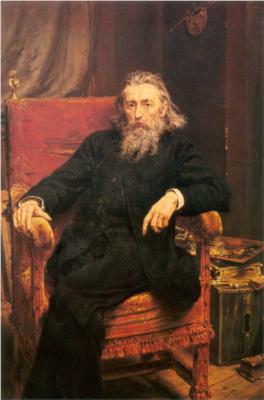
Biography
Matejko was born in Krakow in 1838 to a Czech father and a half-German, half-Polish mother. Despite being only one-quarter Polish by blood, his household was fiercely patriotic: Polish books, portraits of Polish heroes, and a brother who followed General Jozef Bem into the Hungarian Revolution of 1848 (and died in battle). He enrolled at the Krakow Academy of Fine Arts at fourteen, studying under Wojciech Stattler. He never mastered a foreign language and struggled even with Polish, which made the public appearances demanded of him throughout his career an ordeal.
His ambition was to paint Polish history on a monumental scale. Stanczyk (1862) showed the royal jester alone with the news of a military defeat, a painting that reads as an editorial cartoon stretched to the size of a wall. Battle of Grunwald (1878) and Rejtan (1866) followed, each canvas an argument about national identity dressed as historical spectacle. Wilhelm von Kaulbach's method of "historical symbolism", which prioritised interpretation over documentary accuracy, shaped Matejko's approach. His brother Franciszek, a historian at the Jagiellonian Library, fed him archival detail.
As director of the Krakow School of Fine Arts, he trained over eighty students. Maurycy Gottlieb, Jacek Malczewski, Jozef Mehoffer and Stanislaw Wyspianski all passed through his studio; several became leading figures in the Young Poland movement, earning Matejko the title "Father of Young Poland". In 1887 he attended the opening of Queen Jadwiga's sarcophagus to sketch her skull for a portrait. He died in 1893, aged fifty-five.
Timeline
- 1838Born on 24 June in the Free City of Kraków, the ninth of eleven children. His father was a Czech music teacher and his mother was of half-German, half-Polish descent.
- 1852Enrolled at the Kraków Academy of Fine Arts at 14, studying under Wojciech Stattler and Władysław Łuszczkiewicz. He completed his first major historical painting the following year.
- 1859Left Kraków at 21 to study history painting under Hermann Anschütz in Munich, returning the following year.
- 1862Completed Stańczyk at 24, depicting the legendary court jester in solitary contemplation. The painting became one of his most recognised works and a symbol of Polish national consciousness.
- 1866Painted Rejtan at 28, depicting the dramatic protest of Tadeusz Rejtan against the First Partition of Poland. The monumental canvas brought him international attention.
- 1878Completed Battle of Grunwald at 40 in Kraków, a massive canvas depicting the 1410 Teutonic defeat. The painting toured European capitals and cemented his reputation as Poland's national painter.
- 1893Died on 1 November in Kraków from internal bleeding caused by a peptic ulcer, aged 55. His funeral on 5 November drew vast crowds, and his death was reported in at least 32 European newspapers.
Notable Works
Tap to view larger.
Next stop
Realism →
Explore the artists and ideas of Realism.
Jan Matejko prints
Hand-finished archival prints from Jan Matejko's body of work.
 John I Albert (Portrait Study) - Jan Matejko
From £28.00
John I Albert (Portrait Study) - Jan Matejko
From £28.00
 Maurizio Parys - Jan Matejko
From £28.00
Maurizio Parys - Jan Matejko
From £28.00
 Christianization of Lithuania A.D. 1387 - Jan Matejko
From £28.00
Christianization of Lithuania A.D. 1387 - Jan Matejko
From £28.00
 Jagiello with Witold - Jan Matejko
From £28.00
Jagiello with Witold - Jan Matejko
From £28.00
 Jan Kochanowski over the dead body of his daughter - Jan Matejko
From £28.00
Jan Kochanowski over the dead body of his daughter - Jan Matejko
From £28.00
 Armor of Stefan Batory - Jan Matejko
From £28.00
Armor of Stefan Batory - Jan Matejko
From £28.00
Related Artists



Take Jan Matejko home.
See all Jan Matejko prints →Frequently Asked Questions
What should I know about Jan Matejko's prints?
Jan Matejko (1838-1893) was a Polish painter known for his depictions of significant historical events. Prints of his works allowed wider audiences to engage with his art. When considering prints, it is important to understand editioning. An edition is the total number of prints made from a single matrix (plate, woodblock, etc.). A limited edition has a fixed number of prints, while an open edition does not. The artist usually determines the edition size. Each print in a limited edition is typically numbered (for example, 35/100), indicating its place in the series. The artist usually signs and numbers prints in pencil along the bottom margin. The print number and edition size appear on the left, the title in the centre, and the signature on the right. Some artists also create artist's proofs, marked "AP", which are outside the numbered edition. The print market includes both fine art and commercial reproductions. Factors such as the artist's reputation, the image's popularity, and the quality of materials affect prices.What style or movement did Jan Matejko belong to?
Jan Matejko's career occurred during a period of complex transition in European art. During his lifetime (1838-1893), Realism, Symbolism, and early Modernism were emerging, often in opposition to older academic styles. Symbolism, in particular, stood against science and technology. It tried to make spirituality a priority over materialism in art. Instead of scientific logic, its followers turned to intuition, the subconscious, and imagination; these forces inspired the fight against the sovereignty of matter and the laws of physics. Symbolism opposed the prose of everyday life, praised by the naturalistic school, with mysticism, the mystery of the after world, and the search for a hidden meaning in every event or image. It invited everyone to listen to the great strange world surrounding us, and to find the meaning of life, which is possible only for the true creator. Overflowing imagination that remained out of reach for an average painter, took the place of life observation.What techniques or materials did Jan Matejko use?
Jan Matejko (1838-1893) is best known for his large-scale history paintings. He employed academic techniques suited to detailed representational painting. Matejko studied at the Kraków School of Fine Arts, and later at the Munich Academy. He was influenced by the Nazarene movement, which favoured precise outlines and clear forms. Oil paint was his primary medium, allowing him to build up layers of colour and texture. He often used preparatory sketches and studies to plan his compositions. These included detailed drawings of figures and architectural elements. Historical accuracy was important to Matejko. He consulted historical sources and artefacts to ensure the correct depiction of costumes, weapons, and settings. He sometimes incorporated symbolic elements into his paintings; these added layers of meaning to his historical narratives. His approach combined academic training with a concern for historical detail and symbolic communication.What was Jan Matejko known for?
Jan Matejko's work is associated with Symbolism, an artistic and literary movement that arose in opposition to realism and naturalism. Symbolism favoured mysticism, imagination, and the search for hidden meanings, rather than simply depicting everyday life or nature. It was a reaction against what some saw as an over-reliance on science and technology, and a desire to prioritise spirituality and intuition. Symbolists hoped to explore the mysteries of the world and the deeper meaning of existence. Classical art schools reacted negatively to Symbolism, viewing its originality as affectation and a rejection of societal norms. Symbolism was more than just a style; it represented a different perception of reality and a new ideology. Surrealists later drew inspiration from Symbolism, seeking to tap into the power of imagination and the subconscious.When did Jan Matejko live and work?
Jan Matejko (1838-1893) was a Polish painter known for his large historical canvases. He was born in Kraków, and he spent almost his entire life there. Matejko studied at the Kraków School of Fine Arts from 1852 to 1858. He then received a scholarship to study with Hermann Anschütz at the Academy of Fine Arts, Munich. He also spent a short period in Vienna. In 1860, Matejko returned to Kraków. His artistic output largely concerned Polish history, and he aimed to educate the public through his paintings. Among his most famous works are *Kosciuszko at Raclawice* (1888), *The Battle of Grunwald* (1878), and *Baptism of Poland* (1889). These paintings often depict significant events or figures from Poland's past. In 1873, Matejko became the director of the Kraków School of Fine Arts, a position he held until his death. He trained many Polish artists, shaping the next generation. Matejko died in Kraków in November 1893, leaving behind a substantial body of work that continues to be studied.When was jan matejko born?
Jan Matejko was born in 1838 in Cisleithania. Jan Matejko died in 1893, aged 55.Where can I see Jan Matejko's work?
Jan Matejko's paintings are primarily located in museums and galleries throughout Poland. The National Museum in Kraków holds a significant collection of his work, including history paintings and portraits. The Warsaw National Museum also has a selection of his pieces, offering further insight into his artistic output. Other Polish institutions with Matejko's paintings include the Sukiennice Museum, also in Kraków, and the Jan Matejko House, a biographical museum dedicated to the artist. These locations provide opportunities to view his most important works, such as *Battle of Grunwald* and *The Prussian Homage*. Outside Poland, it is more difficult to find Matejko's paintings on display. However, some works may occasionally appear in international exhibitions of Polish art. Consulting museum catalogues and online databases is useful for locating specific paintings and their current locations.Where was Jan Matejko from?
Jan Matejko was born in Kraków, Poland, in 1838. Kraków, a city with a rich history, was then part of the Austrian Empire. His family had mixed Czech, Polish, and German ancestry. Matejko spent almost his entire life in Kraków. He received his initial artistic training at the School of Fine Arts there. Later, he studied at the Munich Academy, and briefly in Vienna. In 1873, Matejko became director of the School of Fine Arts in Kraków. He held this position for the rest of his career. He was deeply connected to the city, and involved in its cultural life. Many of his most famous paintings depict events from Polish history, often set in or around Kraków. Matejko died in Kraków in 1893, and is buried in Rakowicki Cemetery, one of the city's most important historic graveyards.Who did Jan Matejko influence?
Jan Matejko, who died in 1893, had a considerable impact on Polish historical painting. His emphasis on national subjects and dramatic compositions influenced many artists who followed. Among those he taught directly was Maurycy Gottlieb, a Jewish painter who, despite his early death, created works that explored Polish-Jewish relations. Józef Mehoffer, another student, is well known for his stained glass designs and symbolist paintings. Matejko's influence extended beyond his direct students. Artists such as Władysław Łuszczkiewicz adopted his historical approach, although Łuszczkiewicz is now better known for his teaching. The next generation of Polish painters working at the turn of the century, including those associated with the Young Poland movement, often reacted against Matejko's style, seeking new forms of expression. Even so, his vision of Polish history remained a point of reference, whether embraced or rejected. His impact on national identity and historical consciousness is undeniable.Who influenced Jan Matejko?
Jan Matejko's artistic development was shaped by a number of influences, both personal and historical. Early on, his brother Franciszek, a history professor, instilled in him a strong interest in Poland's past. This fascination became a central theme in Matejko's art. He also studied at the Kraków School of Fine Arts, under Wojciech Korneli Stattler and Władysław Łuszczkiewicz. Stattler, a classicist painter, emphasised formal training and academic technique. Łuszczkiewicz, an expert in historical costume and design, further fuelled Matejko's passion for historical accuracy; this is visible in his later works. The painter Christian Ruben, director of the Kraków School, also had an impact. Although Matejko initially clashed with Ruben's more conservative approach, he later acknowledged Ruben's role in improving his technical skills. Furthermore, Matejko admired the work of Paul Delaroche, a French painter known for his dramatic historical scenes. These various figures and styles contributed to Matejko's distinctive approach to history painting.Why are Jan Matejko's works important today?
Jan Matejko (1838-1893) is important because of his large-scale history paintings. These paintings often depict significant events in Polish history. Matejko's works helped to shape Polish national identity during a period of political division and foreign rule. His art is characterised by its dramatic compositions, attention to detail, and symbolic use of historical figures. Matejko aimed to educate and inspire patriotism through his depictions of Poland's past. He was not always concerned with strict historical accuracy; rather, he used historical subjects to convey moral and political messages. Matejko's influence extended beyond the art world. He taught at the Kraków Academy of Fine Arts, training a generation of Polish painters. His paintings continue to be studied for their artistic qualities and historical interpretations. They remain a source of national pride and a reminder of Poland's complex history. His works offer insights into the political and cultural concerns of 19th-century Poland.What art movement was Jan Matejko part of?
Jan Matejko was associated with Realism and Symbolism.
Sources
Editorial draws on the following primary and tertiary references for Jan Matejko.
- [1] museum Royal Castle in Warsaw Used for: museum holdings.
- [2] book Rosales Rodríguez, Agnieszka,Michałowicz, Klaudyna, In the Footsteps of the Old Masters Used for: biography.
- [3] book Masterpieces of western art : a history of art in 900 individual studies from the Gothic to the present day Used for: biography.
Editorial overseen by Solis Prints. Sources verified 2026-08-29. Click a source for details, or hover over [N] in the page above to preview.
Editorial standardsMethodologyCorrectionsAI disclosureAbout the editorial team