



Reza Abbasi
Around 1603[1], at the peak of his standing as court painter to Shah Abbas I, Reza Abbasi walked away from the Safavid court to spend several years in the company of wrestlers, athletes, and what his contemporaries described as disreputable company in Isfahan. The episode is the most revealing thing about him: a painter confident enough in his reputation to afford a voluntary exile, and committed enough to human particularity that the people he spent time with ended up in his drawings. He returned to court service around 1610, probably for financial reasons, and continued painting until his death in 1635[1].
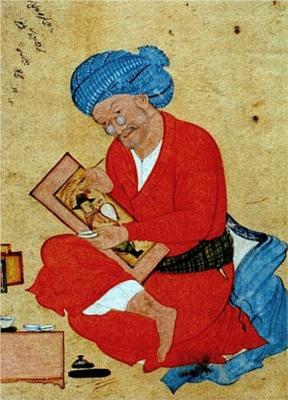
Biography
Born around 1565[1] in Mashhad to a family of court artists, he absorbed the refined calligraphic line that defined Safavid miniature painting before transforming it. His single-figure album paintings of beautiful youths and lovers set against plain grounds became the defining image of the Isfahan school: exquisite in technique, quietly sensual, and compositionally independent in a way that earlier Persian manuscript illustration had not been. He received the honorific title Abbasi from the Shah in 1603[1], formally attaching his name to the royal house.
His later work shifted in character: the luminous palette and bravura line of his early career gave way, after his return, to darker, earthier tones and heavier drawing. He began painting scholars, Sufi divines, and shepherds, and occasionally moved into satirical territory. The scholar Sheila Canby's 1996 monograph accepts 128 works as certainly or probably his. He directed the royal library for much of his life; his pupils included his son Muhammad Shafi Abbasi and Mo'en Mosavver, who painted his portrait decades after his death.
Timeline
- 1565Born in Mashhad, Persia (modern-day Iran).
- 1603Received the honorific title 'Abbasi' from Shah Abbas I.
- 1603Left the Safavid court to spend time in Isfahan.
- 1610Returned to court service, likely for financial reasons.
- 1635Died in Persia.
Notable Works
Tap to view larger.
Next stop
Browse the movements →
Every movement in the collection, from the Renaissance to Pop art.
Related Artists


Frequently Asked Questions
What is Reza Abbasi known for?
Reza Abbasi is known for his single-figure album paintings of beautiful youths and lovers set against plain grounds. These paintings became the defining image of the Isfahan school, and were exquisite in technique, quietly sensual, and compositionally independent.What is Reza Abbasi's most famous work?
Reza Abbasi (1565[1]-1635[1]) was a leading Persian miniaturist, painter, and calligrapher of the Isfahan School, which came to prominence in the Safavid period. Although it is difficult to name one single work as his "most famous", Abbasi was the leading artist of his time, and many examples of his single-page miniatures are held in museum collections today. He is particularly known for single figures, often gracefully posed youths, sometimes in groups of two or three. These figures are typically set against a plain background, with minimal detail. This focus on the individual figure was a departure from earlier Persian miniature traditions, which often featured complex scenes with many figures. Abbasi also led a workshop of artists, and his style was widely imitated during his lifetime and after. He trained many artists who continued his style. His influence is such that the later Isfahan style is often referred to as the "Reza Abbasi style".What should I know about Reza Abbasi's prints?
When considering Reza Abbasi's prints, bear in mind some basic facts about the fine art print market. A print is an image conceived and executed as a print, often in a numbered edition, and signed by the artist. Each print in the edition is an original, produced from a plate, stone, screen, or block created for that purpose. The artist determines the number of prints in an edition. The numbering provides an accounting; for example, 12/25 means it is print number 12 of an edition of 25. Some artists issue documentation sheets to accompany prints being sold or exhibited publicly. This acknowledges potential buyer confusion. The intent of the visual statement marks the difference between an original print and a reproduction. If the intention is to replicate an image best created via another medium, the result is a reproduction. Plates for original prints are made by hand and can only withstand a certain amount of use. Some publishers limit the number of impressions to increase a print’s value.What techniques or materials did Reza Abbasi use?
Without specific details about Reza Abbasi's methods, some general information about artistic techniques may be useful. Artists are not always restricted by the materials they use. Choices exist outside the constraints of technique. Understanding the processes used by artists is important. The interaction between the qualities of medium and technique, plus the aesthetic decisions made by the artist, should be understood. Various techniques exist for making prints, including woodblock, woodcut, engraving, etching, silkscreen, screenprint and lithography. Woodblock and woodcut are relief methods; engraving and etching are intaglio methods. Silkscreen involves stencils and a screen. Lithography uses wax on stone, separating areas that receive and reject ink. The boneless method involves adding water to areas of paper, priming it so brushstrokes diffuse. Applying ink or pigment to the saturated surface tests the paper's absorbency. This method allows exploration of the materials, rather than focusing on the artist's brushwork.What was Reza Abbasi known for?
Reza Abbasi (1565[1]-1635[1]) was a Persian painter and calligrapher. He is considered one of the most important Persian artists of the late Safavid period, and is known for his refined style of painting. Abbasi's early work continued the established style of miniature painting, but he gradually developed a new approach. He moved away from crowded, highly detailed scenes, and instead focused on more intimate, individual figures. These often included fashionable youths, lovers, and sometimes portraits. His figures typically feature delicate lines, subtle colours, and a greater sense of realism than earlier Persian painting. Abbasi also had an interest in naturalistic details, and included elements such as plants and animals in his compositions. In addition to his single-figure studies, Abbasi also produced book illustrations, and he directed the royal workshop in Isfahan. His style had a considerable effect on later Persian painting, and his works are now held in major museum collections around the world.Where can I see Reza Abbasi's work?
You can view works by Reza Abbasi in several public collections. These include the British Museum in London; the Victoria and Albert Museum, also in London; the Metropolitan Museum of Art in New York; and the Musée du Louvre in Paris. Other museums holding his works are the Freer Gallery of Art and the Arthur M. Sackler Gallery in Washington, DC; the Los Angeles County Museum of Art; the Royal Ontario Museum in Toronto; and the National Museums of Scotland in Edinburgh. The Rijksmuseum in Amsterdam, the Staatliche Museen Preussischer Kulturbesitz in Berlin, the Ashmolean Museum in Oxford, and the State Hermitage Museum in St. Petersburg also hold examples. In Iran, the Chehelsotun Museum in Isfahan and the Iran Bastan Museum in Tehran have collections. There is also a Reza Abbasi Museum in Tehran.Where was Reza Abbasi from?
Reza Abbasi was a Persian painter of the Safavid school, active around 1600[1]. The Safavid dynasty ruled Persia from 1501 to 1736, and its art is divided into two traditions. Abbasi worked in the second tradition; his paintings share qualities with the first school, such as purity of colour, elegant figures, interest in details, and assertion of the individual. Abbasi excelled in extraordinary portrayals of poets, musicians, courtiers, and aristocratic life. These portraits often contain satirical elements. Besides portraits, 17th-century Safavid painting also showed an interest in genre scenes: minor events of daily life, such as a washerwoman at work or a tailor sewing. Safavid artists showed a whole society falling apart with stunning precision and cruel sympathy. Carpet-making also flourished under the Safavids, with great schools developing at Tabriz, Kashan, and Kerman.Who did Reza Abbasi influence?
It is difficult to say precisely who Reza Abbasi influenced. Historically, artistic influence has taken different forms. Art theory recognised three stages: "translatio" (close copying for technical study); "imitatio" (varying a work to show understanding of structure and style); and "aemulatio" (surpassing the original model). Later art theory suggests artists use reproductions to revise art history and insert themselves into the canon. This involves actively reworking images, not passive consumption. Some artists make literal adaptations of earlier sources, while others transpose compositions into their own style. Admiration, copying, and transposition can be integral to an artist's education. Comparisons between artists are sometimes made across centuries. For example, some scholars see the seventeenth-century painter Frans Hals as a precursor to nineteenth-century painters like Manet, Courbet, and Cézanne, because of Hals's distinctive style, prominence of individual strokes, and interest in visual impressions.Who influenced Reza Abbasi?
It is difficult to summarise the influences on an artist such as Reza Abbasi. Research notes refer to an unpublished PhD thesis, 'Contemporary Iranian Art: Neo-traditionalism during the 1960s and 1990s', submitted to the University of London in 2004. The thesis was revised during a post-doctoral fellowship at Oxford University in 2008. The author expressed gratitude to institutions, collectors, and artists who gave permission for their works to be reproduced in the article. They also thanked artists who gave them opportunities for interviews and access to private collections. The notes also mention James Allan of the KRC for his support and encouragement during the fellowship. These sources suggest a range of influences, from Iranian traditions to contemporary approaches. However, without more specific information, it is impossible to offer a detailed account of Abbasi's artistic influences.Who was Reza Abbasi?
Reza Abbasi was a Safavid painter active around 1600[1], who, along with Aqa Reza, excelled in portrayals of poets, musicians, courtiers, and aristocrats. He walked away from his position as court painter to Shah Abbas I around 1603, only to return to court service around 1610.Why are Reza Abbasi's works important today?
Reza Abbasi (1575[1]-1635[1]) was a leading Persian miniaturist of the Safavid period. He is significant because he introduced new themes to Iranian art. Abbasi moved away from traditional courtly subjects, and instead often depicted more ordinary people. His style was innovative. Earlier artists had formalised poses and idealised faces. Abbasi, however, focused on naturalism, showing more realistic figures with individualised features. His work also included genre scenes of everyday life, which gave a glimpse into the lives of ordinary people in 17th-century Iran. Abbasi's influence extended beyond his own paintings. He headed a workshop of artists, and his style was widely imitated during his lifetime and afterwards. His emphasis on single-figure studies and naturalistic detail had a major effect on later Persian painting. By depicting a wider range of subjects, he expanded the possibilities of the miniature and created a style that continues to be admired.What was Reza Abbasi's art style?
His art style is characterised by purity of colour, elegant poses, interest in details, and assertion of the individual figure. His early career featured a luminous palette and bravura line, which later gave way to darker, earthier tones and heavier drawing.
Sources
Editorial draws on the following primary and tertiary references for Reza Abbasi.
- [1] wikipedia Wikipedia: Reza Abbasi Used for: biography, birth dates, death dates, identifiers, movement attribution, nationality.
- [2] book Rizvi, Kishwar, Affect, Emotion, and Subjectivity in Early Modern Muslim Empires: New Studies in Ottoman, Safavid, and Mughal Art and Culture Used for: biography.
- [3] book Peter Osier, Islamic Art and Architecture Used for: biography.
- [4] book Britannica Educational Publishing, Islamic Art, Literature, and Culture Used for: biography.
- [5] book Iftikhar Dadi, Modernism and the Art of Muslim South Asia (Islamic Civilization & Muslim Networks) Used for: stylistic analysis.
- [6] book Golombek, Lisa,Mason, Robert B.,Proctor, Patricia,Reilly, Eileen, Persian Pottery in the First Global Age: The Sixteenth and Seventeenth Centuries Used for: biography, stylistic analysis.
- [7] book Branfoot, Crispin (Editor), Portraiture in South Asia since the Mughals: Art, Representation and History Used for: biography, stylistic analysis.
Editorial overseen by Solis Prints. Sources verified 2026-09-22. Click a source for details, or hover over [N] in the page above to preview.
Editorial standardsMethodologyCorrectionsAI disclosureAbout the editorial team