

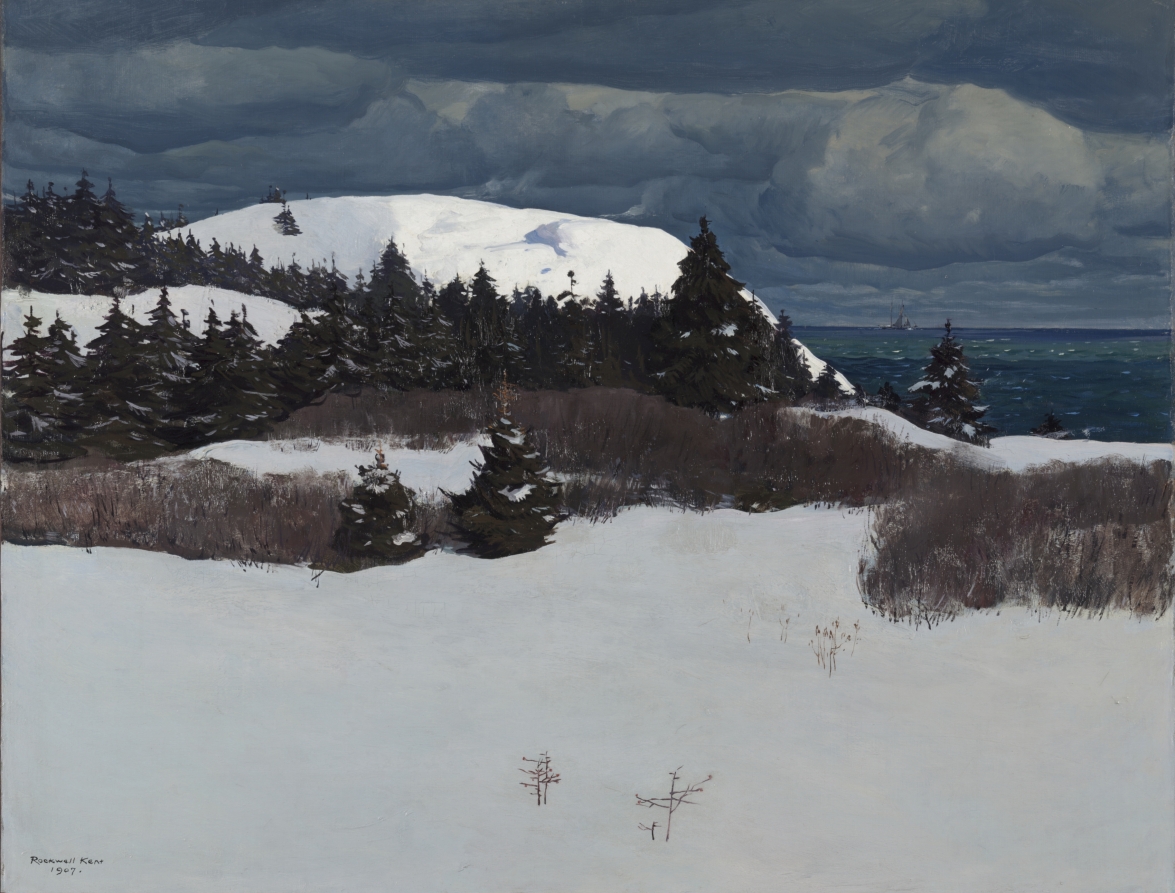
1882–1971 · American
Rockwell Kent

Notable Works
Tap to view larger.
Next stop
Browse the movements →
Every movement in the collection, from the Renaissance to Pop art.
Rockwell Kent prints
Hand-finished archival prints from Rockwell Kent's body of work.


Related Artists
_%E2%80%93_LOC.jpg)



Take Rockwell Kent home.
See all Rockwell Kent prints →Frequently Asked Questions
What is Rockwell Kent's most famous work?
Rockwell Kent is best known for his paintings, printmaking, book illustration, and writing, all often inspired by his extensive travels. He produced work in a Social Realist style, frequently depicting remote wilderness regions. Kent's illustrations for a 1930 edition of Herman Melville's *Moby Dick* are among his most recognised achievements. The book, published by Lakeside Press, included hundreds of his pen drawings. These illustrations contributed significantly to the book's popularity and cemented Kent's reputation as a major American artist. Another notable work is his series of illustrations for *Candide*, published in 1928. These drawings, like his *Moby Dick* illustrations, display a bold, linear style and a strong sense of design. In painting, his Alaskan scenes, such as *Mail Carrier, Alaska* (1919), capture the stark beauty of the Arctic. These paintings, along with his Greenlandic subjects, helped define his artistic identity. Kent's work remains popular for its adventurous spirit and distinctive graphic style.What should I know about Rockwell Kent's prints?
Rockwell Kent (1882-1971) was an American painter, printmaker, illustrator, and writer. He is known for his modernist-influenced, often austere style, and for his depictions of remote wilderness regions. Kent produced a substantial body of graphic work, including wood engravings, lithographs, and illustrations for books and commercial projects. His prints often feature stark contrasts of black and white, simplified forms, and a sense of dramatic intensity. Kent favoured themes of nature, human struggle, and social justice. Some of Kent's best-known prints include "God Speed," "Workers of the World, Unite!", and illustrations for editions of "Moby Dick" and "Beowulf". He used a range of printmaking techniques to achieve different visual effects, from the bold lines of his woodcuts to the more subtle gradations of his lithographs. Kent's prints were popular during his lifetime, and they continue to be collected today. His work is admired for its artistic quality, its social commentary, and its celebration of the natural world. He had a distinctive approach to portraying the human figure, often depicting strong, heroic individuals in conflict with their environment or with social forces.What style or movement did Rockwell Kent belong to?
Rockwell Kent's artistic style is not easily categorised, although elements of decorative pattern and stylisation are often present. Early in his career, his work showed some affinity with the American Scene painters, who depicted everyday life, and with Regionalism, which focused on rural subjects. However, Kent's style was distinct. Kent's illustrations for the 1930 edition of *Moby Dick* show his interest in the outdoors and his personal connection to the story. His style in these illustrations involved pen, brush, and ink drawings imitating wood engravings, giving the edition a craft-like feel. The images, often featuring whales and coastlines, evoke a sense of the sublime. His work also shows inspiration from Romanticism, particularly in his focus on nature and the individual's place within it. Kent's travels to remote locations, such as Greenland and Alaska, influenced his art, leading to stark, haunting images of nature. He sought to capture the essence of these landscapes.What techniques or materials did Rockwell Kent use?
Rockwell Kent was versatile, using varied media. As with many artists, his choices depended on the effect he wanted to achieve. He is known to have used oil paint, applying it to surfaces such as canvas. Preparation of the canvas was also a consideration. Some artists prime their canvases with coats of Flake White thinned with turps, sanding the surface when dry. When applying colour to the canvas, standard artists' oil colour (paint) can be mixed with a medium of wax and turpentine. The mixture is applied to the canvas with a brush and worked over so the medium and paint are thoroughly mixed and evenly cover the shape. The paint is then worked with a large painting spatula and a small painting knife until it arrives at a satisfactory state. Other materials that artists use include hardboard panels primed with acrylic gesso. Also canvas-textured paper pads, sketch pads and pencils.What was Rockwell Kent known for?
Rockwell Kent (1882-1971) was an American painter, printmaker, illustrator, writer, and adventurer. He is best known for his stark, modernist-influenced depictions of wilderness and working-class life. Kent began his art studies with William Merritt Chase, Robert Henri, and Kenneth Hayes Miller, all members of the Ashcan School. Early in his career, he worked in a realist style, painting scenes of New York and rural life. A turning point came with his travels to remote locations such as Monhegan Island, Maine, and Newfoundland. These experiences shifted his focus to the power and drama of nature. During the 1920s and 1930s, Kent produced a series of wood engravings and lithographs, often illustrating his own travel books. These prints, characterised by bold lines and simplified forms, gained him widespread recognition. His illustrations for books such as "Moby Dick" (1930) are particularly well known. Kent’s work often reflected his socialist political views, celebrating the dignity of labour and critiquing social inequality. His art and political beliefs sometimes made him a controversial figure, particularly during the McCarthy era.When did Rockwell Kent live and work?
Rockwell Kent was born on 21 June 1882, in Tarrytown, New York. He died on 13 March 1971, in Plattsburgh, New York. Kent was active as a painter, printmaker, illustrator, writer, and adventurer. Kent studied with several important American artists, including Robert Henri, William Merritt Chase, and Kenneth Hayes Miller. His early work showed the influence of his teachers, particularly Henri's emphasis on realism and the depiction of urban life. Kent's style evolved towards a more simplified, modernist aesthetic, characterised by bold forms and stark contrasts. He is well known for his illustrations, particularly his wood engravings for books such as "Moby Dick" and "Candide". He travelled extensively, with his experiences in remote places such as Alaska and Greenland profoundly shaping his artistic vision. These travels instilled in him a love for stark, dramatic landscapes, which became a recurring theme in his work. Kent's art often reflects his socialist political views, celebrating the dignity of labour and the beauty of the natural world.Where can I see Rockwell Kent's work?
Rockwell Kent's work can be viewed in several locations. In New York, visit the Metropolitan Museum of Art, or the Museum of Modern Art. You can also find his pieces at the Whitney Museum of American Art. Outside of New York, there is the Yale University Art Gallery in New Haven, the Philadelphia Museum of Art, and the Carnegie Museum of Art in Pittsburgh. In Washington, DC, you can see Kent's work at the Hirshhorn Museum and Sculpture Garden, the National Gallery of Art, and the National Museum of American Art. Other locations include the Los Angeles County Museum of Art (LACMA), the Minneapolis Institute of Arts, the Virginia Museum of Fine Arts in Richmond, and the Charles Hosmer Morse Museum of American Art in Winter Park, Florida. In Canada, the Royal Ontario Museum in Toronto and the Art Gallery of Ontario also hold pieces.Where was Rockwell Kent from?
Rockwell Kent was an American artist, born in the city of New York in 1882. He is known for his illustrations, painting, printmaking, writing, and adventurous travels. He spent time in far-flung locations, such as Greenland and Alaska. Kent's journeys often influenced his artistic output. He made his home at Ausable Chasm, New York, and the surrounding country's beauty often appeared in his stylised drawings. Kent is recognised as a significant figure in American illustration. His voyages to the Far North helped popularise his individual designs. He illustrated classics such as Chaucer's works and Herman Melville's *Moby Dick*. Kent also wrote and illustrated his own books, including *Salamina* and *N by E*, journals of adventure that exemplify his style. He died in 1971.Who did Rockwell Kent influence?
Rockwell Kent's influence is complex to trace. One source claims that American illustration is heterogeneous, with little influence from French modernism; instead, artists favour decorative patterns that do not depend too heavily on realism. Rockwell Kent is cited as a leader in this style, popularising individual designs through his Far North voyages. Kent's connection to Herman Melville's *Moby Dick* is notable. Kent designed and illustrated *Moby Dick* as if it were his own diary. He had expansive control over the project. One editor suggested that he treat his *Moby Dick* illustrations like a diary. Kent's illustrations are precisely the story of his travel through text, ocean, and life. Kent's work also had a political dimension, as seen in his post office murals that addressed themes of autonomy and nationhood. His advocacy for freedom of movement, culminating in the *Kent v. Dulles* Supreme Court case, further demonstrates his wider impact. Kent's style of spare, windswept paintings earned him early fame.Who influenced Rockwell Kent?
Rockwell Kent studied with several instructors who shaped his artistic development. At the New York School of Art, he was taught by Robert Henri, who Kent said encouraged his students to engage their hearts in their work; Henri's teaching went beyond style, imparting a general philosophy that 'art is life'. Kent contrasted Henri's earnest approach to that of another of their teachers, Chase, who he felt delighted in showmanship. Kent also studied with Kenneth Hayes Miller, who, unlike Henri, insisted his students engage their heads. Miller emphasised the tactile qualities of paint and the elements of composition. Kent's fellow students also influenced each other. Kent referred to Edward Hopper, who was in Henri's class with him, as 'the John Singer Sargent of the class', due to Hopper's obvious brilliance. The students in Henri's class, according to Kent, discussed writers such as Verlaine and Baudelaire.Who was Rockwell Kent?
Rockwell Kent (1882-1971) was an American painter, printmaker, illustrator, writer, and adventurer. He is known for his modernist-influenced depictions of wilderness and his socialist political views. Born in Tarrytown, New York, Kent studied with several important American artists, including William Merritt Chase, Robert Henri, and Kenneth Hayes Miller. These instructors encouraged him to pursue a career in art. Early in his career, Kent worked primarily as an architectural draftsman. He produced paintings on the side. Kent's artistic style evolved from a relatively conventional realism to a more simplified, graphic style. This change is visible in his wood engravings and lithographs. His travels to remote locations, such as Monhegan Island, Newfoundland, and Greenland, provided inspiration for much of his work. These places feature prominently in his paintings and prints. As an illustrator, Kent produced work for books such as Herman Melville's *Moby Dick* and Geoffrey Chaucer's *The Canterbury Tales*. He also wrote and illustrated his own travel books, including *Wilderness: A Journal of Quiet Adventure in Alaska*. Kent's art and writings often reflected his left-wing political beliefs. These beliefs sometimes created controversy, particularly during the McCarthy era in the United States.Why are Rockwell Kent's works important today?
Rockwell Kent's art retains importance because of its distinctive style and social commentary. His work often presents simplified forms, strong contrasts, and a sense of austere beauty. These elements align with early 20th-century modernism while remaining accessible to a broad audience. Kent's prints and paintings frequently depict remote and wild regions, such as Greenland and Alaska. These locations appealed to his sense of adventure and provided subject matter for his artistic explorations. His depictions of these areas contributed to a romantic vision of the wilderness, which still resonates with contemporary audiences interested in environmental themes. Beyond aesthetics, Kent's socialist political beliefs shaped his artistic output. He created illustrations and designs for leftist publications and organisations. During the Cold War era, his socialist sympathies led to controversy and blacklisting. Today, this aspect of his biography and art generates interest in the relationship between art and politics during a turbulent period in American history. His work provides insight into the social and political concerns of the early to mid-20th century.