



Sir John Everett Millais
- Symbolism
- Pre-Raphaelite Brotherhood
Millais painted Ophelia floating in a river, surrounded by flowers, slowly drowning. It is the most famous painting of the Pre-Raphaelite Brotherhood and one of the most reproduced images in British art. Elizabeth Siddal, who modelled for the figure, lay in a bath of water for hours while Millais painted. The water was heated by lamps underneath, but the lamps went out. She caught a severe cold. Her father sent Millais a doctor's bill.
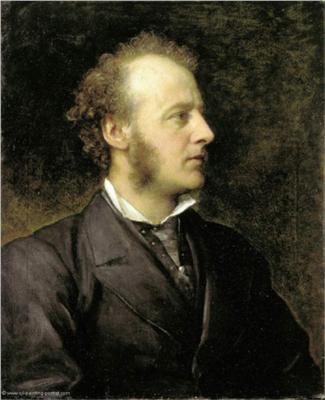
Biography
He was a child prodigy. He entered the Royal Academy Schools at eleven, the youngest student ever admitted. He won every prize. He co-founded the Pre-Raphaelite Brotherhood with Rossetti and Hunt in 1848, when he was nineteen. The early paintings, Christ in the House of His Parents and The Return of the Dove to the Ark, were painted with the meticulous botanical and anatomical precision that defined the group: every leaf, every muscle, every blade of grass individually observed.
His career divides sharply. The Pre-Raphaelite period produced the great paintings: Ophelia, The Blind Girl, Autumn Leaves, The Vale of Rest. After 1860 he moved toward looser, more commercial painting: society portraits and sentimental genre scenes. Bubbles, a portrait of his grandson blowing soap bubbles, was bought by Pears soap and used as an advertisement. The art world was horrified. Millais was pragmatic about money in a way that Rossetti and Hunt were not.
He married Effie Gray after her marriage to John Ruskin was annulled. He became president of the Royal Academy in 1896 and died five months later, at sixty-seven.
Timeline
- 1829Born in Southampton, England, into a prominent Jersey-based family.
- 1840Aged 11, became the youngest student ever admitted to the Royal Academy Schools in London, an unprecedented feat that confirmed his prodigious talent.
- 1848Aged 19, co-founded the Pre-Raphaelite Brotherhood at his family home in Gower Street, London, with William Holman Hunt and Dante Gabriel Rossetti.
- 1852Aged 22, completed Ophelia, painted from life on the banks of the Hogsmill River in Surrey. The model, Elizabeth Siddal, posed in a bathtub of water and caught a severe cold.
- 1863Aged 34, elected a full Royal Academician, having been made an Associate in 1853. By the mid-1850s he had already moved away from strict Pre-Raphaelite principles towards a broader realism.
- 1885Aged 56, created a baronet by Queen Victoria, the first artist to receive a hereditary title. He was by this point one of the wealthiest painters in Britain.
- 1896Died of throat cancer in London, aged 67. Earlier that year he had been elected President of the Royal Academy following the death of Lord Leighton.
Notable Works
Tap to view larger.
Where to See Sir John Everett Millais
4 museums worldwide.
-
44 works
National Gallery
London, United Kingdom
Daily 10:00–18:00 (Fri until 21:00) · Free
-
6 works
Walker Art Gallery
Liverpool, United Kingdom
-
2 works
Victoria and Albert Museum
London, United Kingdom
Daily 10:00–17:45, Friday 10:00–22:00 · Free


Next stop
Symbolism →
Explore the artists and ideas of Symbolism.
Related Artists


Frequently Asked Questions
Sir john everett millais ophelia?
Sir John Everett Millais's painting Ophelia depicts the character from Shakespeare's Hamlet, partially submerged in a stream. She is shown having fallen into the water while picking flowers, driven mad by her father's murder at the hands of her lover, Hamlet.What is Sir John Everett Millais's most famous work?
Sir John Everett Millais is well known for being a founding member of the Pre-Raphaelite Brotherhood; the group formed to counteract the brown undertones and idealisation of subjects of conservative academic painting. Millais's early paintings were carefully planned. He often painted backgrounds en plein air over months, and figures and interiors in his studio. His paintings show influences including van Eyck and Velázquez, pre-Renaissance art, and the Nazarenes (a group of German artists in Rome). His painting depicting the death of Ophelia in Shakespeare’s Hamlet is among his most famous. Millais painted it in two locations: outside by the Hogsmill River in Surrey, and in his London studio. He spent almost four months painting the background, including symbolic flowers: daisies (innocence), roses (youth, love, beauty), violets (faithfulness), and poppies (death). Rossetti’s future wife, Elizabeth Siddal, posed as Ophelia. For months, she posed in a bath of water, heated from below with oil lamps.What should I know about Sir John Everett Millais's prints?
Sir John Everett Millais (1829-1896) was a founding member of the Pre-Raphaelite Brotherhood; he painted, illustrated, and occasionally etched. In 1837, Millais moved to London and attended the Royal Academy Schools in 1840. He exhibited at the Royal Academy from 1846 to 1896 and was elected RA in 1863. Millais was in demand among print dealers, and his works were engraved in large numbers. He produced designs for books and magazines, including Trollope novels in *The Cornhill* (1860-3) and works by Tennyson. By the 1860s, he concentrated on gallery paintings, portraits, and sentimental genre works, which brought him popularity and wealth. He was made a baronet in 1885. Prints after Millais attracted a diverse audience. His *Cherry Ripe* was found in a Tartar peasant's hut, while *Cinderella* was framed in a Samoan chieftain's home. *The North-West-Passage* was found in a South African shepherd's hut. Millais produced only thirteen etchings, but they secured his reputation, especially among Etching Club members. His first etching, *The Young Mother*, appeared in *Etchings for the Art Union of London* (1857) and was praised by print historian P. J. Hamerton.What style or movement did Sir John Everett Millais belong to?
Sir John Everett Millais, born in 1829, was a founding member of the Pre-Raphaelite Brotherhood. This group of artists emerged in the middle of the 19th century. Millais, along with his fellow students Rossetti and Holman Hunt, formed the Brotherhood to challenge the Royal Academy's conservative approach to painting, which they saw as relying too heavily on brown undertones and idealised subjects. The Pre-Raphaelites aimed to be faithful to nature and to exploit the luminosity of colour. Millais's early paintings were carefully planned and executed. He often painted backgrounds en plein air over several months, and then completed the figures and interior scenes in his studio. His painting *Christ in the House of his Parents*, completed in 1850, faced criticism for its depiction of Christ's family as ordinary, working-class people. Medieval themes, literature, poetry, and the Bible served as inspiration for many of his works. Later in his career, Millais moved away from Pre-Raphaelite ideals and began to conform to the Royal Academy's standards.What techniques or materials did Sir John Everett Millais use?
Millais is best known as a painter, and he worked primarily in oils. He was a founding member of the Pre-Raphaelite Brotherhood, and their aesthetic demanded close observation and detail. Early in his career, Millais prepared his canvases with a wet white ground. This was an attempt to achieve a jewel-like quality of colour, and it was based on the methods of the early Italian painters. He and his fellow Pre-Raphaelites William Holman Hunt and Ford Madox Brown each experimented with techniques described in a book about medieval painting methods. Millais used translucent paint glazes over this white ground. Later, his painting technique changed. He began to use a drier brushstroke and a more open style. Some critics complained that his later work was too loosely painted. Millais was also an accomplished watercolourist and draughtsman, and he produced many illustrations for books and magazines.What was Sir John Everett Millais known for?
Sir John Everett Millais (1829-1896) was a founding member of the Pre-Raphaelite Brotherhood, which formed in the mid-19th century. The Brotherhood wanted to counteract the Royal Academy's conservatism, academic painting styles, brown undertones, and idealisation of subjects. Millais, along with his fellow students Rossetti and Holman Hunt, wanted to stay faithful to nature and exploit colour luminosity. Millais was the youngest pupil ever accepted into the Royal Academy of Arts. His early paintings were carefully planned and observed. He would paint backgrounds outside for months, and then paint figures and interior scenes in his studio. Millais's first religious painting, Christ in the House of his Parents, was completed when he was 21. When it was exhibited at the Royal Academy, it attracted criticism for depicting Christ's family as ordinary, working-class people. Medieval themes, literature, poetry, and the Bible were the basis for many of his works. His painting Ophelia depicts the death of Ophelia in Shakespeare's Hamlet. Millais painted this work in two separate locations: outside by the Hogsmill River at Ewell in Surrey, and in his London studio.When did Sir John Everett Millais live and work?
Sir John Everett Millais (1829-1896) was an English painter and illustrator. He is best known as one of the founders of the Pre-Raphaelite Brotherhood in 1848. Millais was born in Southampton, but his family moved to London in 1838. He demonstrated artistic talent early, entering the Royal Academy Schools at the unusually young age of eleven. There, he met William Holman Hunt and Dante Gabriel Rossetti, with whom he formed the Pre-Raphaelite Brotherhood. This group of artists rejected what they saw as the stale conventions of academic art promoted by the Royal Academy. They sought inspiration in the art of the late medieval and early Renaissance periods. His early Pre-Raphaelite works include "Isabella" (1849) and "Ophelia" (1851-52). These paintings are characterised by their detailed realism, bright colours, and literary or historical subject matter. In the later part of his career, Millais moved away from Pre-Raphaelitism. He adopted a broader, more conventional style. He achieved great popularity and commercial success with portraits and sentimental genre scenes, such as "Bubbles" (1886). Millais was elected President of the Royal Academy in 1896, but he died later that year.Where was Sir John Everett Millais from?
Sir John Everett Millais was an English artist. He was born in 1829 and, later in life, became a founding member of the Pre-Raphaelite Brotherhood. This group of artists emerged in the mid-19th century. Millais was the youngest pupil ever admitted to the Royal Academy of Arts in England. He was gifted and hard-working, winning a silver medal for his art at the age of nine. By eleven, he had been accepted into the Royal Academy Schools. There, he befriended fellow artists Rossetti and Holman Hunt. At the age of 19, Millais and his friends formed the Pre-Raphaelite Brotherhood. Their goal was to challenge the conservative academic painting styles of the time, which they saw as relying too heavily on brown undertones and idealised subjects. Millais's art often drew inspiration from medieval themes, literature, poetry, and the Bible. His early paintings were carefully planned and executed, with landscape backgrounds often painted outdoors over several months. Later in life, Oxford University awarded him an honorary degree in 1880, and he was made a baronet in 1885.Who did Sir John Everett Millais influence?
Millais's impact is complex, with both direct followers and those who reacted against his style. Within the Pre-Raphaelite Brotherhood, his shift away from detailed realism towards a looser, more painterly style influenced some members. Artists such as Frank Dicksee adopted Millais's later aesthetic, characterised by sentimental themes and bravura brushwork. Outside the Pre-Raphaelite circle, Millais's commercial success and popular appeal had an effect on the broader art world. His paintings, reproduced as prints, reached a wide audience and shaped Victorian taste. Illustrators, in particular, drew inspiration from his compositions and figure types. However, Millais also faced criticism for what some saw as a decline in artistic integrity. Later generations of artists, seeking to move beyond Victorian sentimentality, reacted against his work. Despite this, his technical skill and innovative approach to subject matter continue to be recognised, securing his place in art history.Who influenced Sir John Everett Millais?
Sir John Everett Millais, a founder of the Pre-Raphaelite Brotherhood, had several artistic influences. Early on, he demonstrated considerable talent, winning a silver medal from the Society of Arts at age nine. He then entered the Royal Academy schools in 1840. At the Academy, Millais encountered the established artistic conventions of the time. However, he and his fellow Pre-Raphaelites sought inspiration from earlier sources. They admired Italian art before Raphael, as well as early Flemish painting. These artists, they believed, possessed a sincerity and attention to detail lost in later, more academic approaches. Specifically, Millais, along with William Holman Hunt and Dante Gabriel Rossetti, looked to the detailed realism of artists like Jan van Eyck and Hans Memling. They favoured clear colours and meticulous observation of nature. This contrasted sharply with the looser brushwork and dramatic lighting favoured by many contemporary artists. The Pre-Raphaelites also drew inspiration from literature, particularly the works of John Keats and Alfred, Lord Tennyson, whose poems provided subjects for many of their paintings.Who was Sir John Everett Millais?
Sir John Everett Millais (1829-1896) was an English painter and one of the founders of the Pre-Raphaelite Brotherhood. This group of artists, formed in 1848, rejected the prevailing academic art promoted by the Royal Academy. They favoured detailed observation of the natural world and a return to the artistic principles of the late medieval period. Millais's early works, such as "Christ in the House of His Parents" (1850), display the Brotherhood's characteristic realism and symbolic detail. These paintings often drew inspiration from religious, historical, and literary sources. His "Ophelia" (1851-52), depicting a character from Shakespeare's Hamlet, is among his most recognised works today. Later in his career, Millais moved away from the Pre-Raphaelite style. He adopted a broader, more conventional approach, achieving considerable commercial success. He produced portraits, such as those of William Gladstone and Lord Salisbury, and popular genre scenes. Millais was elected to the Royal Academy in 1863 and became its President in 1896, shortly before his death. His later work has often been criticised for its sentimentality, a contrast to the radicalism of his Pre-Raphaelite beginnings.Who was sir john everett millais and what is his connection with a bar of soap?
Sir John Everett Millais was a co-founder of the Pre-Raphaelite Brotherhood and president of the Royal Academy in 1896. His portrait of his grandson blowing soap bubbles, entitled Bubbles, was used in an advertisement for Pears soap.
Sources
Editorial draws on the following primary and tertiary references for Sir John Everett Millais.
- [1] museum UCL Art Museum Used for: museum holdings.
- [2] museum Royal Shakespeare Theatre Used for: museum holdings.
- [3] museum National Galleries Scotland Used for: museum holdings.
- [4] museum Amgueddfa Cymru – Museum Wales Used for: museum holdings.
- [5] museum Leighton House Used for: museum holdings.
- [6] museum Guildhall Art Gallery Used for: museum holdings.
- [7] book Susie Hodge, Art Used for: biography.
- [8] book Susie Hodge, Art: Everything You Need to Know About the Greatest Artists and Their Work Used for: biography.
- [9] book Beard, Lee, 1973- author, Butler, Adam, author; Van Cleave, Claire, author; Fortenberry, Diane, author; Stirling, Susan, author, Beard, Lee, 1973- author, Butler, Adam, author; Van Cleave, Claire, author; Fortenberry, Diane, author; Stirling, Susan, author - The Art Book_ New Edition, Mini Format Used for: biography.
Editorial overseen by Solis Prints. Sources verified 2026-08-29. Click a source for details, or hover over [N] in the page above to preview.
Editorial standardsMethodologyCorrectionsAI disclosureAbout the editorial team