



1885–1942 · Japanese
Yamamura Toyonari
- Nihonga
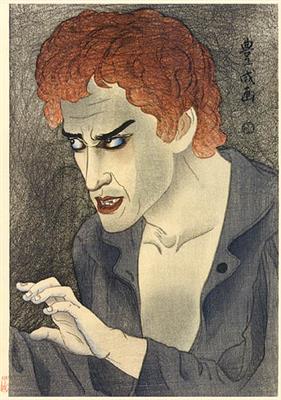
Timeline
- 1916Painted "Nakamura Ganjiro I as Oboshi Yuranosuke" aged 31.
- 1919Painted "Ichikawa Danshiro II as Henmei Tesshinai" aged 34.
- 1921Painted "Ichikawa Uzaemon XV as the Gardener Kichigoro" aged 36.
- 1922Painted "Bando Mitsugoro VII as the Mute in Sannin-Katawa" aged 37.
- 1933Painted "Typical Daughter of Downtown Edo" aged 48.
Notable Works
Tap to view larger.
Next stop
Browse the movements →
Every movement in the collection, from the Renaissance to Pop art.
Related Artists


Frequently Asked Questions
What is Yamamura Toyonari's most famous work?
Yamamura Toyonari (active circa 1741-1764) is notable as a significant figure in Japanese art history, rather than for one specific, famous work. He is credited as the first ukiyo-e artist to depict Western-style perspective in his art. Toyoharu founded the Utagawa school of printmaking. This school proved more durable than any other of the era, and produced some of Japan's most well-known artists, including Toyokuni and Toyohiro. Although Toyoharu's hand-painted pictures are considered superior to his prints, he also designed a number of surimono, a type of privately commissioned print. He studied in Kyoto with a master of the Kanō school before moving to Edo (modern Tokyo) around 1764. He is known to have produced a few chuban ukiyo-e prints of beautiful women and actors. His paintings are characterised by their serenity.What should I know about Yamamura Toyonari's prints?
Yamamura Toyonari was active as a print artist in the late Edo period. He is best known for his *ukiyo-e* prints, a genre of Japanese woodblock prints and paintings. *Ukiyo-e* prints were often made using *washi* paper. *Washi* refers to a variety of Japanese papers suitable for printing. *Hosho* paper is considered one of the finest types and was traditionally used for ceremonial purposes. *Masagami* paper, a relatively inexpensive type of *hosho*, was often used for *ukiyo-e*. Toyonari's prints frequently featured actors and scenes from kabuki theatre. These actor prints (*yakusha-e*) were a popular subject in *ukiyo-e*. Publishers like Murataya Jirobei and Matsumura Tatsuemon commissioned artists to produce these prints, particularly in the late 1700s and early 1800s. Toyokuni, Kunisada, and Kuniyasu were among the artists creating actor and beauty prints during this time. These prints were often produced in series, such as Toyokuni's "The Five Seasonal Festivals" (*Gosekku no uchi*).What style or movement did Yamamura Toyonari belong to?
Yamamura Toyonari (1885-1942) was associated with nihonga, a term used from the Meiji period (1868-1912) for Japanese paintings made using traditional techniques, methods, and materials. Nihonga became an orthodox style accepted into the Japan Painting Association exhibitions. In 1891, a group of young artists including Mizuno Toshikata, Kajita Hanko, Terasaki Kôgyô and Kobori Tomoto formed the Japan Youth Painters' Association. They invited Okakura Tenshin to be their president. In 1896 Tenshin renamed the organisation the Japan Painting Association and took control. He opened its exhibitions to graduates of Tokyo School of Fine Arts and Japanese-style painters in Kyoto. Many artists from the original group formed a new organisation called the Japan Painting Society, but nihonga became the established style.What was Yamamura Toyonari known for?
Yamamura Toyonari (active c. 1764) is significant in Japanese art history as an artist and educator. He is credited as the first to design ukiyo-e (woodblock prints) that depicted domestic interiors and exterior views using Dutch artistic conventions. Toyoharu studied in Kyoto with a master of the Kanō school. He moved to Edo before the Meiwa period, in 1764. Few of his chiban ukiyo-e prints of beautiful women or actors are known today. His paintings are serene, which corresponds with his background. Fifteen years before Toyoharu's death, the Shogun Yoshimune allowed Chinese books to be imported. Many of these books contained pictures that demonstrated Western painting techniques. Toyoharu thoroughly studied this foreign style. He copied and studied until he could design scenes of Edo using European perspective. He also designed interiors of houses and theatre halls of Yoshiwara using European perspective; these pictures are called uki-e. Toyoharu founded the Utagawa school and was a teacher. Toyokuni and Toyohiro were his pupils. He painted many themes, including lovely women on kakemono-e (hanging scroll picture). Toyoharu's hand-painted pictures are considered superior to his prints, but he designed many first-class surimono (privately commissioned prints). He is seen as a precursor to Hiroshige and Utagawa Kuniyoshi.Where can I see Yamamura Toyonari's work?
Yamamura Toyonari's woodblock prints, particularly *surimono*, can be viewed in several museum collections. The Tokyo National Museum has a collection of 14,000 prints, which includes 112 *surimono*. These include works by Kiyonaga, Shumman, Choki, Kuniyoshi, Hiroshige, Hokusai, Shigenobu, and Hokkei. The catalogue is available in both Japanese and English, with 3,926 reproductions. The Rijksmuseum in Amsterdam has a collection of *surimono* from the collection of the late Mr J. A. Bieren de Haan. The Museum für Kunst und Gewerbe in Hamburg owns a collection of about 300 *surimono*. The Fogg Museum at Harvard University possesses a large *surimono* collection, though it has not been catalogued. The Kunstmuseum in Düsseldorf held an exhibition titled Die Osaka Meister in 1966, which included one *surimono*. The Museum Boymanns van Beuninggen in Rotterdam has also held a *surimono* exhibition.Who did Yamamura Toyonari influence?
Yamamura Toyonari (1735-1814) founded the Utagawa school; it lasted longer than any other of its time. Toyoharu's most prominent student, Utagawa Toyokuni (1769-1825), took his teacher's name and expanded the school. Utagawa school artists often used 'Utagawa' in their art names, marking their connection to Toyokuni's artistic lineage. Kunisada and Kuniyoshi were among Toyokuni's well-known students. Toyohiro also studied under Toyoharu and taught Andō Hiroshige (1797-1858), a noted artist of Japanese scenery. Toyoharu was the first to design ukiyo-e prints showing external views and house interiors, based on Dutch models. He studied Western painting techniques after Shogun Yoshimune allowed importing Chinese books. Toyoharu copied and studied Western methods until he could design scenes of Edo in the new style. He created uki-e, pictures using European perspective to depict house interiors and theatre halls. Toyoharu became a precursor to landscapists like Hiroshige and Utagawa Kuniyoshi.Who influenced Yamamura Toyonari?
Although Yamamura Toyonari's specific influences remain undocumented, the practice of artistic influence has a long history. Art theory, mirroring literary theory, recognised the importance of models in education. Pupils would initially create close copies for technical study. They would then produce variations demonstrating their grasp of structure and style. The final stage involved surpassing the model, signifying competition and improvement between the artist and their source. Franciscus Junius advised artists to seek guidance from the best masters, improving upon recognisable prompts. This approach served as both homage to the model and a display of the artist's superiority. Examining an artist's influences provides insight into their creative process and artistic development.When was Yamamura Toyonari born?
Yamamura Toyonari was born in 1885 in Japan. Yamamura Toyonari died in 1942, aged 57.How did Yamamura Toyonari die?
Yamamura Toyonari died in 1942 at the age of 57.
Sources
Editorial draws on the following primary and tertiary references for Yamamura Toyonari.
- [1] book Andreas Marks, Japanese Woodblock Prints Used for: biography, stylistic analysis.
- [2] book Scanned using Book ScanCenter 5022 Used for: biography, stylistic analysis.
Editorial overseen by Solis Prints. Sources verified 2026-09-30. Click a source for details, or hover over [N] in the page above to preview.
Editorial standardsMethodologyCorrectionsAI disclosureAbout the editorial team