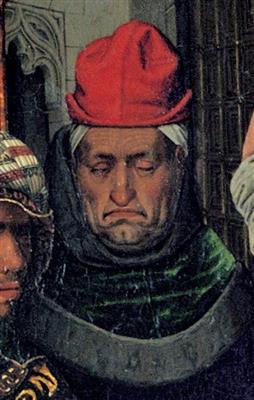
The Ambassadors by Hans Holbein the Younger
The Body of the Dead Christ in the Tomb by Hans Holbein the Younger
Hell scene and monsters by Hieronymus Bosch
Paradise and Hell by Hieronymus Bosch
The Magpie on the Gallows by Pieter Brueghel the Elder
Parable of the Sower by Pieter Brueghel the Elder
Adam and Eve by Albrecht Dürer
Seven Sorrows Polyptych by Albrecht Dürer
Triumphal Arch by Albrecht Altdorfer
Begging Sits on Pride's Train by Albrecht Altdorfer
Christ and the Woman Taken in Adultery by Pieter Aertsen
Butcher's Stall with the Flight into Egypt by Pieter Aertsen

Northern Renaissance

9 artists · 1420–1580

The Northern Renaissance[4] describes the flowering of art, learning and scientific inquiry that spread across the Low Countries, Germany, France and England between roughly 1420 and 1580. While Italian Renaissance artists pursued classical ideals of beauty and mathematical perspective, their northern counterparts developed an alternative tradition rooted in meticulous observation of the visible world. Oil painting, perfected in Flanders, allowed for unprecedented detail: the glint of a jewel, the texture of fur, the play of light through stained glass. Northern artists excelled at portraiture, domestic interiors, landscape and moral allegory. The Protestant Reformation reshaped artistic production after 1517, redirecting patronage away from church altarpieces and toward secular subjects. Printmaking, especially woodcut and engraving, became a powerful medium for spreading both religious ideas and artistic innovation. Albrecht Durer carried prints across the Alps and became the first artist to operate as an international brand.

Key Ideas

  • The Ambassadors — Northern Renaissance

    Empirical Observation Over Classical Ideals

    Where Italian painters began with geometry, proportion and the study of ancient sculpture, northern artists started with the eye. Jan van Eyck painted individual threads in fabric, reflections in convex mirrors and the veins on a hand with a precision that astonished contemporaries. This empirical approach extended to landscape: Pieter Brueghel the Elder recorded the specific look of Flemish villages, winter skies and harvest fields. Northern painters were less interested in the idealised human body than in the particular texture of a specific face, room or season.

  • The Body of the Dead Christ in the Tomb — Northern Renaissance

    Oil Painting and Technical Mastery

    The Flemish development of oil-on-panel technique gave northern artists a tool their Italian contemporaries initially lacked. Oil paint dried slowly, allowing subtle blending and glazing. Thin translucent layers built up optical depth, so that a red robe appeared to glow from within. Van Eyck exploited this property so fully that he was long credited (incorrectly) with inventing the medium. The technique spread south to Italy through trade and travel, eventually merging with Florentine draughtsmanship to produce the High Renaissance synthesis.

  • Hell scene and monsters — Northern Renaissance

    Printmaking as Mass Communication

    Durer transformed the woodcut and engraving from reproductive craft into independent art forms. His prints circulated across Europe in editions of hundreds, making his imagery accessible to a far wider audience than any panel painting could reach. Printmaking also served the Reformation: Luther's ideas spread partly through illustrated pamphlets and broadsheets. The combination of moveable type and high-quality woodcuts created a new visual culture in which images carried arguments, satire and news to literate and illiterate audiences alike.

  • Paradise and Hell — Northern Renaissance

    Moral Allegory and Hidden Symbolism

    Northern Renaissance paintings often operate on two levels. A domestic interior may also be a moral lesson; a landscape may contain a theological argument. Hieronymus Bosch filled his panels with hundreds of symbolic creatures whose meanings scholars still debate. Brueghel embedded proverbs and folk wisdom into crowd scenes. Even seemingly straightforward portraits by Holbein contain symbolic objects that comment on the sitter's character, faith or mortality. This layered approach rewarded attentive viewing and gave northern art an intellectual density distinct from Italian grandeur.

Origins

Flemish Innovation: Oil Paint and the Observed World

The Northern Renaissance began in the prosperous trading cities of Flanders during the 1420s. Jan van Eyck and Robert Campin developed oil-painting techniques that allowed a new level of surface detail. Bruges, Ghent and Brussels were centres of textile production and international commerce, and their wealthy merchant patrons demanded paintings that reflected the material world they inhabited. Flemish altarpieces and devotional panels combined religious subjects with meticulously painted interiors, textiles and landscapes. This Flemish tradition set the standard for northern European painting for the next century.

Durer and the German Tradition

Albrecht Durer of Nuremberg became the key figure in transmitting Italian Renaissance ideas northward. He travelled to Venice twice, in 1494 and 1505, studying perspective, anatomy and proportion. Back in Germany, he merged these lessons with the northern tradition of precise observation and printmaking skill. His theoretical writings on human proportion and geometry were the first of their kind in northern Europe. Through his widely distributed prints, Durer's synthesis of north and south reached artists across the continent.

The Reformation and New Subjects

Martin Luther's challenge to the Catholic Church in 1517 transformed the market for art in northern Europe. Protestant theology rejected the veneration of images, and iconoclasm destroyed thousands of religious paintings and sculptures in the Low Countries and Germany. Artists adapted by turning to portraiture, landscape, still life and scenes of daily life. Hans Holbein the Younger moved from religious commissions in Basel to portrait work at the English court of Henry VIII. Brueghel painted peasant festivals and seasonal landscapes. The Reformation did not end religious art in the north, but it permanently expanded the range of acceptable subjects.

In Their Words

“Art is embedded in nature; he who can extract it, has it.”
Albrecht Durer, Vier Bucher von menschlicher Proportion (Four Books on Human Proportion), 1528
“Simplicity is the greatest adornment of art.”
Albrecht Durer, Attributed, from notes on artistic practice

All Northern Renaissance Artists

7 artists.

Recommended Reading

  • The Art of the Northern Renaissance

    The Art of the Northern Renaissance

    Craig Harbison · 1995

    Clear introduction to the period covering painting, printmaking and sculpture in the Low Countries and Germany.

  • Albrecht Durer and His Legacy

    Albrecht Durer and His Legacy

    Giulia Bartrum · 2002

    British Museum catalogue examining Durer's prints and their influence on subsequent generations of northern European artists.

  • Pieter Bruegel and the Art of Laughter

    Pieter Bruegel and the Art of Laughter

    Walter S. Gibson · 2006

    Study of Brueghel's comic and satirical paintings, arguing for their intellectual seriousness beneath surface humour.

Frequently Asked Questions

  • What is the Northern Renaissance?
    The Northern Renaissance[4] was the version of the Renaissance that developed in the Low Countries, Germany, France and England from about 1430 to 1580, running in parallel with the Italian Renaissance but drawing on distinct local traditions. It produced the invention of oil painting as a flexible artistic medium, the German and Flemish schools of portraiture, detailed landscape backgrounds, and domestic genre scenes unknown in Italian art of the period.
  • When did the Northern Renaissance start?
    The movement's conventional starting point is the early 1430s, with Jan van Eyck's Ghent Altarpiece (1432) and Robert Campin's Mérode Altarpiece (c. 1427 to 1432) as foundational works. These paintings achieved a new depth of observed detail and optical realism through oil paint, a technique van Eyck refined to a new level. The style continued through Bruegel, Dürer and Holbein, concluding around 1580 with the late German tradition.
  • Who are the most famous Northern Renaissance artists?
    Jan van Eyck, Rogier van der Weyden, Hugo van der Goes and Hans Memling led the Flemish school of the fifteenth century. Hieronymus Bosch produced his fantastical religious allegories around 1500. Pieter Bruegel the Elder worked in the mid-sixteenth century. In Germany, Albrecht Dürer was the dominant figure, followed by Matthias Grünewald, Lucas Cranach the Elder and Hans Holbein the Younger, who worked extensively in Tudor England.
  • What defines Northern Renaissance art?
    Northern Renaissance[4] paintings feature intensely observed detail applied uniformly across the picture surface, luminous oil-paint glazes, detailed landscape backgrounds often stretching to a distant horizon, domestic and genre subjects alongside religious scenes, and an iconographic complexity drawn from Northern European theological writing. Figures are often portrait-like rather than classically idealised, and clothing, jewellery and interiors are rendered with documentary precision.
  • What is the difference between Northern and Italian Renaissance art?
    Italian Renaissance art (c. 1400 to 1600) prioritised classical antiquity, linear perspective, anatomical idealisation and monumental religious or mythological subjects. The Northern Renaissance[4] (c. 1430 to 1580) prioritised observed detail, oil-paint glazing, and genre and portrait subjects that had no Italian equivalent. Italian painters learned oil technique from Flemish sources; Northern painters absorbed perspective and antique iconography from Italian travel and print.
  • Why was the Northern Renaissance important?
    The Northern Renaissance[4] developed oil painting into the flexible medium that would dominate European art for the next four centuries. It created the modern portrait, the landscape, the still life and the genre scene, four categories with no secure equivalent in Italian art of the same period. Dutch Golden Age painting of the seventeenth century is a direct continuation of the Flemish fifteenth-century tradition.
  • Where can I see the best Northern Renaissance paintings?
    The Ghent Altarpiece remains in Saint Bavo's Cathedral in Ghent. The Royal Museums of Fine Arts of Belgium in Brussels and the Groeningemuseum in Bruges hold the densest Flemish collections. The Prado in Madrid holds most of Bosch's surviving paintings and major Bruegel canvases. Vienna's Kunsthistorisches Museum has the world's strongest Bruegel and Dürer collection. London's National Gallery and Berlin's Gemäldegalerie hold substantial supplementary holdings.

Sources

Northern Renaissance editorial draws on the following published scholarship.

  1. [1] book Craig Harbison, The Art of the Northern Renaissance, 1995 Used for: biography, stylistic analysis.
  2. [2] book Giulia Bartrum, Albrecht Durer and His Legacy, 2002 Used for: influences, stylistic analysis.
  3. [3] book Walter S. Gibson, Pieter Bruegel and the Art of Laughter, 2006 Used for: influences, stylistic analysis.
  4. [4] wikipedia Wikipedia: Northern Renaissance Used for: biography.
  5. [5] book by Claudia Lyn Cahan and Catherine Riley, Bosch, Bruegel, and the Northern Renaissance Used for: biography.
  6. [6] book by Claudia Lyn Cahan and Catherine Riley, Bosch, Bruegel, and the Northern Renaissance_1 Used for: biography.
  7. [7] book Beckett, Wendy, The story of painting Used for: biography.
  8. [8] wikipedia Wikipedia: Bartolome Bermejo Used for: biography.

Editorial overseen by Solis Prints. Sources verified 2026-06-18. Click a source for details, or hover over [N] in the page above to preview.

Take Northern Renaissance home.

See all Northern Renaissance prints →
Back to Discover