

About Abdulmejid II
Turkish · 1868–1944
Ottoman prince and last Caliph of Islam; his harem paintings rank among the most significant works of late Ottoman art.
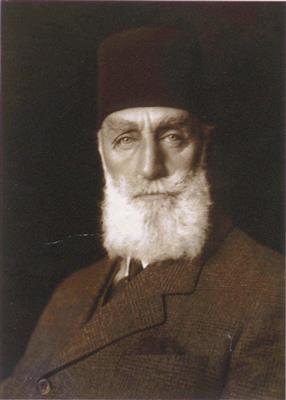
Where to see Abdulmejid II
Collection holdings are reported here; current display varies. Check with each museum before visiting.
Frequently Asked Questions
Where can I see Abdulmejid II's work?
Many museums hold works by Abdulmejid II, though they are spread across the globe. In the United Kingdom, the National Museums of Scotland (in Edinburgh) and the Victoria & Albert Museum (in London) both possess pieces. Other European museums include the Rijksmuseum in Amsterdam; the Staatliche Museen Preussischer Kulturbesitz in Berlin; the Czartoryski Museum in Cracow; the Musée des Arts Décoratifs and the Musée du Louvre, both in Paris; the Calouste Gulbenkian Museum in Lisbon; the Österreichisches Museum für Angewandte Kunst in Vienna; and the State Hermitage Museum in St. Petersburg. In North America, you can find his works at the Metropolitan Museum of Art in New York; the Los Angeles County Museum of Art; the Brooklyn Museum in Brooklyn; the Royal Ontario Museum in Toronto; the Seattle Art Museum; the Arthur M. Sackler Museum at Harvard University; and the Freer Gallery of Art / Arthur M. Sackler Gallery at the Smithsonian Institution, in Washington, DC. Other locations are the Middle East Culture Centre in Tokyo; the Chehelsotun Museum and Reza Abbasi Museum in Tehran; and the Dar al-Athar al-Islamiyya and the Tareq Rajab Museum in Kuwait.What should I know about Abdulmejid II's prints?
Abdulmejid II, the last Caliph of the Ottoman Caliphate, was a painter as well as a royal figure. While specific details about his printmaking are scarce, understanding the context of graphic reproduction in art history can be helpful. Prints are often created after paintings, either as copies or as a means of wider distribution. For example, several etchings were made of Rembrandt's paintings in the 18th century by artists such as Georg Friedrich Schmidt and Johann Andreas Nothnagel. These prints sometimes reversed the image of the original painting or included variations in costume and details. The purpose of such prints could vary, from documenting the original artwork to making it accessible to a larger audience. Some prints were based directly on paintings, while others were created from existing prints. This practice means that variations and inaccuracies could occur as the image was reproduced multiple times. When examining prints related to Abdulmejid II's work, it is useful to consider the printmaker, the date of creation, and the relationship to any original paintings. These factors can provide insight into the print's purpose and accuracy.Why are Abdulmejid II's works important today?
Abdulmejid II's artistic output remains relevant because it provides insight into early 20th-century Ottoman culture and the artistic interests of a figure who was briefly head of state during a period of significant political transition. After the abolition of the Ottoman Sultanate in 1922[1], Abdulmejid II was elected Caliph by the Turkish[1] National Assembly; he held this religious office, which had lost most of its former power, until the Caliphate was also abolished in 1924. Later in the 20th century, figures from the Islamic past became subjects in modern dramas, passion plays, and tragedies. These interpretations often served as symbols of suffering for one’s ideals, appealing to both conservative Muslims and progressive social critics. Similarly, Abdulmejid II's life and work are viewed through the lens of a changing world.What techniques or materials did Abdulmejid II use?
Abdulmejid II's artistic interests extended to painting and photography. Archival evidence suggests a connection between the Ottoman court and technocrat artists, cultivated as 'officers endowed with technical knowledge' from military and engineering schools. These graduates were appointed to instruct in other schools under the Hamidian regime's expanded educational initiatives. When the court needed technical expertise for projects, skilled individuals from both schools were assembled. They delivered results using visual and documentary surveying methods. Some group members later created oil paintings from photographs of singular monuments or grand vistas. The photographs of geographies, cityscapes, monuments, and inhabitants were soon repurposed for gift albums. Furthermore, multimedia artists were aware of photography's shortfalls when capturing interiors; the fact that they could only be in grayscale but also the full scope of volumetric shading, spatial depth, and panoramic representation of enclosed spaces could not be fully realised through late-nineteenth-century photo technologies.Who did Abdulmejid II influence?
Abdulmejid II's artistic influence is difficult to measure directly, but some scholars suggest his paintings, particularly those inspired by his visit to the harem, had an impact on later artists. His work, with its heightened colour and attention to light, may have influenced artists such as Renoir and Matisse. These artists were interested in the intense colour inspired by oriental travels, and by the way Abdulmejid II brightened the traditional brownish colours of painting. Other possible connections are less direct. Some scholars have noted similarities between the works of Emilie Mediz-Pelikan and Claude Monet, suggesting that Mediz-Pelikan's study of French Impressionism, and Monet in particular, may have informed her style. Theodor von Hoérmann also found inspiration in French painting, developing a lighter palette and focusing on capturing the optical appearance of objects. However, influence can be a complex idea; some artists may be inspired by those they have never directly encountered.Who influenced Abdulmejid II?
Abdulmejid II, as a late-Ottoman figure, was influenced by artists and instructors tied to military and engineering schools. These schools played a role in state-managed art training outside traditional fine arts academies. Graduates often became bureaucrats, using their skills in surveying and visual documentation for state projects. Sultan Abdülhamid II's court relied on these technocrat artists, described as 'officers endowed with technical knowledge'. They were skilled in multiple visual modes. Examples include Sururili Ahmed Emin (painting and photography instructor at the School of Engineering) and Ali Rıza (painting instructor at the Military Academy). These officer-artists produced comprehensive portfolios of sketches, drawings, and reports. Some later created oil paintings from photographs of monuments or vistas. Their photographs were repurposed in gift albums, illustrating Ottoman history for figures such as Otto von Bismarck.What is Abdulmejid II's most famous work?
It is difficult to identify Abdulmejid II's single 'most famous work' definitively. He was a painter working in a Western style, while also fulfilling his duties as a caliph in the Ottoman Empire. As a painter, Abdulmejid II is known for his interest in portraiture and for large-scale history paintings. His works often include scenes from Ottoman history or depictions of important figures. Some better-known paintings include portraits of family members and court officials. However, his role as a caliph and his involvement in political events have often overshadowed his artistic output. Further research into exhibition catalogues and Ottoman-era art criticism would be needed to assess which of his works achieved the most recognition during his lifetime.What style or movement did Abdulmejid II belong to?
Abdulmejid II's artistic affiliations are complex. The modernisation policies of Abdul Hamid II, the last Sultan of the Ottoman Empire, included invitations to European architects. This led to the application of Art Nouveau styles in Istanbul, drawn from various European centres. Art Nouveau ornament was often applied to standard buildings, giving them a veneer of modernity. In Istanbul, ornamental ironwork and moulded plaster details became a cost-effective way to add European glamour to new constructions. The Italian architect Raimondo D’Aronco, who worked for Abdul Hamid II, integrated European Art Nouveau with Islamic calligraphy and geometric patterns. This approach aimed to create designs that were both contemporary and rooted in local traditions. Designers in various Eastern European cities also used Byzantine elements to express their regional identity. Similarly, Islamic architecture was combined with European forms to create a modern national style within the Ottoman Empire.
Sources
Where to See guide aggregates verified holdings of Abdulmejid II's works across the following collections.
- [1] wikipedia Wikipedia: Abdulmejid II Used for: biography.
- [2] book guggenheim-guhe00solo Used for: biography.
- [3] book Braun, Emily, 1957-; Asor Rosa, Alberto; Royal Academy of Arts (Great Britain), Italian art in the 20th century : painting and sculpture, 1900-1988 Used for: biography.
- [4] book Masterpieces of western art : a history of art in 900 individual studies from the Gothic to the present day Used for: biography.
Editorial overseen by Solis Prints. Sources verified 2026-10-14. Click a source for details, or hover over [N] in the page above to preview.
Editorial standardsMethodologyCorrectionsAI disclosureAbout the editorial team