



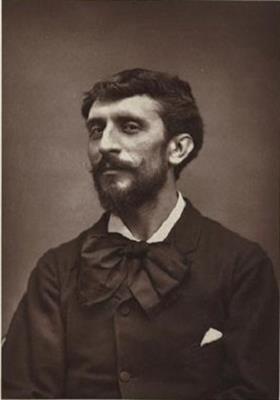
About Albert Aublet
Museums2
Countries2
Most worksMusée des Beaux-Arts de la ville de Paris, Paris · 6 works
Loading map…
Where to see Albert Aublet
Ranked by works you can see in person.
-
6 works
Musée des Beaux-Arts de la ville de Paris
Paris, France
-
1 work
Yale University Art Gallery
New Haven, United States


Frequently Asked Questions
Where can I see Albert Aublet's work?
Works by Albert Aublet can be viewed in various museums and galleries. These include the Musée des Beaux-Arts in both Nantes and Dijon, as well as the Musée Crozatier in Le Puy. Additionally, Aublet's art is held in the collections of the Musée des Beaux-Arts in Lille, the Musée des Beaux-Arts Jules Cheret in Nice, and the Musée des Beaux-Arts in Orléans. In Paris, his pieces can be seen at the Musée des Arts Decoratifs, Musée d’Orsay, and Musée du Petit Palais. Other locations include the Musée Saint-Denis in Reims, the Musée des Beaux-Arts in Rouen, and the Musée d’Art et d'lndustrie in Saint Etienne. Further afield, collections include the Musée des Augustins in Toulouse. These museums offer opportunities to view Aublet's artistic output.What should I know about Albert Aublet's prints?
When considering Albert Aublet's prints, it is useful to understand some basics of printmaking. An original print is conceived as a print, and created solely as a print. Each one in the edition is an original, made from a plate, stone, screen, or block created for that purpose. The artist inks and pulls each print individually; it is a multi-original medium. The artist decides the number of prints in the edition. Sequential numbering accounts for the number of prints; each has a specific number, such as 12/25 (print number 12 from an edition of 25). Numbering of prints is a relatively recent convention. Early prints were not numbered or signed; sometimes the artist signed the plate or stone, rather than each individual print. A reproduction has no relationship to an original print. It copies a work of art conceived in another medium, such as painting or watercolour. These reproductions are usually made by photomechanical means. Numbering and signing a reproduction does not change its essence; it remains a reproduction, not an original print. Prints are often categorised as Artist Proofs, Lettered Proofs, Presentation Proofs, Proofs before letters, and Remarque Artist Proofs.Why are Albert Aublet's works important today?
Albert Aublet (1851[1]-1938[1]) was a French[1] artist who worked in a variety of genres. He is known for his portraits, genre scenes, and depictions of historical events. Aublet's paintings often feature careful attention to detail, a refined colour palette, and a sense of elegance. Although Aublet may not be as widely recognised as some of his contemporaries, his works are important for several reasons. They provide insight into the artistic tastes and cultural values of the late 19th and early 20th centuries. His paintings offer a glimpse into the lives of the upper classes, depicting their leisure activities, social gatherings, and domestic environments. Aublet's historical paintings reflect the prevailing attitudes towards the past, often idealising or romanticising historical events and figures. His contribution to French art is worthy of continued study.What techniques or materials did Albert Aublet use?
Information about Albert Aublet's specific techniques is scarce. However, we can discuss the broader artistic context of his time. During the 17th and 18th centuries, French[1] painting techniques were heavily influenced by Italian methods. Treatises from this period, such as De La Fontaine's Academie de La peinture (1679), detail practices involving pigment mixtures for oil, fresco, pastel, and miniature painting. Preparation of the canvas involved stretching, pumice-stone smoothing, glue sizing, and applying a double ground. The first ground was coloured with raw umber and red-brown, spread with a knife; the second used lead white with a touch of carbon black for a grey tone. By the late 19th century, some artists moved away from traditional methods. Jean Dubuffet, for example, incorporated unconventional materials like cement, tar, gravel, and even butterfly wings into his paintings. He combined these elements with a thick paste of light-coloured oil paint, ashes, sand, and coal dust, applied with a spatula. This approach reflects a rejection of conventional techniques in favour of more spontaneous and primitive forms of expression.Who did Albert Aublet influence?
Albert Aublet's artistic influence is not well documented. However, some connections can be drawn between Aublet and other artists of his time. Aublet's work, particularly his interest in monumental and decorative painting, shares similarities with Henri Martin, who adopted Neo-Impressionism in 1889[1] and combined it with idealistic themes, similar to those favoured by Puvis de Chavannes. Additionally, Aublet's academic training and classical style may have resonated with artists who, like Paul Ranson, studied at the École des Arts Décoratifs and the Académie Julian. These institutions fostered an environment where artists explored the union of fine and decorative arts. Aublet's involvement with the Société des Artistes Français also suggests a connection to established artistic circles, where influence could have been exchanged with other members.Who influenced Albert Aublet?
Without specific biographical details about Aublet's artistic training, it is difficult to name individuals who directly shaped his style. However, by considering the broader artistic environment of his time, we can identify potential influences. The late 19th century saw the rise of Post-Impressionism, with figures such as van Gogh, Gauguin, and Toulouse-Lautrec making an impact. These artists moved away from the descriptive function of colour, a shift that affected many. Simultaneously, Symbolism gained traction, influencing painters with its literary and often exotic themes. Gustave Moreau, a teacher to many Fauvist painters, promoted a richly ornate style that appealed to writers and artists alike. Another potential influence was Pierre Puvis de Chavannes, admired for his placid, mythological subjects and his dedication to mural painting. Aublet's interest in decorative work may reflect the trends of the time, as artists explored the union of fine and decorative arts. Without more information, these remain possible contextual influences rather than confirmed individual connections.What style or movement did Albert Aublet belong to?
Albert Aublet is associated with the Orientalist movement, which was popular in France throughout the 19th century and beyond. This style was fueled by French[1] colonial expansion and a fascination with the Middle East, North Africa, and, to a lesser extent, other parts of Asia. The rise of Orientalism[1] in French art can be traced to several factors, including Napoleon's Egyptian campaign (1798-1801[1]) and the Greek struggle for independence in the 1820s. These events piqued French interest in the region. Artists like Eugène Delacroix, Théodore Chassériau, and Horace Vernet travelled to these areas, seeking inspiration, authentic costumes, and settings for their work. Vernet, for example, travelled to Egypt, Syria, and Turkey in 1839 to gather material for Biblical scenes. Orientalist paintings often presented an idealised, sometimes romanticised, view of the East. They catered to a European audience seeking an escape from industrialised society. The exotic nature of these regions, with their "opulent exoticism, savagery, and sensuality," proved irresistible to many. The Société des Peintres Orientalistes was formed in 1893[1], with Jean-Léon Gérôme as honorary president, marking the culmination of this long-running artistic trend.
Sources
Where to See guide aggregates verified holdings of Albert Aublet's works across the following collections.
- [1] wikipedia Wikipedia: Albert Aublet Used for: biography.
- [2] book Bernard Denvir, World of Art_ Post-Impressionism Used for: biography.
- [3] book Bernard Denvir, World of Art_ Post-Impressionism Used for: biography.
- [4] book Bernard Denvir, World of Art_ Post-Impressionism Used for: biography.
Editorial overseen by Solis Prints. Sources verified 2026-09-26. Click a source for details, or hover over [N] in the page above to preview.
Editorial standardsMethodologyCorrectionsAI disclosureAbout the editorial team