



About Algernon Talmage
Oxfordshire-born painter of the St Ives School, war artist on the Western Front, and founding teacher of the Cornish School of Landscape Painting.
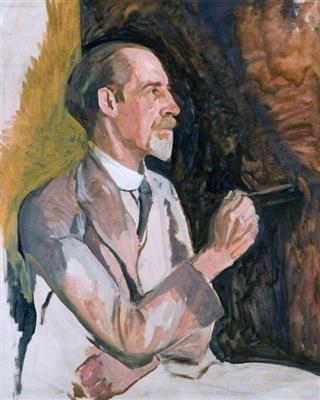
Where to see Algernon Talmage
Ranked by works you can see in person.
-
25 works
Canadian War Museum
Ottawa, Canada
-
4 works
Kirklees Museums and Galleries
Huddersfield, United Kingdom

-
2 works
Bristol City Museum & Art Gallery
Bristol, United Kingdom
-
2 works
Art Gallery of South Australia
Adelaide, Australia
-
1 works
Harris Museum
Preston, United Kingdom
-
1 works
Newport Museum and Art Gallery
Newport, United Kingdom
-
1 works
Guildhall Art Gallery
London, United Kingdom
-
1 works
Royal Academy of Arts
London, United Kingdom
-
1 works
Gallery Oldham
Oldham, United Kingdom
-
1 works
Laing Art Gallery
Newcastle upon Tyne, United Kingdom


View all 14 museums
-
1 works
National Gallery
London, United Kingdom
-
1 works
Manchester Art Gallery
Manchester, United Kingdom
-
1 works
Grundy Art Gallery
Blackpool, United Kingdom
Also here (3)
-
1 works
Tate
London, United Kingdom


Frequently Asked Questions
Where can I see Algernon Talmage's work?
You can find examples of Algernon Talmage's work in several museums. In the United States, these include the Charles Hosmer Morse Museum of American Art (Winter Park, Florida), the Los Angeles County Museum of Art (Los Angeles), the Metropolitan Museum of Art (New York), the Minneapolis Institute of Arts (Minneapolis), the Museum of Modern Art (New York), the Virginia Museum of Fine Arts (Richmond), and the Wolfsonian at Florida International University (Miami Beach). In Canada, his work can be viewed at the Royal Ontario Museum (Toronto). In the United Kingdom, see the Bakelite Museum (Williton), the Brighton Museum & Art Gallery (Brighton), the Geffrye Museum (London), the Manchester Art Gallery (Manchester), the National Museums of Scotland, Royal Museum (Edinburgh), and the Victoria & Albert Museum (London).What should I know about Algernon Talmage's prints?
When considering a print by Algernon Talmage, it is helpful to understand some basic print terminology. A 'vintage print' is one produced around the time the negative was made. A 'period print' is one made within roughly 10 to 15 years of the original shooting. Any print made later than that is generally termed an 'old print'. A 'modern print' or 'contemporary print' refers to a photograph recently produced from the original negative. An 'original print' is one the artist made or directly supervised. Lastly, a 'facsimile' is a print created either by re-photographing a print or by using the original negative, using materials and processes as close as possible to the original; this is generally a vintage print. The Professional Art Dealers Association of Canada defines an original print as an image conceived and executed solely as a print, usually in a numbered edition, and signed by the artist.Why are Algernon Talmage's works important today?
Algernon Talmage's importance lies in his position within early twentieth-century British[2] art. He represents a generation of painters who found themselves at odds with the rise of modernism. Figures such as Phillip Burne-Jones and W B Richmond felt that their practices were under attack from critics such as Roger Fry. Fry criticised the work of Lawrence Alma-Tadema, a painter closely connected with Burne-Jones and Richmond. This led to a defence of more traditional artistic values, but it also meant a missed opportunity to explain their own standards. Fry and his supporters seized the chance to promote Post-Impressionism. Walter Sickert, a contemporary of Talmage, also found himself in a fluctuating position as new movements appeared. Although he was influenced by French art, he remained an individual figure. Sickert’s work was sometimes seen as provocative due to its challenging subject matter and handling of paint. Like Talmage, Sickert’s career shows the tensions between tradition and innovation in British art during this period.What techniques or materials did Algernon Talmage use?
Algernon Talmage's painting methods involved careful preparation and application. For grounds, he used gessoed MDF, primed canvas adhered to MDF board, and primed canvas. He favoured artists' quality materials for both the grounds and the paints themselves, believing that lesser quality paints lacked colour saturation and permanence. Talmage preferred filberts and flats, ranging from small to large sizes. He used hog hair brushes, valuing their springy resistance against the canvas and their ability to create broad, expansive marks. He avoided synthetic brushes. When beginning a work, Talmage started with pure turpentine. As the work progressed through several stages, he gradually added linseed oil, increasing the proportion with each session. After approximately ten sessions, he would use pure linseed oil. His palette remained relatively consistent over the years, with occasional additions of supplementary blues, yellows, or greens. He believed that limiting the number of paints helped to avoid unwanted complexities and distractions from the painting process.Who did Algernon Talmage influence?
Information regarding Algernon Talmage's direct artistic influence is limited in the provided texts. However, the passages do discuss the influence of other artists on the California art scene. For example, Macdonald-Wright had a strong influence on progressive artists, collectors, and enthusiasts through lectures and painting demonstrations at the Art Students League of Los Angeles and the Chouinard Art Institute in the 1920s. Mabel Alvarez and Edouard Vysekal were among his students. Donna Schuster was inspired by him to paint in a bolder manner, focusing on distorted forms and more intense colours. Henrietta Shore, who had a local reputation for a colourful, expressionistic style, helped plan independent exhibitions beyond the conservative juried annuals of the California Art Club. Shore returned to Los Angeles in July 1923[2] with an established East Coast reputation and was well received by artists, critics, and friends.Who influenced Algernon Talmage?
Algernon Talmage (1871[2]-1939[2]) was an American-born British[2] Impressionist painter. He is best known for rural and equestrian subjects. Talmage received early instruction from his father, a sculptor. He studied at the Académie Julian in Paris. Here, he was exposed to the work of French Impressionists. These artists had a considerable effect on his style. Later, Talmage became associated with the Newlyn School of painters. This group, based in Cornwall, favoured plein-air painting and naturalistic subjects. Though not a formal member, the Newlyn artists' approach to light and atmosphere resonated with Talmage's artistic sensibilities. John Singer Sargent also influenced Talmage. Both artists shared a bravura painting style. They used loose brushwork to capture fleeting effects. Talmage admired Sargent's portraits and figure paintings. He incorporated similar techniques into his own work. Through his training and associations, Talmage synthesised various influences into his distinctive Impressionistic style.What is Algernon Talmage's most famous work?
Algernon Talmage (1871[2]-1939[2]) was a British[2] Impressionist painter, known for rural and equestrian subjects. Although no single work overshadows his entire output, several paintings secured recognition during his lifetime and continue to be admired. *A Frosty Morning* (date unknown) is a characteristic example of his style. It depicts horses in a misty, wintry setting, a theme he returned to repeatedly. Other notable paintings include *The First Cloud of the Season* (1910[2]), which captures a fleeting atmospheric effect over a field. *Building the Rick* (date unknown) shows farm labourers at work. Talmage's skill in depicting animals, particularly horses, contributed to his popularity. He received commissions to paint portraits of racehorses and hunters, further establishing his reputation in sporting art circles. His paintings are held in numerous public and private collections, including the Tate, and continue to be sought after by collectors of British Impressionism.What style or movement did Algernon Talmage belong to?
Algernon Talmage (1871[2]-1939[2]) was a British[2] Impressionist painter, although elements of other styles can be observed in his work. Impressionism, which gained momentum in the late 19th century, moved away from precise representation, favouring instead the capturing of fleeting moments and the effects of light and colour. Impressionist artists often worked outdoors (en plein air) to directly observe these effects. While Talmage is mainly categorised as an Impressionist, some art historians note qualities from other movements in his paintings. Some suggest he used realism, and others suggest he adopted a decorative character in some of his works. This blending of styles is not unusual, as many artists incorporate diverse influences into their practice.
Sources
Where to See guide aggregates verified holdings of Algernon Talmage's works across the following collections.
- [1] museum Canadian War Museum Used for: museum holdings.
- [2] wikipedia Wikipedia: Algernon Talmage Used for: biography.
- [3] book Alfred Frankenstein, After the Hunt _ William Harnett and Other American Still Life Painters, 1870-1900 Used for: biography.
- [4] book Landauer, Susan, The not-so-still life : a century of California painting and sculpture Used for: biography.
Editorial overseen by Solis Prints. Sources verified 2026-08-29. Click a source for details, or hover over [N] in the page above to preview.
Editorial standardsMethodologyCorrectionsAI disclosureAbout the editorial team