

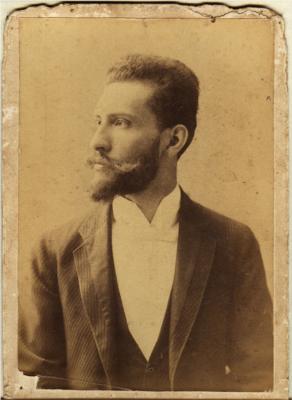
About Arturo Michelena
Venezuelan · 1863–1898
- history painting
Venezuela's foremost 19th-century academic painter, who won gold medals in Paris before tuberculosis claimed him at thirty-five.
Where to see Arturo Michelena
Collection holdings are reported here; current display varies. Check with each museum before visiting.
Frequently Asked Questions
What should I know about Arturo Michelena's prints?
Information on Arturo Michelena's prints is scarce; however, some general information about fine art prints may be useful. Original prints, such as woodcuts, engravings, or lithographs, are produced by hand. The artist creates the artwork directly on a plate, block, or screen. Each print is considered an original because of this direct involvement. Plates for original prints are made by hand and can only withstand a certain amount of use; the number of prints is thus limited. Some publishers impose their own limits to increase a print’s value. Offset reproductions, also known as posters, are produced by photochemical means. The plates do not wear out, so quantities may be limited by the publisher to add value. Giclée prints are inkjet fine art prints that are gaining popularity as colour-copier technology matures. Canvas transfers are also becoming more popular; the image is transferred onto canvas to give the work the look and feel of a painting. When buying prints, it is important to understand the terms and practices in the art market. The Professional Art Dealers Association of Canada defines an original print as an image conceived and executed solely as a print, usually in a numbered edition, and signed by the artist. Each print is individually inked and pulled.Why are Arturo Michelena's works important today?
Arturo Michelena (1863[1]-1898[1]) was a Venezuelan[1] artist best known for his history paintings and portraits. He achieved international recognition during his short career. Michelena's importance stems partly from his artistic skill. He won a gold medal at the Exposition Universelle in Paris in 1889[1] for *Charlotte Corday conduite au supplice* (Charlotte Corday Led to the Scaffold). This success marked a high point for Latin American art on the world stage. He also received acclaim for his portraits, capturing the likenesses of prominent figures. His paintings often explored themes of Venezuelan history and identity. Works such as *Vuelvan Caras* depict significant moments in the country's past. These paintings contribute to a visual record of Venezuelan history. They also reflect the artistic trends of the late 19th century, blending academic realism with dramatic compositions. Michelena's works are preserved in major collections, including the Arturo Michelena Foundation and the National Art Gallery in Caracas. His art continues to be studied, exhibited, and appreciated for its historical and artistic value.What techniques or materials did Arturo Michelena use?
Arturo Michelena (1863[1]-1898[1]) was a Venezuelan[1] artist known for his history paintings, portraits, and genre scenes. He received academic training, first in Caracas, then in Paris at the Académie Julian. Michelena was a skilled draughtsman and painter in the academic tradition. He primarily used oil paint on canvas. His technique involved careful underdrawing, precise modelling of forms, and smooth brushwork. He often employed a warm colour palette, with attention to light and shadow to create dramatic effects. His submissions to the Salon des Artistes Français in Paris show his technical facility. "L'Enfant Malade" (1886[1]) won a gold medal; this success brought him wider recognition. Later works, such as the equestrian portrait of General Crespo, demonstrate his ability to handle complex compositions and textures. Although he died young, his paintings show a mastery of academic techniques.Who did Arturo Michelena influence?
Arturo Michelena's direct influence is difficult to trace, as he died relatively young, at 35. However, his academic style and patriotic themes resonated with many Latin American artists who followed. Michelena's work, particularly his history paintings, helped to establish a sense of national identity in Venezuela. His depictions of Venezuelan[1] heroes, such as Francisco de Miranda in *Miranda en la Carraca*, provided visual representations of the country's past. This approach was adopted by other Latin American artists who sought to depict their own nations' histories and struggles for independence. His influence can also be seen in the work of later Venezuelan artists who embraced realism and academic techniques. Although no specific students or direct followers are widely documented, his example encouraged a generation to pursue art education in Europe and to bring those skills back to Venezuela. His legacy is more about setting a standard and opening possibilities than about a clearly defined school of followers.Who influenced Arturo Michelena?
Arturo Michelena's artistic development occurred in Venezuela and Paris, exposing him to a range of influences. Early on, Michelena would have seen reproductions of works, including Millet's *Angelus* and chromolithographs of Murillo's Madonnas. These, however, did not resonate with him. Later, while studying in Caracas, Michelena encountered Cubism, particularly a still life by Braque. This encounter sparked an interest in modern art. He sought to understand Braque and, through him, Picasso. He also explored Cézanne and van Gogh. Although briefly drawn to Gauguin's colours, he was not convinced by his forms or symbolic vision. In Paris, he saw original works by Sisley and Dunoyer de Segonzac. He initially wanted to add movement to Mondrian's works but realised Mondrian had already addressed that issue. He found László Moholy-Nagy important, along with Calder, Marcel Duchamp, and Gabo. He aimed to build on their ideas and find answers to the questions they posed.What is Arturo Michelena's most famous work?
It is difficult to identify Arturo Michelena's single "most famous" work, as fame is subjective and shifts over time. However, several paintings are particularly well known and representative of his artistic skill. One notable example is "Miranda in La Carraca" (1896[1]), which depicts Francisco de Miranda, a Venezuelan[1] revolutionary, in prison. This work is admired for its emotional intensity and historical subject matter. Another significant painting is "La Joven Madre" (The Young Mother), which offers a tender portrayal of motherhood. Michelena also created historical paintings, such as the equestrian portrait of General Joaquín Crespo. His work often explored themes of Venezuelan identity, history, and social issues. Although he died young, at 35, Michelena produced a substantial body of work that secured his place as a major figure in Venezuelan art history.What style or movement did Arturo Michelena belong to?
Arturo Michelena (1863[1]-1898[1]) was a Venezuelan[1] artist who achieved international recognition during his lifetime. Although it is difficult to assign him to one specific movement, his work incorporates elements of several late 19th-century styles. Michelena's paintings often display characteristics of Academic art, a style that predominated in European academies. Academic art emphasised technical skill, historical or mythological subjects, and a polished finish. However, Michelena also engaged with Realism, evident in his attention to detail and his focus on contemporary subjects. Some scholars also note the influence of Impressionism in his looser brushwork and interest in capturing fleeting moments. He synthesised aspects of these different approaches, creating a distinctive style that brought him success in Venezuela and Paris.What is Arturo Michelena known for?
Arturo Michelena is known for his historical paintings, such as Vuelvan Caras and Miranda en La Carraca. He won gold medals at the Salon de Paris for The Sick Child and at the Exposition Universelle for Charlotte Corday on the Way to the Scaffold. His work played a role in shaping Venezuelan[1] national identity.
Sources
Where to See guide aggregates verified holdings of Arturo Michelena's works across the following collections.
- [1] wikipedia Wikipedia: Arturo Michelena Used for: biography.
- [2] book Brodskaya Nathalia, Brodskaya Nathalia - Symbolism Used for: biography.
- [3] book guggenheim-sospectiv00soto Used for: biography.
- [4] book guggenheim-twopri00weis Used for: biography.
- [5] book Masterpieces of western art : a history of art in 900 individual studies from the Gothic to the present day Used for: biography.
- [6] book Rolando Pérez, Severo Sarduy and the Neo-Baroque Image of Thought in the Visual Arts (Purdue Studies in Romance Literatures, 53) Used for: stylistic analysis.
- [7] book Untitled Used for: biography, stylistic analysis.
Editorial overseen by Solis Prints. Sources verified 2026-10-15. Click a source for details, or hover over [N] in the page above to preview.
Editorial standardsMethodologyCorrectionsAI disclosureAbout the editorial team