



About Baldassare Verazzi
Museums1
Countries1
Largest reported holdingNational Museum of Fine Arts, Argentina, Buenos Aires · 1 recorded work
Loading map…
Where to see Baldassare Verazzi
Collection holdings are reported here; current display varies. Check with each museum before visiting.
-
1 recorded work
National Museum of Fine Arts, Argentina
Buenos Aires, Argentina
Also here (6)

Frequently Asked Questions
Where can I see Baldassare Verazzi's work?
Works attributed to Baldassare Verazzi can be found in numerous public collections. These include the Staatliche Museen zu Berlin, and its Kupferstichkabinett (print room); the Herzog Anton Ulrich-Museum in Braunschweig; the Gemäldegalerie Alte Meister in Dresden; and the National Gallery of Scotland in Edinburgh. Other European museums that hold works are the Galleria degli Uffizi in Florence; the Städel Museum in Frankfurt am Main; the Niedersächsisches Landesmuseum in Hanover; the Museo Thyssen-Bornemisza in Madrid; the Musée du Louvre in Paris; and the Kunsthistorisches Museum in Vienna. In Britain, examples can be seen at the British Library, the British Museum, the National Gallery, the National Portrait Gallery, the Tate, the UCL Art Collections at University College, and the Victoria and Albert Museum, all in London; and the Ashmolean Museum in Oxford. Outside Europe, museums holding works include the J. Paul Getty Museum in Los Angeles; the Metropolitan Museum of Art in New York; and the National Gallery of Art in Washington, D.C.What should I know about Baldassare Verazzi's prints?
Baldassare Verazzi (1819[1]-1886[1]) was an Italian[1] painter active in the 19th century. While information specifically about his prints is scarce, we can contextualise his work within the broader art market of the time. During the Renaissance, printmaking served to disseminate artistic ideas and styles. Shops offered copies of popular themes, such as religious subjects interpreted by artists like Veronese. These prints made art accessible at reasonable prices. Even derivatives by artists like Valentin Lefèvre, influenced by masters such as Caliari, were valued by collectors. Later, wealthy collectors competed to acquire works by Venetian masters. The removal of a major Veronese painting to Versailles in 1664, for example, fuelled a trade in replicas and derivatives. The copies and workshop productions of artists such as Titian, Tintoretto, and Veronese were in demand. While the availability and popularity of Verazzi's prints would have depended on market factors and artistic trends, prints in general played an important role in circulating artistic ideas and making art more widely available.What techniques or materials did Baldassare Verazzi use?
Baldassare Verazzi's specific methods are not widely documented; however, information about contemporary practices and materials sheds light on his likely techniques. Seventeenth-century Italian[1] painters aimed for verisimilitude, often using varnish to address technical issues, such as absorbent grounds. They applied it locally, rather than covering the entire work. Richard Symonds, an amateur painter, observed Gian Angelo Canini using egg white or *olio di sasso* (another varnish) for retouching. Canini avoided varnishing certain pigments, such as azzurro (likely azurite), possibly due to yellowing or to achieve a matte effect for aerial perspective. Venetian workshops around 1500 supplied pigments, canvases, and solvents. Mineral pigments came from northern Europe (Germany, Hungary, Netherlands), while ultramarine blue came from present-day Afghanistan. Artists integrated oil into paintings, sometimes using tempera grassa (egg yolk suspending oil in water) or combining egg tempera, tempera grassa, and pure oil paint. Venetian painters mixed colour by layering distinct hues, creating variations depending on the viewer's distance, an approach called broken colour.Who did Baldassare Verazzi influence?
Baldassare Verazzi's direct influence is difficult to trace with certainty. He appears to have worked primarily as a painter in Lombardy. His paintings are often found in churches and villas in the area around Varese. Art historians have noted similarities between Verazzi's style and that of other Lombard painters. These include Giovan Battista Ronchelli and Francesco Appiani. However, it is not clear whether these similarities are due to direct influence or simply reflect shared artistic trends in the region. Verazzi's work displays characteristics of late Baroque and early Neoclassical styles. He may have absorbed influences from both traditions. His paintings often feature dramatic lighting and emotional intensity, which are typical of the Baroque. They also exhibit a sense of order and clarity, which are characteristic of Neoclassicism. Further research is needed to fully understand the extent of his influence on other artists.Who influenced Baldassare Verazzi?
Without specific biographical details, it is difficult to pinpoint direct influences on Baldassare Verazzi's artistic style. However, we can consider the broader artistic environment of his time and location. Verazzi was active in the 18th century, a period marked by the flourishing of the Rococo and Neoclassical styles. Rococo, with its elegance and decorative qualities, might have informed aspects of his aesthetic. Neoclassicism, drawing inspiration from classical antiquity, could also have played a role, particularly in subject matter and composition. Looking at the names of artists active in Italy during the relevant period, one sees figures such as Giovanni Battista Nelli, Antonio Novelli, and perhaps even earlier masters like Andrea Mantegna or Raphael. These artists, among many others, represent the artistic heritage that Verazzi would have been exposed to. Analysing Verazzi's specific works in relation to these artists could reveal potential influences.What is Baldassare Verazzi's most famous work?
It is difficult to name one single work as Baldassare Verazzi's most famous. He was active as a painter in Milan during the late 18th century. Verazzi is best known for his history paintings and altarpieces. He is documented as a professor at the Accademia di Brera, Milan, from 1776. He painted a number of significant works in Milanese churches, including *San Giovanni Battista decollato* in San Marco, and *Martirio di Santa Giustina* for the church of Sant'Alessandro in Zebedia. These commissions reflect his standing as an established artist within the local artistic community. Further research may be needed to identify which of his works has received the most attention from art historians.What style or movement did Baldassare Verazzi belong to?
Baldassare Verazzi was active during a period of transition from the Baroque to the Neoclassical. The Baroque style, which began to appear in the 1620s, moved away from the static forms of the Renaissance. Baroque art is characterised by dynamism, energy, and movement, often employing a spiral line of force to create a sense of vitality. Figures within Baroque compositions frequently blend together, and the use of light and shade is integral to the overall effect. However, by the 18th century, the Baroque style was evolving. Movements became quicker and more graceful, with lighter forms and more subtle indications of movement. This later phase paved the way for the Rococo style and a renewed interest in classicism. Architecture and costume of the period offer clear indications of the changing tastes, with a persistent undercurrent of classicism that reasserted itself in the second half of the eighteenth century.What was Baldassare Verazzi known for?
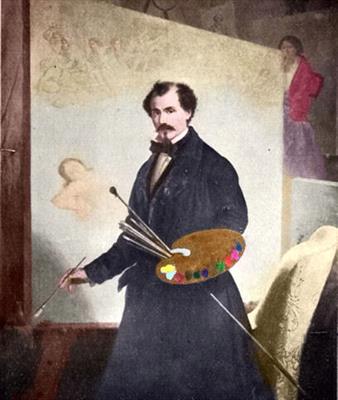
Baldassare Verazzi (1819[1]-1886[1]) was an Italian[1] painter, active mainly in Lombardy. He is best known for historical scenes and portraits. Verazzi studied at the Accademia di Brera in Milan. He later became a professor there. His paintings often depicted events from Italian history, particularly the Risorgimento, the 19th-century movement for Italian unification. One example is his painting "Episode during the Five Days of Milan", referring to the 1848[1] uprising against Austrian rule. He also painted portraits of prominent figures. These commissions added to his reputation during his lifetime. Verazzi's style is characterised by academic precision and attention to detail. He employed a realistic approach, aiming for accuracy in his depictions of historical events and people. His work reflects the artistic tastes of his time, which favoured grand historical narratives and formal portraiture. He died in Casteggio in 1886.
Sources
Where to See guide aggregates verified holdings of Baldassare Verazzi's works across the following collections.
- [1] wikipedia Wikipedia: Baldassare Verazzi Used for: biography.
- [2] book Horst Bredekamp;, Galileo's Thinking Hand Used for: stylistic analysis.
- [3] book Jennifer Montagu;, Gold, Silver, and Bronze Used for: biography.
- [4] book Lilian H. Zirpolo, Historical Dictionary of Baroque Art and Architecture Used for: biography, stylistic analysis.
- [5] book Palmer, Allison Lee, Historical Dictionary of Neoclassical Art and Architecture Used for: biography.
- [6] book Masterpieces of western art : a history of art in 900 individual studies from the Gothic to the present day Used for: biography.
- [7] book Michael Wyatt, The Cambridge Companion to the Italian Renaissance (Cambridge Companions to Culture) Used for: biography, stylistic analysis.
Editorial overseen by Solis Prints. Sources verified 2026-09-30. Click a source for details, or hover over [N] in the page above to preview.
Editorial standardsMethodologyCorrectionsAI disclosureAbout the editorial team