



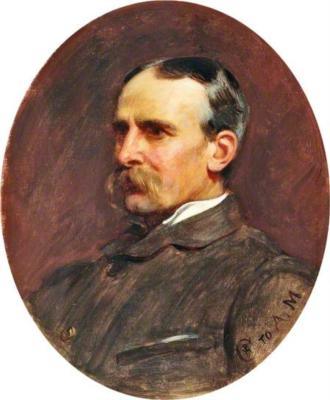
About Briton Riviere
- academic art
Victorian painter who turned animal subjects into scenes of quiet dignity, best known for his monumental Daniel paintings.
Where to see Briton Riviere
Ranked by works you can see in person.
-
6 works
National Gallery
London, United Kingdom
-
6 works
Manchester Art Gallery
Manchester, United Kingdom


-
2 works
Walker Art Gallery
Liverpool, United Kingdom
-
2 works
Aberdeen Archives, Gallery and Museums collections
Aberdeen, United Kingdom
-
2 works
Sudley House
Liverpool, United Kingdom
-
2 works
Royal Holloway, University of London
Egham, United Kingdom
-
2 works
National Gallery of Victoria
Melbourne, Australia
-
 2 works
McLean Museum and Art Gallery
Greenock, United Kingdom
-
2 works
Nottingham Museums
Nottingham, United Kingdom
-
1 works
Dahesh Museum of Art
New York City, United States


Own a piece of it
Briton Riviere prints
Hand-finished archival prints from Briton Riviere's body of work.


View all 19 museums
-
1 works
Royal Academy of Arts
London, United Kingdom
-
1 works
Whitworth Art Gallery
Manchester, United Kingdom
-
1 works
Tate Britain
London, United Kingdom
-
1 works
Brighton Museum & Art Gallery
Brighton and Hove, United Kingdom
-
1 works
Dundee Art Galleries and Museums
Dundee, United Kingdom
-
1 works
Nottingham Castle Ducal Mansion
Nottingham, United Kingdom
Also here (3)
-
1 works
Lady Lever Art Gallery
Port Sunlight, United Kingdom
-
1 works
Metropolitan Museum of Art
New York City, United States
-
1 works
Auckland Art Gallery Toi o Tāmaki
Auckland, New Zealand


Can't travel? Bring Briton Riviere home.
See all Briton Riviere prints →Frequently Asked Questions
Where can I see Briton Riviere's work?
Briton Riviere's paintings are held in numerous public collections, mainly in the United Kingdom. The Tate Gallery in London holds several paintings, including "Daniel's Answer to the King" (1890[1]) and "The Last Spoonful" (1873). Another major collection is at the Walker Art Gallery in Liverpool, which includes "A Roman Holiday" (1881). Other UK museums with works by Riviere include the Royal Academy of Arts, the Guildhall Art Gallery, Manchester Art Gallery, and the Wolverhampton Art Gallery. Outside the UK, his work can occasionally be found in museums with significant British[1] art holdings, such as the Yale Center for British Art in New Haven, USA, which owns "Sympathy" (1877). Major auction houses, such as Christie's and Sotheby's, also handle Riviere's paintings from time to time, so checking their catalogues may provide opportunities to view his work.What should I know about Briton Riviere's prints?
Briton Riviere (born 1840[1], died 1920[1]) was an English artist who produced paintings and illustrations. Prints of Pre-Raphaelite paintings gained popularity through printed editions. These prints secured reputations, travelled widely, and were bought in large numbers. To promote artwork, galleries sometimes held special exhibitions for private viewing. Subscriptions were then offered for engravings. The individual artists took considerable care with such promotion. The best reproductive engravers were hired, but there could be a significant time gap between commissioning and publishing a print, sometimes five to eight years. Print subscribers were willing to wait, confident in the quality of the engraving. The reproductive etchings after paintings were considered fine works of art, the result of collaboration between engraver and painter. Some artists respected the potential of engraving, understanding the difficulties of transferring painted images into line and colour into engraved tone. They believed that etchings and mezzotints could even improve the ethereal qualities of certain subjects. To ensure quality and exclusivity, plates were destroyed after small editions.Why are Briton Riviere's works important today?
Briton Riviere (1840[1]-1920[1]) was part of a late-19th-century revival of interest in wood-engraved illustration. The Pre-Raphaelite style influenced a new generation of illustrators, such as Laurence Housman and Charles Ricketts, who took Pre-Raphaelite illustration in new directions. These artists remain important figures in the Private Press movement, which produces limited editions of poetry and literature based on Pre-Raphaelite models of tasteful design and restrained decoration. The Pre-Raphaelites were initially considered bold and eccentric when artists like Millais, Hunt, and Rossetti exhibited their first paintings in 1850[1]. By 1853, their literary and pictorial works were well-known and appreciated. Walter Crane noted that the Pre-Raphaelite movement marked a new era in decorative art, turning attention to branches of design other than painting. Crane argued that art in the second half of the 19th century followed two directions opened up by the Pre-Raphaelites: Impressionism and the pursuit of beauty.What techniques or materials did Briton Riviere use?
Briton Riviere (1840[1]-1920[1]) was an English artist known for his paintings, illustrations, and sculptures. He employed a range of techniques and materials throughout his career, adapting his approach to suit the subject and desired effect. Riviere's early training focused on draughtsmanship, evident in his detailed studies of animals and figures. He worked primarily in oils on canvas, building up layers of paint to create texture and depth. His paintings often feature carefully observed details, achieved through precise brushwork and a keen eye for light and shadow. In addition to painting, Riviere was a skilled watercolourist. He used watercolour to create quick sketches and studies, as well as finished works. His watercolours are characterised by their transparency and luminosity, achieved through layering washes of colour. Riviere also experimented with sculpture, creating bronze figures of animals and people. His sculptures demonstrate his understanding of form and anatomy. He also produced numerous illustrations for books and magazines using pen and ink or wood engraving. His versatility across different media contributed to his success as an artist and illustrator.Who did Briton Riviere influence?
Briton Riviere's artistic impact can be understood within the context of the Pre-Raphaelite movement and its later developments. The Pre-Raphaelites, initially considered bold and irreverent, gained recognition by 1853[1]. Their aesthetic principles influenced a range of subsequent artists and movements. Edward Burne-Jones, who made trips to Italy in 1859 and 1862, adapted Pre-Raphaelite ideas, incorporating rich colours inspired by Venetian masters. The Pre-Raphaelite aesthetic also inspired Julia Margaret Cameron, a pioneer of art photography. Cameron used soft-focus lenses and close cropping to create pictorial effects, evoking multilayered melancholy in her subjects. Later Pre-Raphaelite paintings influenced the Symbolist movement, with artists such as James Whistler and Aubrey Beardsley adopting elements from Rossetti and Burne-Jones. Burne-Jones' work, such as *Cupid’s Hunting Fields* (1885), is closely related to the Symbolist aesthetic. His languid lines may also have influenced the Art Nouveau style in the 1890s.Who influenced Briton Riviere?
Briton Riviere's artistic development occurred during a period of change in British[1] art education. The apprenticeship system was dying out, replaced by art academies. Students received advice, but lacked the close guidance of a master. Some artists depended on the example and advice of more advanced fellow students. One artist noted the need to distinguish between passing enjoyment and critical judgement. He admired the sensibility and skill of many British artists, but felt dissatisfaction in merely continuing their ambitions. He sought his own path, guided by the masters of previous ages. Benjamin Haydon attempted to revive the old masters' system of teaching. He originated the idea of Schools of Design, but received no reward. Some considered him self-willed, rarely taking advice. Despite this, he studied forms from nature. Artists were departing from conventionalism, pursuing open-air nature and daylight effects. However, cases of daylight effect in subject paintings were rare. Some artists substituted prettiness for beauty, lacking vigorous health in their work.What is Briton Riviere's most famous work?
Briton Riviere was an English artist of the late 19th and early 20th centuries. He produced paintings and illustrations and was associated with the Pre-Raphaelite movement. Riviere is known for his animal paintings, particularly those featuring dogs. Although it is difficult to name one single most famous work, a number of his pieces received attention during his career and continue to be recognised today. These include 'Sympathy' (1877[1]), depicting a young girl and a dog, which captures a sense of shared sorrow. Another popular work is 'A Matter of Life or Death' (1869), which portrays a dog attempting to revive a seemingly lifeless child. These paintings, along with others such as 'The Long Sleep' and 'Daniel' (ca. 1872-1775[1]), contributed to Riviere's reputation as a skilled animal painter capable of conveying emotion through his art.What style or movement did Briton Riviere belong to?
Briton Riviere (1840[1]-1920[1]) was active during a period when academic painting was very popular. Academic art received wide public admiration in both Paris and London. The Royal Academy in London was a major venue. Public interest in art exhibitions grew during the 19th century, with the newly affluent middle class becoming important patrons. Acceptance by the Salon was a mark of success for artists. Academic painters sometimes sought to reconcile Realism with established history painting. Some artists moved away from modern settings, using traditional peasant costumes to create a timeless quality. Others depicted French peasant life, avoiding modern fashions. These paintings sometimes had a Realist inclination. Some academic masters of the 19th century presented Realism subtly, in contrast to the Belle Epoque artists who portrayed Parisian life.
Sources
Where to See guide aggregates verified holdings of Briton Riviere's works across the following collections.
- [1] wikipedia Wikipedia: Briton Riviere Used for: biography.
- [2] book Jesse Bryant Wilder, Art History For Dummies Used for: stylistic analysis.
- [3] book Beard, Lee, 1973- author, Butler, Adam, author; Van Cleave, Claire, author; Fortenberry, Diane, author; Stirling, Susan, author, Beard, Lee, 1973- author, Butler, Adam, author; Van Cleave, Claire, author; Fortenberry, Diane, author; Stirling, Susan, author - The Art Book_ New Edition, Mini Format Used for: biography.
- [4] book Getty, Getty - Julia Margaret Cameron Complete Photographs Used for: stylistic analysis.
- [5] book Masterpieces of western art : a history of art in 900 individual studies from the Gothic to the present day Used for: biography.
- [6] book Post-impressionism : cross-currents in European painting Used for: biography.
- [7] book Engen, Rodney K, Pre-Raphaelite prints : the graphic art of Millais, Holman Hunt, Rossetti and their followers Used for: biography, stylistic analysis.
Editorial overseen by Solis Prints. Sources verified 2026-08-29. Click a source for details, or hover over [N] in the page above to preview.
Editorial standardsMethodologyCorrectionsAI disclosureAbout the editorial team