

About Camille Graeser
Swiss · 1892–1980
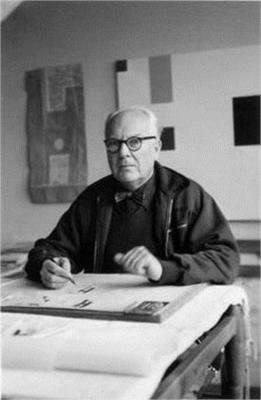
Swiss[1] Concrete Art painter who trained as a furniture designer before becoming one of four central figures of post-war geometric abstraction in Zurich.
Museums6
Countries4
Largest reported holdingKunsthaus Zürich, Zurich · 5 recorded works
Loading map…
Where to see Camille Graeser
Collection holdings are reported here; current display varies. Check with each museum before visiting.
-
5 recorded works
Kunsthaus Zürich
Zurich, Switzerland
-
1 recorded work
Westphalian State Museum of Art and Cultural History
Münster, Germany


-
1 recorded work
Museum Ludwig
Cologne, Germany
-
1 recorded work
Museum of Modern Art
New York City, United States
-
1 recorded work
Busch–Reisinger Museum
Cambridge, United States
-
1 recorded work
Musée National d'Art Moderne
Paris, France


Frequently Asked Questions
Where can I see Camille Graeser's work?
You can view Camille Graeser's work in several European museums. These include the Kunstmuseum and the Gottfried Keller Stiftung in Berne; the Kunstmuseum in Winterthur; the Kunsthaus in Zurich; and the Kunstmuseum in Basle. His pieces are also held in private collections such as those of M. Feilchenfeldt, Louis Franck, Samuel Josefowitz, Dr Jacques Koerfer, and the Staechelin Foundation, as well as the Thyssen-Bornemisza Collection and the Petit Palais in Geneva. Other museums that exhibit similar artists, styles, and periods include the Musée d’Orsay and the Musée du Louvre in Paris; the Koninklijk Museum voor Schone Kunsten in Antwerp; the Kunsthistorisches Museum and the Osterreichische Galerie in Vienna; the Art Gallery of Ontario; and the Narodni Galerie in Prague.Why are Camille Graeser's works important today?
Camille Graeser (1892[1]-1980[1]) was a Swiss[1] artist and designer whose theories and artworks are still relevant to discussions of abstraction and concrete art. Graeser began his career as a designer, working in advertising and graphic design. This background informed his later artistic practice, which was characterised by a precise, geometric approach. He moved towards concrete art in the late 1920s, developing a style that emphasised the use of pure, non-representational forms and colours. His theories about art, particularly his emphasis on mathematical principles and seriality, have had a continuing impact. Graeser believed that art should be based on rational principles, and he sought to create works that were objective and universal. His exploration of seriality, in which a motif or form is repeated and varied, anticipates later developments in Minimalist and Conceptual art. Graeser's work provides a link between the early pioneers of abstraction and later movements that explored the relationship between art, design, and technology. His emphasis on clarity, order, and the use of geometric forms continues to resonate with artists and designers today.What techniques or materials did Camille Graeser use?
Camille Graeser is associated with geometric abstraction, sometimes called Concrete Art. "Technique" in this context refers to the artist's intellectual intention, not only their materials or method. Technique is defined as the manual and mechanical operations that act upon the raw material to organise and shape it according to artistic intentions. The artist's choice of material is conditioned by the effect they intend to achieve. In the mid-20th century, some artists moved away from oil paint to acrylics, which promote flatness and colour contrast. Some artists combined media; they might use oils, acrylics, aniline dyes, pastels, and charcoal in varying densities. Some artists used commercial products, such as emulsion-coated canvas and ready-to-use emulsion. One version, developed in Munich, was described as suitable for most surfaces.Who did Camille Graeser influence?
Camille Graeser's concrete art had an impact on a number of later artists, particularly in Germany and Switzerland. His emphasis on geometric abstraction and serial composition influenced artists associated with the Zurich School of Concrete Art. This group included Max Bill, Richard Paul Lohse, and Verena Loewensberg; they further developed concrete art principles. Graeser's exploration of colour theory and his use of mathematical systems in art also resonated with artists interested in the intersection of art and science. His work influenced the development of Op Art and Kinetic Art, as artists explored the creation of dynamic visual effects through geometric forms and colour relationships. Graeser's teachings and writings helped to disseminate the ideas of concrete art to a wider audience, inspiring younger artists to experiment with non-representational forms and systematic approaches to art making. His focus on the social responsibility of the artist also encouraged artists to engage with the built environment and to create art that was integrated into everyday life.Who influenced Camille Graeser?
Camille Graeser's artistic development was shaped by several influences. The Bauhaus, with its emphasis on functional design and geometric abstraction, played a significant role. The school's focus on the interplay between art, technology, and industry resonated with Graeser's own interest in creating art that was both aesthetically pleasing and socially relevant. Graeser's exploration of colour and form also owes a debt to the theories of Josef Albers, who taught at the Bauhaus and later at Black Mountain College. Albers's work on colour interaction and his systematic approach to composition provided Graeser with a framework for his own artistic investigations. Additionally, the broader currents of Impressionism, particularly as it developed in Germany and Austria, may have had an impact on Graeser's aesthetic. The "Stimmungsimpressionisten" (Atmospheric Impressionists) sought to capture fleeting moments and subjective experiences through colour and light, an approach that aligns with some aspects of Graeser's work.What is Camille Graeser's most famous work?
It is difficult to name a single, definitive most famous work by Camille Graeser, as popularity can vary among audiences and critics. Graeser produced a large number of paintings, drawings, and sculptures, and he also worked in graphic design and exhibition design. Without more information about which aspects of his career are of interest, it is not possible to pick one artwork as his most well-known. Further research into specific periods, styles, or media within Graeser's oeuvre would be needed to identify a particular piece that has achieved widespread recognition or critical acclaim. Examining exhibition catalogues, art historical texts, and online databases might reveal which works are most frequently discussed or reproduced.What style or movement did Camille Graeser belong to?
It is difficult to assign Camille Graeser to one specific style. He is generally associated with concrete art, a movement that emphasises non-representational abstraction. Concrete art, which emerged in the 1930s, rejects illusionism and subjective expression. Instead, it focuses on geometric forms, precise mathematical relationships, and the use of pure colour. Artists working in this mode aimed to create autonomous artworks, independent of any external references or symbolic meanings. Graeser's work aligns with these principles through its use of geometric shapes, ordered compositions, and systematic colour arrangements. His artistic approach also relates to the broader field of constructive art, which shares an emphasis on geometric abstraction and the use of mathematical principles in artistic creation.What is Camille Graeser known for?
Camille Graeser is known for his contributions to Concrete Art. His approach was more intuitive compared to his contemporaries, as he explored relationships between colours and squares, resulting in works that balanced structural discipline with visual sensation.
Sources
Where to See guide aggregates verified holdings of Camille Graeser's works across the following collections.
- [1] wikipedia Wikipedia: Camille Graeser Used for: biography.
- [2] book guggenheim-artoftomorrowfif1939gugg Used for: biography.
- [3] book guggenheim-twopri00weis Used for: biography.
- [4] book Masterpieces of western art : a history of art in 900 individual studies from the Gothic to the present day Used for: biography.
- [5] book 1892-1968, Panofsky, Erwin,, Tomb sculpture: four lectures on its changing aspects from ancient Egypt to Bernini Used for: biography, stylistic analysis.
Editorial overseen by Solis Prints. Sources verified 2026-09-30. Click a source for details, or hover over [N] in the page above to preview.
Editorial standardsMethodologyCorrectionsAI disclosureAbout the editorial team