



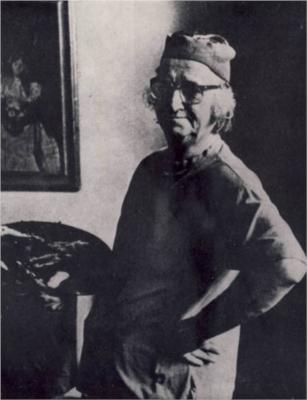
About Corneliu Baba
Romanian · 1906–1997
- Impressionism
- Expressionism
- socialist realism
Romanian[1] figurative painter known for psychologically complex portraits and allegorical Harlequin series, deeply influenced by Rembrandt, Goya, and El Greco.
Museums1
Countries1
Largest reported holdingHungarian National Gallery, Budapest · 1 recorded work
Loading map…
Where to see Corneliu Baba
Collection holdings are reported here; current display varies. Check with each museum before visiting.
-
1 recorded work
Hungarian National Gallery
Budapest, Hungary
Also here (6)
Bertalan SzekelyVilmos Aba-NovakEndre BalintAladar Korosfoi-KrieschEgry JózsefAugust von Pettenkofen

Frequently Asked Questions
Where can I see Corneliu Baba's work?
It is difficult to pinpoint exactly where Corneliu Baba's works are held. However, many major museums hold collections of paintings and prints that may include his work. These include: the Metropolitan Museum of Art (New York); the Museum of Modern Art (New York); the Los Angeles County Museum of Art; the Minneapolis Institute of Arts; the Royal Ontario Museum (Toronto); the Virginia Museum of Fine Arts (Richmond); the Wolfsonian at Florida International University (Miami Beach); Brighton Museum & Art Gallery; Manchester Art Gallery; the National Museums of Scotland (Edinburgh); and the Victoria & Albert Museum (London). Other museums with significant collections include the Musée d’Orsay (Paris), the Museo Nacional del Prado (Madrid), the Hermitage Museum (St Petersburg), and the Narodni Galerie (Prague).What should I know about Corneliu Baba's prints?
When considering Corneliu Baba's prints, it is useful to understand some basic principles. An original print is conceived as a print, and executed solely as a print, often in a numbered edition, and signed by the artist. Each print in the edition is an original, printed from a plate, stone, screen, block or other matrix created for that purpose. The artist inks and pulls each print individually, so it is a multi-original medium. The artist decides the number of prints in the edition. The numbering of prints is a relatively recent convention. Early prints were not usually numbered or signed; in some cases the artist might have signed the plate or stone itself, with no pencilled signature on each print. The edition claim is usually written as a pair of numbers on the left bottom margin of the print itself: a print number and an edition number. The title of the print is written in the middle of the bottom margin, and the signature is on the right. Reproductions are copies of artworks conceived in another medium (painting, watercolour, etc.). They are usually made by photo-mechanical means. Numbering and signing a reproduction does not change its essence; it is still a reproduction, not an original print.Why are Corneliu Baba's works important today?
Corneliu Baba (1906[1]-1997[1]) was a Romanian[1] artist whose career developed during a period of considerable political and social change in Eastern Europe. He is known for his figurative paintings, particularly portraits and compositions with theatrical or literary themes. Baba's importance stems partly from his position as an artist who navigated the complexities of working under a communist regime. His art often displays a sense of psychological depth and social commentary, though expressed through a visual language that, while representational, also incorporates elements of modernism. This approach allowed him to engage with important issues, while adhering to some extent to the official artistic doctrines of the time. His works provide insight into the artistic and intellectual climate of the Eastern Bloc during the mid-20th century. They also present a view of humanity marked by introspection, and at times, a sense of alienation. This continues to resonate with contemporary audiences.Who was Corneliu Baba?
Corneliu Baba was a Romanian[1] artist who developed his mature style through a combination of Old Master influence and the pressures of living under the Romanian communist regime. He is the son of academic painter Gheorghe Baba, and he trained under Nicolae Tonitza in Iași.Who influenced Corneliu Baba?
Without more specific biographical information, it is difficult to identify Corneliu Baba's influences with certainty. However, some potential figures can be identified based on the period and location in which he worked. Baba was a Romanian[1] artist active during much of the 20th century. Given his location in Eastern Europe, it is possible that he was aware of Russian artists such as Pavel Filonov and Kasimir Malevich. Both were important figures in early abstract art. It is also possible that Baba was familiar with the work of German Expressionist painters, such as Ernst Ludwig Kirchner, Emil Nolde, and Oskar Kokoschka. These artists explored emotional and psychological themes through distorted forms and non-naturalistic colour. Gustave Courbet, a French painter known for his realist works, is another possibility.What is Corneliu Baba's most famous work?
Corneliu Baba is best known for his portraits and figure compositions, often executed in a style that blends realism with elements of expressionism. While it is difficult to pinpoint a single "most famous" work, several paintings have received considerable attention and critical acclaim. One such painting is "The Chess Player" (1973[1]), which exists in several versions. It typifies Baba's interest in the human condition, showing a solitary figure absorbed in thought. The dark colour palette and the subject's introspective gaze are characteristic of Baba's style. Another notable work is "Family Portrait" (1977). This painting demonstrates Baba's skill in capturing the psychological dynamics between individuals. The figures are rendered with a certain gravity, reflecting Baba's concern with themes of alienation and existential angst. Baba's series of "Kings" paintings, created over several decades, also contributes to his reputation. These works present powerful, often unsettling, images of authority figures, inviting viewers to consider the nature of power and its effects on individuals. While no single piece eclipses all others, these works are among his most recognised and discussed.What style or movement did Corneliu Baba belong to?
Corneliu Baba is usually associated with Expressionism, although Romanian[1] art history does not record organised Expressionist groups with manifestos. Expressionism in Romania took diverse forms, often incorporating realistic elements and reacting against an absurd existence. Baba's work shares characteristics with Expressionism's focus on emotional intensity and social critique. Romanian artists often used Expressionist devices to express sarcasm towards Fascism and to convey a militant attitude with broad social implications. Some critics see Baba as part of a trend reacting against modernism, linking him to late Romanticism. Expressionism arose partly as a reaction to Impressionism[1], which was viewed as too concerned with surface appearances. Expressionist artists aimed to grasp the essence of things, using colour and dynamic brushwork to convey emotional values rather than simply depicting light. This aligns with Baba's intense, often dark, and emotionally charged paintings.What was Corneliu Baba known for?
Corneliu Baba (1906[1]-1997[1]) was a Romanian[1] artist best known for his figurative work, which often explored themes of social commentary and the human condition. Although Romanian art history makes little reference to organised Expressionist groups, Baba's work has been linked to Expressionism[1], particularly its realistic trend. This style often critiqued bourgeois society and militarism. Some Romanian artists used Expressionist techniques to express sarcasm towards Fascism. Baba's paintings frequently feature portraits and compositions with a strong emotional charge. His style is characterised by bold brushwork and a distinctive use of colour. Baba's art often reflects a sense of drama; some critics note his ability to capture the tragic sense of the world.
Sources
Where to See guide aggregates verified holdings of Corneliu Baba's works across the following collections.
- [1] wikipedia Wikipedia: Corneliu Baba Used for: biography.
- [2] book guggenheim-guhe00solo Used for: biography.
- [3] book guggenheim-masterp00solo Used for: biography.
- [4] book guggenheim-twopri00weis Used for: biography.
Editorial overseen by Solis Prints. Sources verified 2026-09-30. Click a source for details, or hover over [N] in the page above to preview.
Editorial standardsMethodologyCorrectionsAI disclosureAbout the editorial team