



About Edmonia Lewis
American · 1844–1907
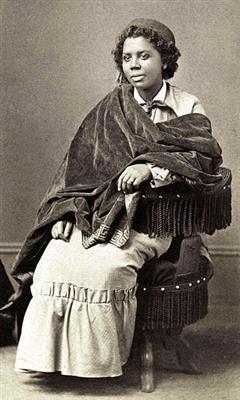
- portrait
The first professional sculptor of African-American[1] and Native American descent, Lewis built a neoclassical career in Rome from a childhood of extraordinary hardship.
Museums2
Countries1
Largest reported holdingSmithsonian American Art Museum, Washington D.C. · 8 recorded works
Loading map…
Where to see Edmonia Lewis
Collection holdings are reported here; current display varies. Check with each museum before visiting.
-
8 recorded works
Smithsonian American Art Museum
Washington D.C., United States
-
4 recorded works
Metropolitan Museum of Art
New York City, United States


Frequently Asked Questions
Where can I see Edmonia Lewis's work?
Edmonia Lewis's artworks can be viewed in several locations. In the United States, these include the Metropolitan Museum of Art (New York), the Los Angeles County Museum of Art (LACMA), the Minneapolis Institute of Arts, the Virginia Museum of Fine Arts (Richmond), and the Charles Hosmer Morse Museum of American[1] Art (Winter Park, Florida). Outside the United States, her work can be seen at the Royal Ontario Museum in Toronto. Lewis was of African American and Native American heritage. Born in New York State, she was known as Wildfire during her youth. She received art instruction in Boston and created a sculpture of Hiawatha, a figure from Henry Wadsworth Longfellow's poem *The Song of Hiawatha*.What should I know about Edmonia Lewis's prints?
Edmonia Lewis was a sculptor, not a printmaker. Therefore, there are no original prints by her. However, images of her sculptures were reproduced as photographic prints, engravings, and possibly lithographs during her lifetime and afterwards. These reproductions circulated as a way to make her work more accessible to a wider audience. They also served to document her sculptures, some of which are now lost or damaged. Prints of Lewis's sculptures can be found in museum collections, archives, and private holdings. The subjects of these prints include her best-known works, such as "Forever Free" (1867[1]) and "The Death of Cleopatra" (1876). These reproductions offer a glimpse into Lewis's artistic practice and the cultural context in which she worked. They also reflect the growing interest in sculpture as a medium for artistic expression and social commentary during the 19th century.Why are Edmonia Lewis's works important today?
Edmonia Lewis (circa 1844[1]-after 1911) was the first non-white American[1] sculptor to achieve prominence. Of African-American and Native American heritage, her work offers a unique perspective on nineteenth-century American identity and artistic expression. Lewis spent part of her career in Rome, among a community of American and British women artists. Between 1866[1] and 1872, she created marble sculptures based on Henry Wadsworth Longfellow's poem, *The Song of Hiawatha*. Lewis's approach combined classical and Renaissance techniques with her knowledge of her mother's Chippewa culture. For example, her sculpture *Hiawatha* presents an idealised, classical figure in native clothing, avoiding both nudity and stereotypical depictions. Her work is significant because it challenged prevailing views about race, gender, and artistic capability. Some critics interpreted her heritage through the lens of the "exotic" or saw her as a subversive feminist. Lewis's art also countered visual stereotypes of Black women. Despite facing prejudice and limited resources, she persevered as an artist, completing most of her sculptures without assistance. Her determination to build a successful career defied expectations and made her an important figure.What techniques or materials did Edmonia Lewis use?
Edmonia Lewis primarily used marble, working in the neoclassical style. Sculptors working with marble use tools such as mallets and chisels to remove stone. Various weights and shapes of tool are employed, depending on the amount of marble to be removed. Claw chisels, with notched teeth, may be used to add texture, and flat chisels provide a smoother finish. Rasps or files are used after the chiselling stage to render the chisel marks invisible; sandpaper, wet or dry, is used to achieve varying degrees of polish. She also worked with bronze. Bronze sculptures are usually made initially using the additive process, which involves building up and modelling a form from a soft substance such as clay, plaster or sculptor’s wax (a malleable wax) before it is cast into bronze. The casting is done in a foundry by craftsmen; rarely by the artist, although the artist will oversee the process.Who did Edmonia Lewis influence?
Edmonia Lewis's influence can be seen in later artists who addressed similar themes of race and identity. Alain Locke's *The Negro in Art: A Pictorial Record of the Negro Artist and of the Negro Theme in Art* (1968) acknowledges her place in the history of Black artists. Lewis's mixed African American[1] and Native American heritage shaped how critics and art historians viewed her work, sometimes positioning her as either an "exotic" figure or a "wily subversive feminist". This duality created analytical challenges in understanding her artistic contributions. Some period observers, such as Lydia Maria Child, held prejudiced views about Lewis's capabilities, believing her background limited her understanding of "refined life". Child saw Lewis's drive as an artist as a childish impatience, rather than a legitimate pursuit of autonomy and a career. Despite such biases, Lewis persevered, challenging the prevailing narratives that sought to define her based on her race and heritage. Her determination paved the way for future generations of artists of colour.Who influenced Edmonia Lewis?
Edmonia Lewis (born circa 1844[1]/5) was of African-American[1] and Native American heritage. She spent part of her career in Rome among a community of American and British women involved in the arts. While in Rome, between 1866[1] and 1872, she completed marble sculptures on the theme of Hiawatha and Minnehaha from Henry Wadsworth Longfellow’s poem *The Song of Hiawatha* (1855). Longfellow’s character came from the same indigenous group as Lewis’s mother. Her carving method combined knowledge gleaned from growing up with her mother’s Chippewa people and classical and Renaissance lessons learned in Rome. The classical influence can be seen in the idealized shape of Hiawatha’s head and his elegant profile. Lewis rarely employed Italian workmen while in Rome, completing most of her sculpture without assistance.What is Edmonia Lewis's most famous work?
Edmonia Lewis (born around 1844[1], died after 1911) was of African-American[1] and Native American ancestry. She is considered America’s first prominent non-white sculptor. Between 1866[1] and 1872, Lewis lived in Rome among a community of expatriate American and British women artists. During this period, she completed a series of marble sculptures on the theme of Hiawatha and Minnehaha; these figures were lovers in the 1855 epic poem *The Song of Hiawatha* by Henry Wadsworth Longfellow. Longfellow's poem was based on a real person from the same indigenous group as Lewis’s mother. Her sculptures combined knowledge from her mother’s Chippewa people with classical and Renaissance lessons she learned in Rome. The classical influence is visible in the shape of Hiawatha’s head and his profile, as Lewis used the concept of the proud yet uncivilised noble savage. She avoided the typical male artist’s representation of a nude and instead created a man in native clothing. Lewis rarely employed Italian workmen while in Rome and completed most of her sculpture without assistance.What style or movement did Edmonia Lewis belong to?
Edmonia Lewis is associated with the Neoclassical style. After early work creating portrait[1] medals, Lewis travelled to Rome, where she lived and worked near other artists. She created statues of historical and biblical figures, as well as sculptures of the ancient Egyptian queen Cleopatra. Lewis was of Native American[1] and African American heritage. She created sculptures of African American and Native American people, using a classical European style usually reserved for depictions of white people. Her sculptures were smooth and realistic-looking, based on ancient Greek and Roman art. Lewis's African American sculptures portrayed enslaved people; subjects often ignored in art. Lewis's studio was a popular destination. She worked independently in Europe and used abolitionist networks to encourage American interest in her work. Unlike most sculptors, who carved their work in clay for Italian stoneworkers to copy in marble, Lewis carved all her own work.
Sources
Where to See guide aggregates verified holdings of Edmonia Lewis's works across the following collections.
- [1] wikipedia Wikipedia: Edmonia Lewis Used for: biography.
- [2] book Dorling Kindersley, Artists: Inspiring Stories of the World's Most Creative Minds Used for: biography, stylistic analysis.
- [3] book Hodge, Susie, 1960- author, The short story of women artists : a pocket guide to movements, works, breakthroughs, & themes Used for: biography, stylistic analysis.
Editorial overseen by Solis Prints. Sources verified 2026-09-30. Click a source for details, or hover over [N] in the page above to preview.
Editorial standardsMethodologyCorrectionsAI disclosureAbout the editorial team