



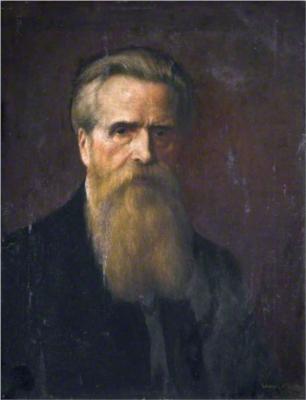
About Edward R. Taylor
1838–1911
Victorian painter and educator who led Birmingham's Municipal School of Arts and Crafts for twenty-six years.
Museums1
Countries1
Largest reported holdingUsher Gallery, Lincoln · 1 recorded work
Loading map…
Where to see Edward R. Taylor
Collection holdings are reported here; current display varies. Check with each museum before visiting.
-
1 recorded work
Usher Gallery
Lincoln, United Kingdom

Frequently Asked Questions
Where can I see Edward R. Taylor's work?
Edward R. Taylor's work may be viewed in several museums. These include the Los Angeles County Museum of Art (LACMA), located in Los Angeles, and the Metropolitan Museum of Art in New York. Other American museums that sometimes exhibit Taylor's art are the Minneapolis Institute of Arts; the Museum of Modern Art, New York; the Virginia Museum of Fine Arts, in Richmond; the Charles Hosmer Morse Museum of American Art, in Winter Park, Florida; and the Wolfsonian at Florida International University, Miami Beach. In Canada, the Royal Ontario Museum in Toronto has examples of Taylor's work. In the UK, you might see his pieces at the Brighton Museum & Art Gallery; the Geffrye Museum, London; the Manchester Art Gallery; the National Museums of Scotland, Royal Museum, in Edinburgh; and the Victoria & Albert Museum, London.Who did Edward R. Taylor influence?
Edward R. Taylor taught painting on black velvet to Bill Erwin, a sign painter in Honolulu during the 1930s. Erwin's paintings captured the vivaciousness of Hilo Hattie, a dancer and singer popular with Hawaiians, tourists, and the military. Erwin also painted dogs and local children, in addition to nude women. Eric Askew, a New Zealander, also learned black velvet painting from Taylor in Tahiti. Askew, who had difficulty making a living as a sign painter during the Depression, settled in southern California after serving in WWII. Taylor's sons, Michael and Danny, were considered the best painters in the family. Danny initially painted black velvets like his father, but later used watercolours and charcoal.What was Edward R. Taylor known for?
Edward R. Taylor was an educator and artist associated with the British Arts and Crafts movement. He is particularly known for his role as the headmaster of the Birmingham School of Art, a position he held from 1877[1] to 1903. During his tenure, Taylor implemented reforms, shifting the school's focus toward practical design and craftsmanship. He encouraged students to engage with various media, such as metalwork, jewellery, and decorative painting, in addition to drawing and painting. Taylor also promoted the integration of art and industry, believing that artists should be involved in the design and production of everyday objects. His leadership helped establish Birmingham as a centre for Arts and Crafts production. He was himself a designer and watercolourist, creating decorative schemes and stained glass.What is Edward R. Taylor known for?
Edward R. Taylor is known for his role as headmaster of the Birmingham Municipal School of Arts and Crafts. Under his direction, the school became one of England's most effective incubators of Arts and Crafts sensibility.What was Edward R. Taylor's art style?
As a painter, Edward R. Taylor worked in both oils and watercolour. He concentrated on landscapes in the tradition of the Birmingham school and understood light and atmosphere.
Sources
Where to See guide aggregates verified holdings of Edward R. Taylor's works across the following collections.
- [1] wikipedia Wikipedia: Edward R. Taylor Used for: biography.
- [2] book Art, the ape of nature : studies in honor of H. W. Janson Used for: biography.
- [3] book Engen, Rodney K, Pre-Raphaelite prints : the graphic art of Millais, Holman Hunt, Rossetti and their followers Used for: biography.
- [4] book Pre-Raphaelitism and the Pre-Raphaelite Brotherhood (2 Volumes) Used for: biography.
- [5] book Nagel, Alexander, The controversy of Renaissance art Used for: biography.
- [6] book Landauer, Susan, The not-so-still life : a century of California painting and sculpture Used for: biography.
- [7] book 1892-1968, Panofsky, Erwin,, Tomb sculpture: four lectures on its changing aspects from ancient Egypt to Bernini Used for: biography.
Editorial overseen by Solis Prints. Sources verified 2026-09-30. Click a source for details, or hover over [N] in the page above to preview.
Editorial standardsMethodologyCorrectionsAI disclosureAbout the editorial team