

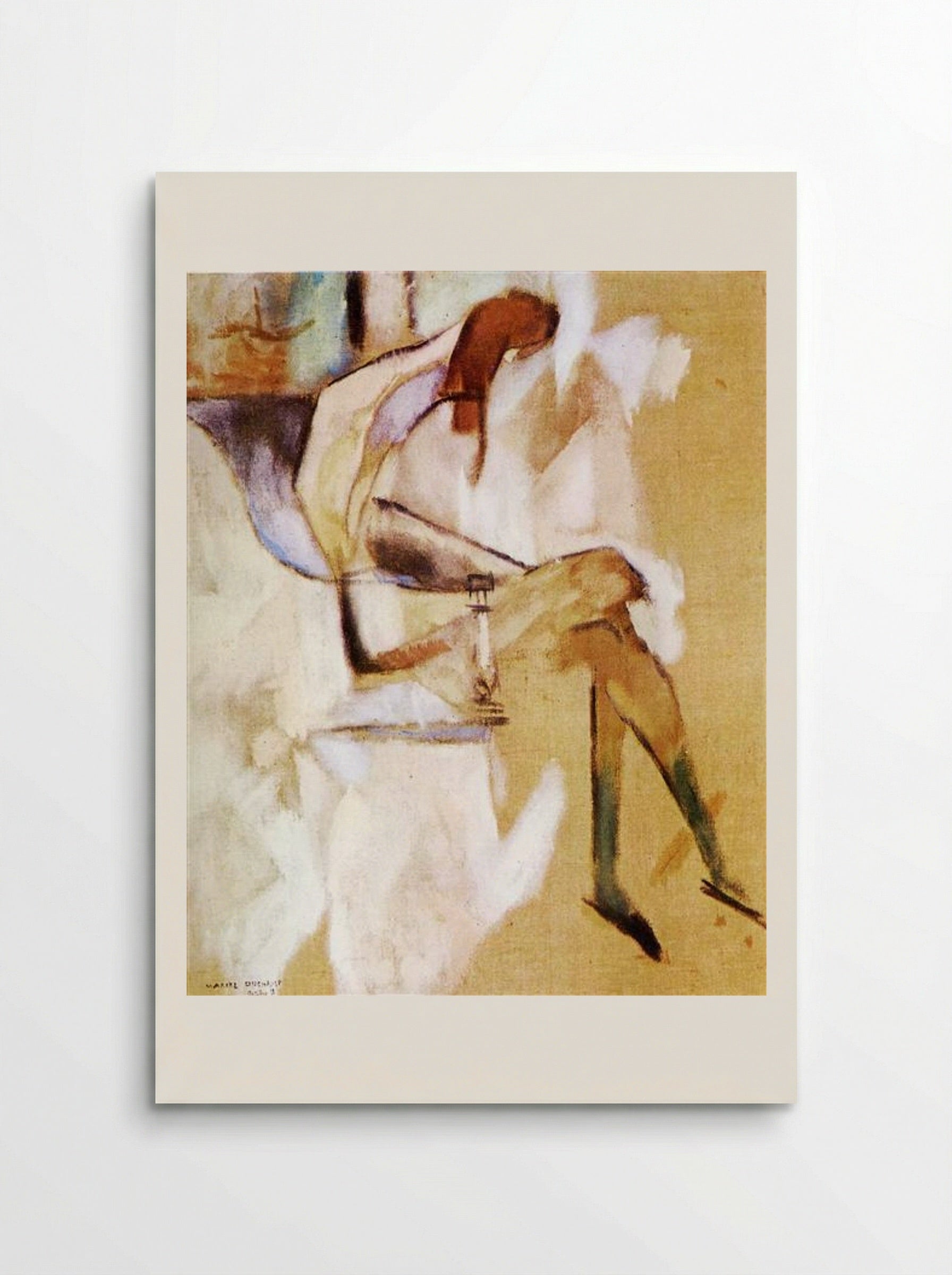
About Young Sister - Marcel Duchamp
Archival giclée
Frames arrive ready to hang
Secure checkout
Made to order
Description
A 1911 oil painting by Marcel Duchamp, this work demonstrates the artist's early engagement with Cubist techniques and the deconstruction of the human form.
Painted in 1911, About Young Sister captures a transitional moment in the career of Marcel Duchamp. During this period, the artist moved away from his earlier Fauvist influences, adopting the fractured spatial logic of Cubism. The work depicts a seated figure, yet the subject is rendered through a series of overlapping planes and muted tones rather than traditional anatomical precision. The composition relies on a restricted palette of ochre, cream, and soft blue, which allows the viewer to focus on the structural arrangement of the form. Duchamp explores the relationship between the figure and the surrounding space by dissolving the boundaries between them. The limbs and torso are suggested through gestural brushwork, creating a sense of movement that anticipates his later interest in kinetic energy and mechanical processes. Unlike the rigid geometry found in the works of his contemporaries, this painting retains a degree of fluidity. The figure appears to emerge from the canvas, with the background and subject sharing a unified, painterly surface. This piece offers a glimpse into the experimental nature of early twentieth-century European art. It reflects the broader shift towards abstraction, where the objective is not to replicate reality, but to analyse the mechanics of perception. The work remains a study in balance, where the weight of the figure is offset by the negative space surrounding it. By stripping away unnecessary detail, Duchamp directs attention to the essential lines and rhythms of the human form. This print reproduces the original canvas, maintaining the texture and subtle colour variations of the oil paint, providing an authentic representation of this early modernist experiment.
Return policy
Because every print is made to order, we don't offer change-of-mind returns, refunds or exchanges. If your order arrives faulty, damaged or incorrect, we'll replace it free of charge — just contact us within 48 hours of delivery. See our refunds page for full details.
Shipping
We ship worldwide, printing at the production hub nearest to your delivery address. Delivery times and costs vary by destination — you'll see the options available to you at checkout.
Manufacturing
Each print is produced to order using 12-colour giclée printing on FSC-certified archival paper. Designed in Britain and printed at your nearest production hub to reduce waste and speed up delivery.
Care and materials
Specific Features
Every Solis piece is made to order with archival, gallery-quality materials built to last.
- Museum-grade giclée printing for rich, fade-resistant colour
- Archival matte fine-art paper, FSC-certified
- Multiple sizes and framing options available
- Frames in black, natural wood, dark wood or white
- Framed prints arrive ready to hang
Care & Cleaning
To keep your artwork looking its best:
- Dust gently with a soft, dry cloth
- Avoid prolonged direct sunlight
- Never use liquid cleaners on the print or canvas surface
- Keep in a dry, room-temperature space
- Handle prints with clean, dry hands
Materials & Sizing
Museum-grade giclée on FSC-certified archival matte paper, with framed and canvas options.
- Paper sizes: A4, A3, A2, A1, A0 and B2 (50×70 cm)
- Canvas: XS (20×30 cm) to Large (60×90 cm)
- Frames: black, natural wood, dark wood or white
About Young Sister - Marcel Duchamp

Artist Biography
Marcel Duchamp
He was born near Rouen in Normandy, the brother of the sculptor Raymond Duchamp-Villon and the painter Jacques Villon. The family produced three significant artists, which is unusual. Marcel was the youngest and the most destructive.
His early career moved through Impressionism, Fauvism, and Cubism in rapid succession. Nude Descending a Staircase No. 2 (1912), a Cubist-Futurist painting of fragmented motion, caused a scandal at the New York Armory Show in 1913. One critic called it 'an explosion in a shingle factory'. The painting made Duchamp famous in America before he had set foot there.
He moved to New York in 1915. His contribution to art from this point was largely conceptual. The 'readymades', ordinary manufactured objects designated as art by the artist's choice (a bottle rack, a snow shovel, the urinal), dismantled the idea that art required skill, craft, or even making. The artist's decision was sufficient.
He spent twenty years officially retired from art, playing chess at a competitive level. In secret, he was building Etant Donnes, an installation visible only through two peepholes in a door. It was revealed after his death in 1968 and is permanently installed at the Philadelphia Museum of Art. He had been working on it for twenty years while telling everyone he had stopped making art.
Why Choose Us ?
Damage-free delivery guarantee
Fast Shipping
Museum-Quality Materials
You May Also Like