

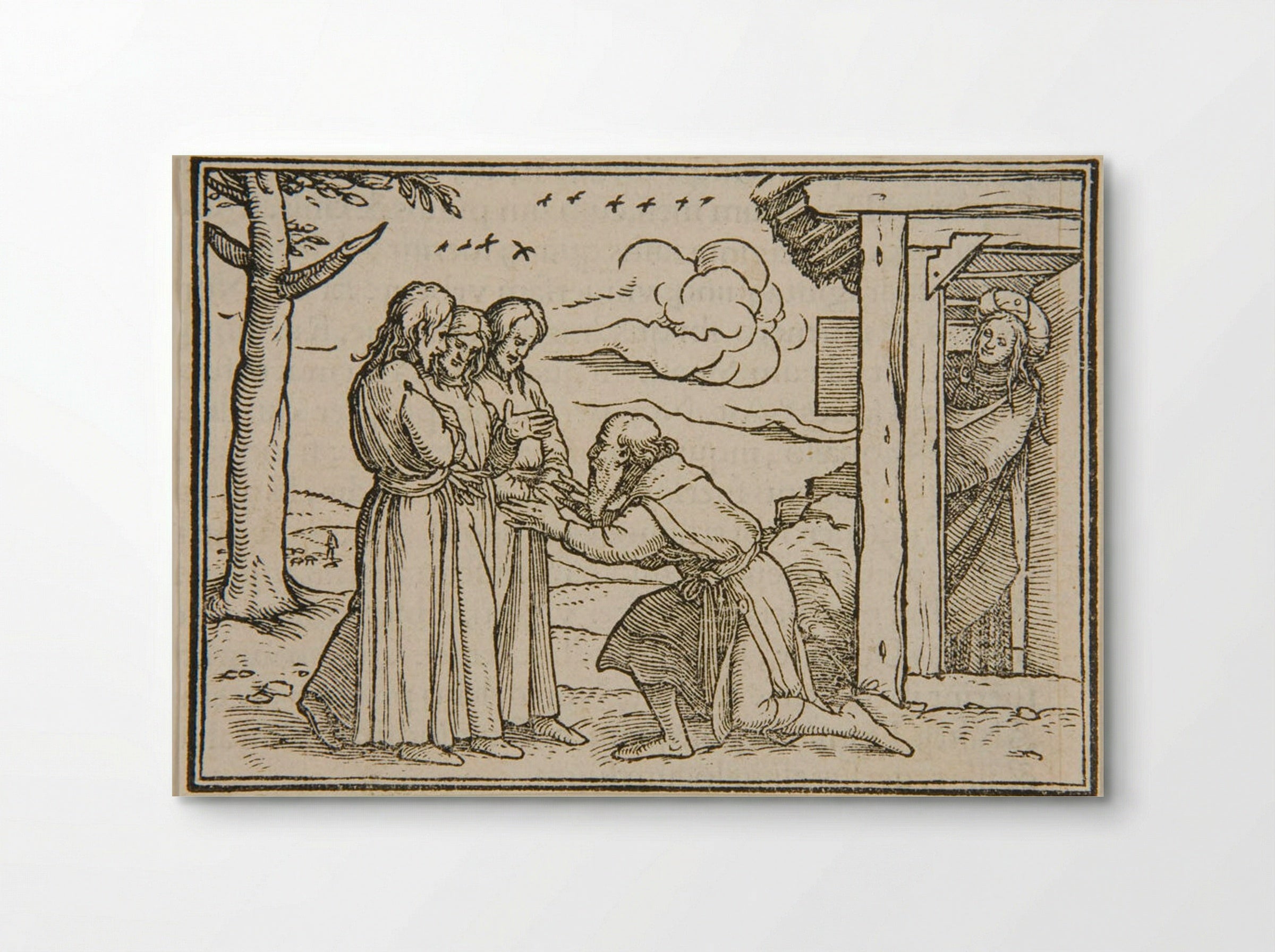
Abraham's Hospitality - Hans Holbein the Younger
Archival giclée
Frames arrive ready to hang
Secure checkout
Made to order
Description
A classic woodcut by Hans Holbein the Younger, depicting the biblical encounter between Abraham and his three visitors with precise, clean lines.
This woodcut by Hans Holbein the Younger depicts the biblical narrative of Abraham receiving three visitors, often interpreted as the Holy Trinity. The composition is characteristic of Holbein's work for the Icones Historiarum Veteris Testamenti, a series of illustrations that brought complex theological narratives into a compact, accessible format. In the foreground, Abraham kneels in a gesture of reverence before the three figures, who stand with a calm, unified presence. To the right, a figure peers from the doorway of a dwelling, providing a sense of domestic scale to the scene. The background is sparse, featuring a solitary tree and a distant, simplified horizon line, which directs the viewer's focus entirely to the interaction between the figures. Holbein employs a clean, precise line quality typical of the German printmaking tradition of the sixteenth century. The shading is achieved through disciplined hatching, which defines the folds of the garments and the contours of the figures without unnecessary clutter. The work demonstrates the artist's ability to convey narrative clarity within a small frame. By stripping away extraneous detail, Holbein ensures that the emotional and spiritual weight of the encounter remains the primary focus. This print is a fine example of the technical skill involved in woodblock cutting during the period, where every mark served a specific purpose in constructing the image. The balance between the kneeling patriarch and the standing visitors creates a stable, triangular arrangement that anchors the composition. It remains a clear representation of Holbein's graphic style, which prioritised legibility and human expression over decorative excess.
Return policy
Because every print is made to order, we don't offer change-of-mind returns, refunds or exchanges. If your order arrives faulty, damaged or incorrect, we'll replace it free of charge — just contact us within 48 hours of delivery. See our refunds page for full details.
Shipping
We ship worldwide, printing at the production hub nearest to your delivery address. Delivery times and costs vary by destination — you'll see the options available to you at checkout.
Manufacturing
Each print is produced to order using 12-colour giclée printing on FSC-certified archival paper. Designed in Britain and printed at your nearest production hub to reduce waste and speed up delivery.
Abraham's Hospitality - Hans Holbein the Younger

Artist Biography
Hans Holbein The Younger
He was born in Augsburg, Germany, the son of a painter also called Hans Holbein. He studied under his father and was working independently by his late teens. He moved to Basel, where he painted portraits and religious works and illustrated Erasmus's In Praise of Folly with marginal drawings. Erasmus recommended him to Thomas More in England, writing that 'the arts are freezing' in Basel and Holbein should try his luck elsewhere.
He arrived in London in 1526 and painted More's family portrait, the first group portrait of a domestic scene in Northern European art. He returned to Basel, found the Reformation had destroyed the market for religious art, and went back to England permanently in 1532.
His portraits of the Tudor court are the visual record of the period: Thomas More, Thomas Cromwell, Anne Boleyn (probably), Jane Seymour, and the succession of courtiers and merchants who populated Henry's orbit. The technique is almost supernaturally precise. The textures of fur, velvet, jewellery, and skin are rendered with a fidelity that makes other portraitists look approximate.
He was sent to paint prospective brides for Henry, including Anne of Cleves, whose portrait Henry found more attractive than the person. Holbein was not blamed. He died during a plague outbreak in London in 1543, at forty-five.
Our Features
Designed for Lasting Impact
Specific Features
Every Solis piece is made to order with archival, gallery-quality materials built to last.
- Museum-grade giclée printing for rich, fade-resistant colour
- Archival matte fine-art paper, FSC-certified
- Multiple sizes and framing options available
- Frames in black, natural wood, dark wood or white
- Framed prints arrive ready to hang
Care & Cleaning
To keep your artwork looking its best:
- Dust gently with a soft, dry cloth
- Avoid prolonged direct sunlight
- Never use liquid cleaners on the print or canvas surface
- Keep in a dry, room-temperature space
- Handle prints with clean, dry hands
Materials & Sizing
Museum-grade giclée on FSC-certified archival matte paper, with framed and canvas options.
- Paper sizes: A4, A3, A2, A1, A0 and B2 (50×70 cm)
- Canvas: XS (20×30 cm) to Large (60×90 cm)
- Frames: black, natural wood, dark wood or white
Why Choose Us ?
Damage-free delivery guarantee
Fast Shipping
Museum-Quality Materials
Artist Biography
Hans Holbein the Younger
He was born in Augsburg, Germany, the son of a painter also called Hans Holbein. He studied under his father and was working independently by his late teens. He moved to Basel, where he painted portraits and religious works and illustrated Erasmus's In Praise of Folly with marginal drawings. Erasmus recommended him to Thomas More in England, writing that 'the arts are freezing' in Basel and Holbein should try his luck elsewhere.
He arrived in London in 1526 and painted More's family portrait, the first group portrait of a domestic scene in Northern European art. He returned to Basel, found the Reformation had destroyed the market for religious art, and went back to England permanently in 1532.
His portraits of the Tudor court are the visual record of the period: Thomas More, Thomas Cromwell, Anne Boleyn (probably), Jane Seymour, and the succession of courtiers and merchants who populated Henry's orbit. The technique is almost supernaturally precise. The textures of fur, velvet, jewellery, and skin are rendered with a fidelity that makes other portraitists look approximate.
He was sent to paint prospective brides for Henry, including Anne of Cleves, whose portrait Henry found more attractive than the person. Holbein was not blamed. He died during a plague outbreak in London in 1543, at forty-five.
You May Also Like